World Sickle Cell Day 2026: Apollo Hospitals Navi Mumbai Successfully Performs Bone Marrow Transplant On 33-Year-Old Patient
Ahead of World Sickle Cell Day, Apollo Hospitals Navi Mumbai reported the successful bone marrow transplant of a 33-year-old patient suffering from severe sickle cell disease. Using his sister as a compatible donor, doctors performed a haploidentical transplant that eliminated the need for regular blood transfusions and significantly improved his quality of life.

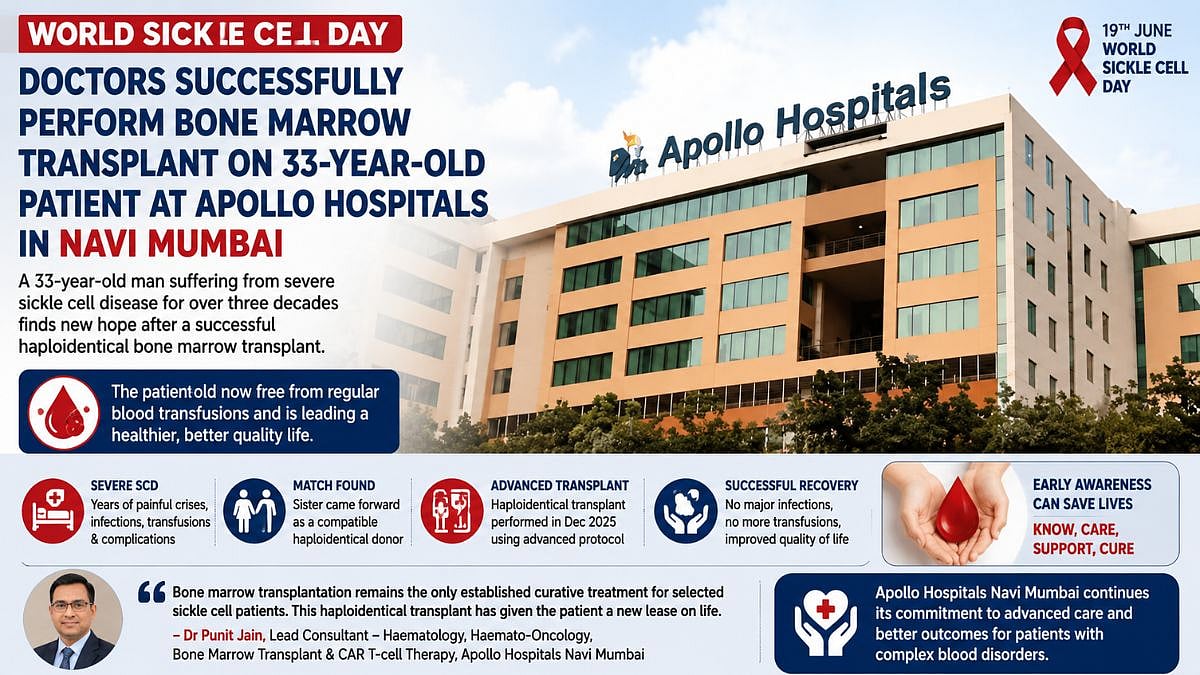
Doctors at Apollo Hospitals Navi Mumbai successfully performed a bone marrow transplant that helped a sickle cell disease patient achieve transfusion-free recovery | AI Generated Image
Navi Mumbai, June 18: As the world observes World Sickle Cell Day on June 19, a 33-year-old man battling severe sickle cell disease (SCD) for more than three decades has found new hope after successfully undergoing a haploidentical bone marrow transplant at a Navi Mumbai hospital.
The treatment, considered a potentially curative option for selected patients, has freed him from regular blood transfusions and significantly improved his quality of life.
The procedure was performed at Apollo Hospitals Navi Mumbai, where the patient, Rahul (name changed), first sought treatment in October 2025 after years of enduring recurrent painful crises, repeated hospitalisations, multiple blood transfusions, chronic leg ulcers, recurrent infections and silent brain infarcts associated with advanced sickle cell disease.
Following a detailed evaluation by the hospital's haematology and bone marrow transplant team, Rahul was identified as a suitable candidate for an allogeneic stem cell transplant. His sister was found to be a compatible haploidentical donor, making it possible to proceed with the transplant despite the absence of a fully matched donor.
Advanced transplant procedure
Before the transplant, doctors focused on controlling infections and improving the patient's overall health between October and November 2025.
Once stabilised, he underwent a haploidentical stem cell transplant in December 2025 using an advanced protocol that included desensitisation for high donor-specific antibodies and post-transplant cyclophosphamide (PTCy), a technique designed to reduce transplant-related complications such as graft-versus-host disease.
The month-long transplant process was followed by six months of intensive monitoring and recovery. According to the treating team, the patient has remained free from major infections, no longer requires regular blood transfusions and has shown a marked improvement in his overall functional status.
"Sickle cell disease can be a lifelong struggle for many patients, particularly adults who have already developed recurrent painful crises, transfusion dependence and organ-related complications. Bone marrow transplantation remains the only established curative treatment for selected patients. In this case, a haploidentical transplant using his sister as the donor enabled us to offer a potentially curative option despite the absence of a fully matched donor. His recovery so far has been extremely encouraging," said Dr Punit Jain, Lead Consultant – Haematology, Haemato-Oncology, Bone Marrow Transplant and CAR T-cell Therapy at Apollo Hospitals Navi Mumbai.
Hope for severe SCD patients
Medical experts noted that while sickle cell disease is diagnosed at birth, its cumulative effects often become more pronounced during adulthood, leading to progressive organ damage, recurrent painful episodes and dependence on blood transfusions.
India contributes a significant share of the global burden of sickle cell disease, making access to advanced treatment options increasingly important.
Also Watch:
Doctors said recent advances in transplant techniques, donor selection strategies and supportive care have expanded curative treatment possibilities for adult patients with severe sickle cell disease.
While transplantation may not be necessary for every patient, carefully selected individuals with recurrent crises, transfusion dependence or progressive organ damage can benefit substantially from such interventions, the doctor said.
To get details on exclusive and budget-friendly property deals in Mumbai & surrounding regions, do visit: https://budgetproperties.in/
RECENT STORIES
-
-
-
-
-