Renowned Indus Valley Civilization Scholar And Archaeologist Shereen Ratnagar Passes Away In Mumbai At 82
Archaeologist and historian Shereen Ratnagar, a leading scholar of the Indus Valley Civilization, died in Mumbai on Monday night after a brief illness, family sources said. She was 82. Ratnagar taught archaeology and ancient history at JNU and was known for research on Harappan trade, urbanism, social organisation and decline through empirical analysis of sites and artefacts.

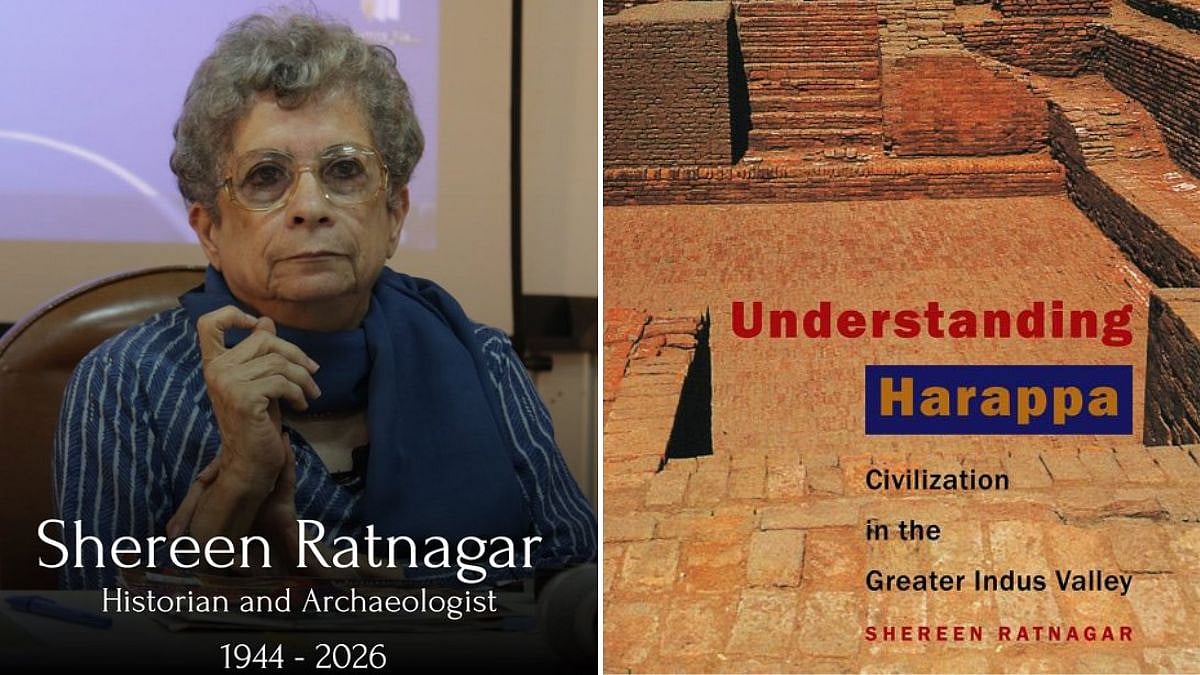
Renowned Indus Valley Civilization Scholar And Archaeologist Shereen Ratnagar Passes Away In Mumbai At 82 | X @iameshansharma_
Mumbai: Archaeologist and historian Shereen Ratnagar, one of India’s leading scholars of the Indus Valley Civilization, died in Mumbai after a brief illness, family sources said on Tuesday. She was 82.
Ratnagar Was Authority on Harappan Trade Networks and Decline
Ratnagar, who died on Monday night, was widely regarded as an authority on Harappan history, specialising in the civilisation’s trade networks, social organisation and decline through empirical analysis of archaeological sites and artefacts.
Educated at Deccan College in Pune and the Institute of Archaeology at University College London, where she studied Mesopotamian archaeology, Ratnagar later joined Jawaharlal Nehru University’s Centre for Historical Studies in Delhi as professor of archaeology and ancient history. After retiring in 2000, she continued independent research in Mumbai.
Authored Seminal Books on Harappan Economy and Trade
Her 1981 book The Westerly Trade of the Harappa Civilization documented Harappan artefacts, including chert weights discovered in Iraq, as evidence of trade links with western regions. In Understanding Harappa: Civilization of the Indus, published in 2001, she presented a detailed study of Harappan economy, urbanism and intercultural exchanges.
Ratnagar was also known for challenging interpretations she considered unsubstantiated. She re-evaluated the “dancing girl” bronze from Mohenjo-daro as unrelated to dance and questioned earlier interpretations influenced by Edwardian-era assumptions. Her work also highlighted evidence of state-controlled production of beads and tools at sites such as the Rohri Hills.
Born in Mumbai in 1944, Initially Studied History
Born in Mumbai in 1944, Ratnagar initially studied history before specialising in archaeology.
She also served as an expert witness for the Sunni Waqf Board in the Ayodhya title suit, contesting the Archaeological Survey of India’s 2003 findings that a Hindu temple existed beneath the Babri Masjid site.
ALSO READ
ASI Had Claimed Temple Existed Beneath Babri Masjid
The ASI report concluded that a Hindu temple existed beneath the mosque, based on features like pillar bases, terracotta figurines, and stratigraphic layers dated to the 12th century or earlier.
Ratnagar argued that the evidence was inconclusive, emphasising disturbed stratigraphy due to prior construction and demolition activities.
Ratnagar contended that the pillar bases identified by ASI were not uniquely indicative of a grand Ram temple, as similar features appeared in non-temple Islamic structures.
Critics accused Ratnagar of allowing Marxist ideological influences to shape her archaeological interpretations.
To get details on exclusive and budget-friendly property deals in Mumbai & surrounding regions, do visit: https://budgetproperties.in/
RECENT STORIES
-
-
-
-
-