Remembering Sir Adamjee Peerbhoy: The Forgotten Pioneer Behind Matheran’s Toy Train
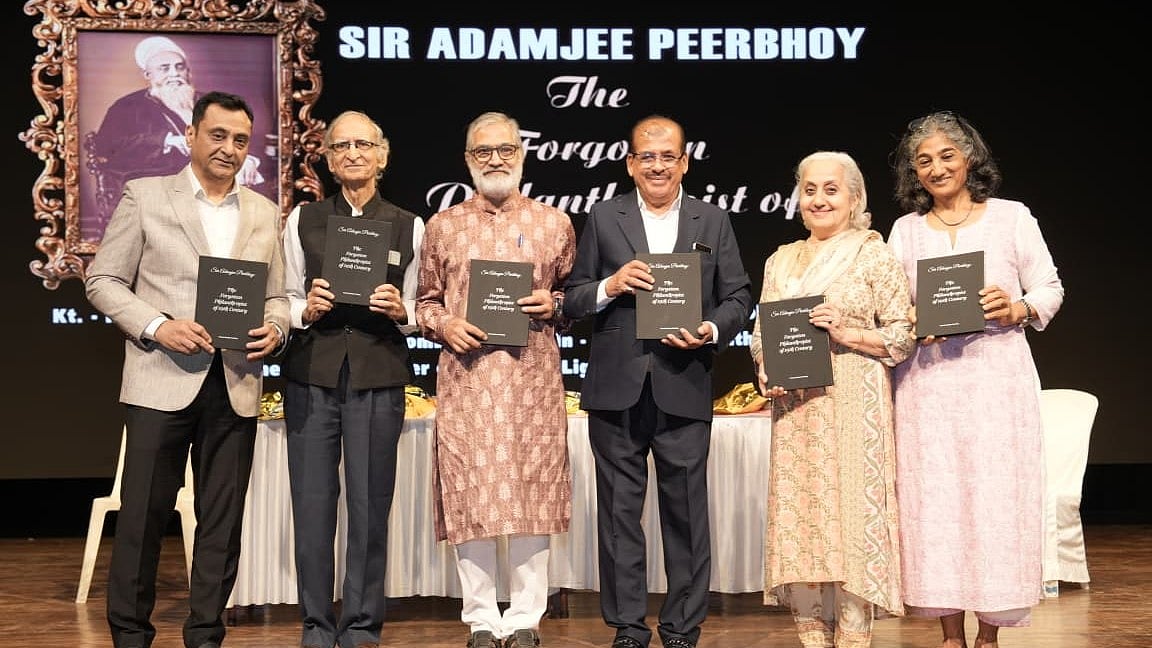
A new book on Sir Adamjee Peerbhoy, unveiled in Mumbai on Sunday by his great-grandson Hussain Adamjee Peerbhoy, revisits the forgotten industrialist who built the Matheran Light Railway and funded schools, healthcare and famine relief. Hussain said the work fulfils a legacy, highlighting Peerbhoy’s philanthropy across communities and his role in the city’s early development.

Remembering Sir Adamjee Peerbhoy: The Forgotten Pioneer Behind Matheran’s Toy Train |
Mumbai: Visitors riding the historic Matheran Light Railway to the automobile-free hill station on Mumbai’s outskirts may be unaware that the 20-km narrow-gauge line winding along the Sahyadri ridges was not built by the colonial administration, but by an Indian businessman, Sir Adamjee Peerbhoy.
A marble bust of Peerbhoy, installed in 1985 at the Matheran terminus, offers one of the few public reminders of his legacy. Yet, the city has no street named after the philanthropist whose contributions supported thousands during famines and aided the freedom struggle, even at the cost of his own business interests.
Peerbhoy’s life and legacy are now the subject of a new book, Sir Adamjee Peerbhoy: The Forgotten Philanthropist of the 19th Century, unveiled on Sunday at St Andrew’s Auditorium in Bandra by his great-grandson, Hussain Adamjee Peerbhoy. “For me, this book is not just a tribute; it is the fulfilment of a legacy,” he said.
The project was originally initiated by Hussain’s father, who began documenting the family’s history after their migration from Dhoraji in Gujarat. Following his father’s passing, Hussain completed the work, dividing it into three volumes that trace over 150 years of family history intertwined with that of the Dawoodi Bohra community.
Born in 1846, Sir Adamjee arrived in Mumbai as a teenager with just Rs 5. Within decades, he became a major contractor supplying goods to the colonial army. He established what was then Asia’s largest tannery in Dharavi and built Peerbhoy Palace on Malabar Hill, now the residence of Syedna Mufaddal Saifuddin, the 53rd spiritual leader of the Dawoodi Bohra community.
His philanthropy included funding 26 schools, a municipal market, a sanatorium at Charni Road (now the site of Saifee Hospital), and providing aid during the 19th-century Kathiawad famine. He also built dispensaries and guest houses in Mecca, Medina and Karbala. In 1897, he became the first Indian Sheriff of Bombay.
Also Watch:
In 1901, encouraged by his son, he began constructing the Matheran Light Railway, then a vital link to a hill station accessible only by horse. Built at a cost of Rs 16 lakh, the line was completed in 1907. When initial ridership was low, the family promoted a bungalow scheme to develop Matheran as a public resort. Peerbhoy was knighted the same year.
The book incorporates audio-visual elements through QR codes, allowing readers to access archival material. During his research, Hussain discovered lesser-known aspects of his great-grandfather, including plans to build an animal hospital.
“His charity was never limited by caste, creed or community,” he said. “He helped anyone in need, whether through education, healthcare or basic survival. In today’s divided world, that spirit feels more relevant than ever.”
The family continues his legacy, having established a free English-medium school at the foothills of Matheran.
To get details on exclusive and budget-friendly property deals in Mumbai & surrounding regions, do visit: https://budgetproperties.in/
Your voice matters. If you have a community story, issue, or inspiring local experience to share, send it to community@fpj.co.in and be a part of the conversation.
RECENT STORIES
-
-
-
-
-