Mumbai's Drug Menace Deepens As City Of 1.2 Crore Has Only Three Government De-Addiction Centres, Experts Call For Holistic Approach
Experts have warned that Mumbai’s growing drug menace is being worsened by inadequate government-run rehabilitation facilities and rising synthetic drug abuse among youngsters. Despite a population exceeding 1.2 crore, the city has only three government de-addiction centres.

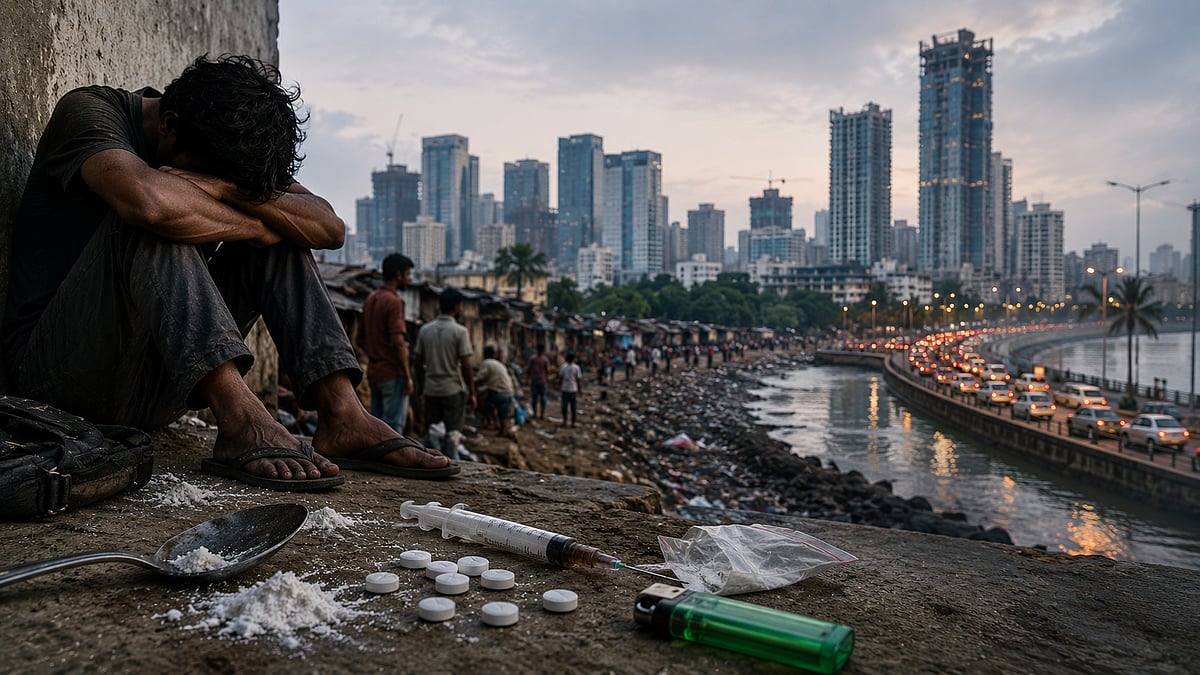
Mumbai's Drug Menace Deepens As City Of 1.2 Crore Has Only Three Government De-Addiction Centres, Experts Call For Holistic Approach | AI
Mumbai: Drug menace is one of the key social and policing challenges being faced by Mumbai. While the law agencies are continuously swooping on narcotics networks, syndicates continue to rear their ugly heads and the reason is simple – where there is demand, there is supply.
Focus Should Be on Helping Addicts Quit
For a holistic approach towards the vexed problem, the focus should be on helping drug addicts say no to substance abuse for once and all. However, the strategy is impeded by the lack of government-run treatment and rehab infrastructure.
Despite Mumbai’s population exceeding 1.2 crore, it has only three government-run de-addiction centres based at KEM Hospital in Parel, Bhardawadi Hospital in Andheri and Rajawadi Hospital in Ghatkopar. Apart from them, a few civic and government institutions, including Sion, GT and Cooper Hospitals, provide psychiatric treatment and counselling. However, there is no modern facility equipped with mental and medical support to tackle the problem.
NGOs and Private Centres Fill the Gap
A significant portion of rehab services in Mumbai is being offered by NGOs, charitable organisations and private centres. While some offer subsidised or free treatment, many private facilities remain financially inaccessible for economically-weaker families.
This lack of accessibility becomes more concerning, given the fact that the nature of addiction has changed drastically over the years. According to Dr Vijay Makwana, medical officer at municipal drug de-addiction centre running from Bhardawadi, younger individuals are increasingly falling prey to multiple drugs at the same time. “Male patients are more common, especially in the 20 to 40 age group. Most addicts do not consume just one drug. Many take cocktail drugs, including MD and brown sugar, together.” Dr Makwana continued, “Often, an adolescent starts consuming cannabis at the age of 15 or 16 and by the time he turns 30, he may turn to consuming brown sugar, MD and cocaine together.”
Synthetic and Psychedelic Drugs on the Rise
Sameer Wankhede, who worked as the Narcotics Control Bureau's Mumbai zonal director, expressed worry over “the rise of synthetic and psychedelic drugs among youngsters”. Psychedelics are a group of drugs that alter a person’s perception of reality and hence they are also known as hallucinogens. “Many types of psychedelic drugs are entering the market. For example, drugs like ketamine are being consumed widely. MDMA and ecstasy are also being used extensively,” Wankhede pointed out. He added, “There are also zombie drugs, psychedelic mushrooms consumed in high-end societies and mescaline, which is derived from cactus and is considered a foreign drug. The situation is very alarming.”
Medical professionals explained that recovery is a long psychological and emotional process that requires counselling, family support and rehabilitation. “There are often chances of relapse. For instance, if a person (who has recovered from drug abuse) loses a parent, he/she may start consuming drugs to deal with the grief,” Dr Makwana said.
Families Also Suffer Emotional and Financial Distress
He further highlighted that the issue also impacts the individual's family, resulting in emotional and financial distress, and social stigma. “Patients often go through a tough withdrawal phase filled with agitation and irritation. It is equally important to involve family members.”
Mental health experts and activists asserted that Mumbai urgently needs more government-run rehab centres, awareness programmes in schools and colleges and stronger community-based recovery systems.
To get details on exclusive and budget-friendly property deals in Mumbai & surrounding regions, do visit: https://budgetproperties.in/
RECENT STORIES
-
-
-
-
-