Mumbai: BJP MLC Pravin Darekar Urges Housing Societies To Opt For Self-Redevelopment Over Builder-Led Projects
BJP MLC Pravin Darekar has urged Mumbai's cooperative housing societies to choose self-redevelopment over builder-led projects, saying the government-backed SGRA model offers better construction quality, greater transparency, larger carpet area benefits and financial assistance. He said nearly 1,600 proposals have already been received under the initiative.

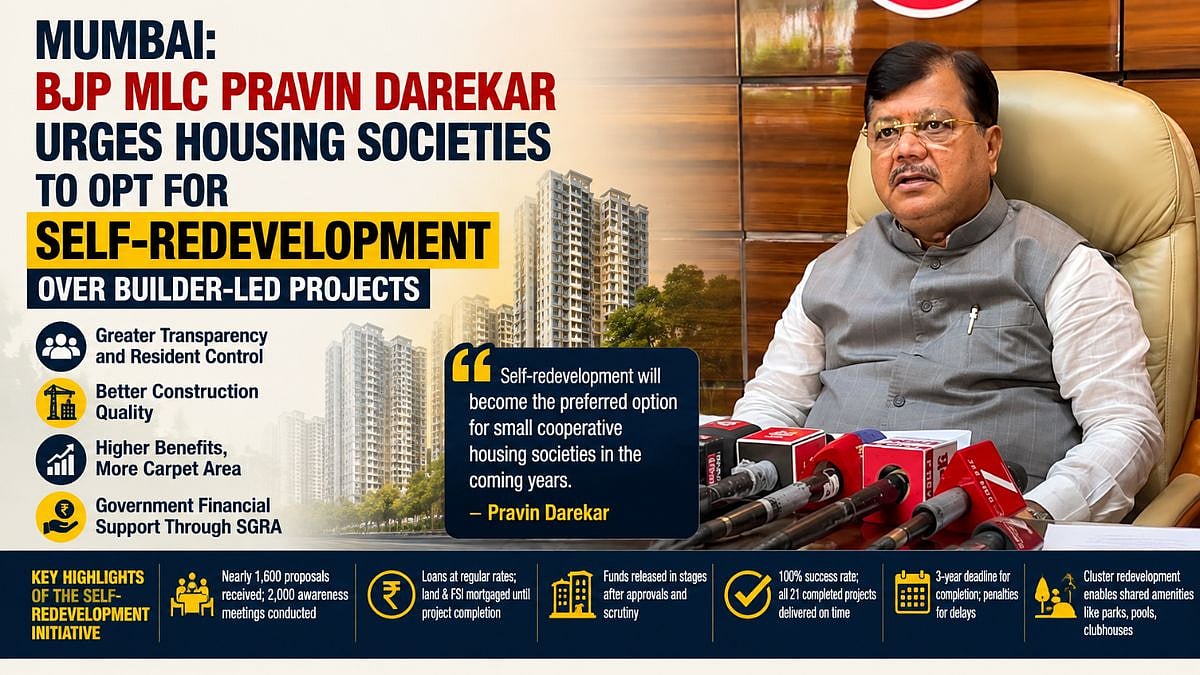
BJP MLC Pravin Darekar advocates self-redevelopment as a transparent and more rewarding alternative to builder-led redevelopment for Mumbai housing societies | AI Generated Image
Mumbai, August 3, 2026: BJP MLC Pravin Darekar has urged cooperative housing societies in Mumbai to opt for self-redevelopment with the help of the state government's Self Group Redevelopment Authority (SGRA), instead of handing over projects to private builders, claiming the model offers greater transparency, better-quality construction and significantly higher benefits to residents, especially those from the middle class.
Government Push For Self-Redevelopment
Speaking about the state government’s push for self-redevelopment, Darekar said the initiative has gained considerable momentum, with nearly 1,600 proposals already received.
He added that while mobilising funds for such projects remains a challenge, the Maharashtra government, under Chief Minister Devendra Fadnavis, is extending financial support to ensure societies can undertake redevelopment independently.
“In the coming years, self-redevelopment will become the preferred option for small cooperative housing societies. As people witness successful projects, their confidence in the model continues to grow,” Darekar said.
He noted that the biggest concerns among middle-class residents are arranging finances and ensuring the timely completion of redevelopment projects. According to him, government-backed financial assistance has helped address these concerns, encouraging more societies to adopt the model.
Financial Assistance Explained
Darekar said cooperative housing societies registered under the Cooperative Societies Act are eligible to receive loans at regular lending rates. Societies that are yet to be registered would also be assisted with registration before being considered for financial aid.
He clarified that while funds are released for self-redevelopment, the land and saleable Floor Space Index (FSI) remain mortgaged as security until the project is completed.
Claiming a “100 per cent success rate”, Darekar said none of the self-redevelopment projects sanctioned so far have failed.
He also credited the Chief Minister for promoting citizen ownership instead of favouring the builder lobby. “This initiative is meant for the middle class. Wealthier people may choose builder-led redevelopment, but the government is standing with ordinary citizens by providing financial support for self-redevelopment,” he said.
Process And Oversight
Explaining the process, Darekar advised societies to first undertake a feasibility study. He said government teams visit housing societies to explain the concept and have already conducted around 2,000 awareness meetings, mostly on weekends.
Once a society decides to proceed, the project report is simultaneously submitted to banks for financial approval and to government authorities for statutory permissions.
After scrutiny, funds are released in stages. While societies are free to appoint architects of their choice, the plans are reviewed by a government-approved panel before approval.
Emphasising transparency, Darekar said self-redevelopment ensures better construction quality because residents themselves supervise the project. “When people build their own homes, there is no compromise on quality. Compromises generally arise when a builder is constructing homes for someone else,” he said.
Cluster Model And Timelines
Darekar further said the government has expanded the concept to include cluster self-redevelopment, enabling multiple societies to jointly redevelop and create common amenities such as parks, swimming pools and clubhouses. He said a committee headed by him was constituted to formulate the cluster self-redevelopment model.
He said the state government has fixed a three-year deadline for the completion of self-redevelopment projects, failing which penalties can be imposed on defaulters. According to him, all 21 projects completed under the scheme have been delivered within 2.5 to 3 years.
Also Watch:
ALSO READ
Darekar also pointed out that the project cost includes rent payable to residents during the redevelopment period. He claimed that, in many cases, self-redevelopment can provide residents with almost double the additional carpet area compared to what they may receive under builder-led redevelopment, making it a more beneficial option for cooperative housing societies.
To get details on exclusive and budget-friendly property deals in Mumbai & surrounding regions, do visit: https://budgetproperties.in/
RECENT STORIES
-
-
-
-
-