How A Dam Drought Since 2014 Left Mumbai’s Water Security Hanging On Languishing Gargai, Damanganga-Pinjal Link Projects
Spurred by an acute summer crisis that has frozen construction and forced strict civic rationing, Mumbai is facing the harsh consequences of a 12-year infrastructure stagnation as bureaucratic delays keep its most critical auxiliary water networks entirely on paper

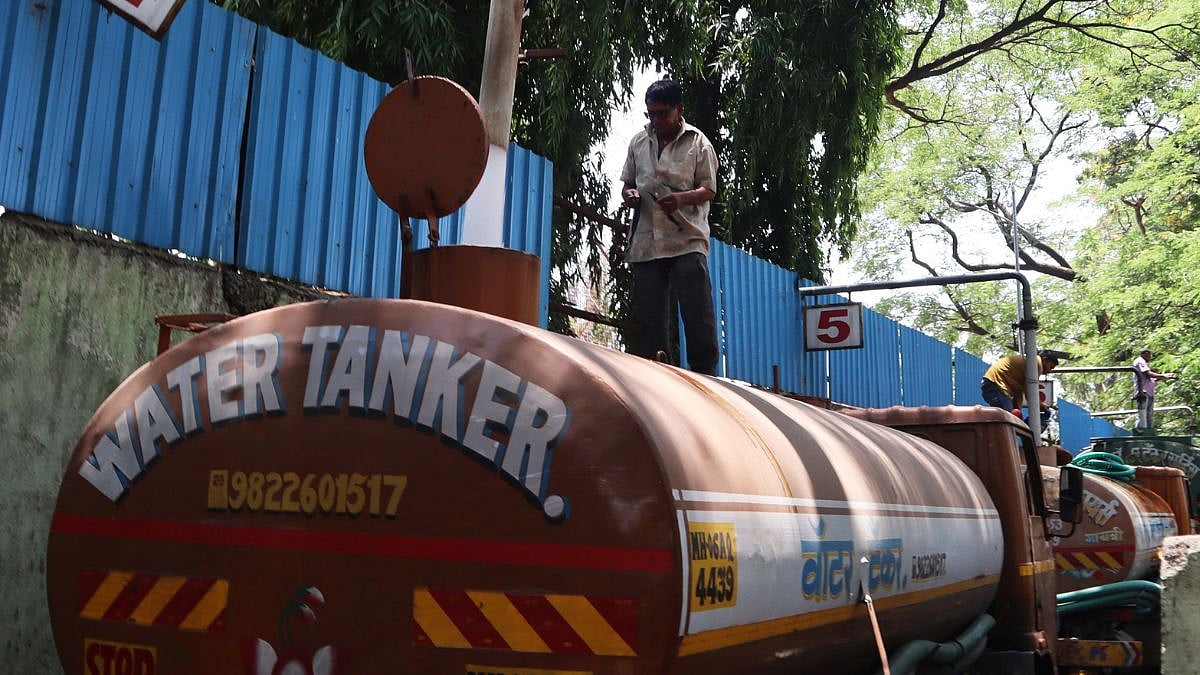
Mumbai water crisis deepens as projects are languishing in delays and there is no sight of monsoon | File Photo
Mumbai is currently enduring a gruelling, humid dry spell as weak weather systems slow down monsoon currents along the western coast. While the southwest monsoon typically reaches the city by June 11, its arrival has been delayed by more than a week, creating an anxious wait for its 22 million residents.
According to the India Meteorological Department (IMD), an anticyclonic circulation north of Mumbai and an unfavourable Madden-Julian Oscillation phase have blocked the monsoon's progress.
The immediate result is a severe, city-wide water shortage. On June 17, 2026, the Brihanmumbai Municipal Corporation (BMC) reported that the total water stock across the city’s seven supply reservoirs had plummeted to 1,44,918 million litres—just 9.33 percent to 10.01 percent of their total useful capacity of 14,47,363 million litres.
This is a critical drop compared to the 12.27 percent available during the same period last year. Alarmingly, catchment areas have recorded 0 mm of rainfall so far this season, compared to 101 mm by this date last year.
However, Mumbai's dry taps are not merely the result of a delayed monsoon. The ongoing emergency exposes a deeper structural crisis. While the city's population has ballooned over the last 12 years, but its water storage infrastructure has remained entirely stagnant.
12-year infrastructure freeze versus skyrocketing demand
The root of Mumbai’s vulnerability lies in a stark mathematical imbalance between demographic expansion and civil engineering. The completion of the Middle Vaitarna dam in 2014 was the last major water supply asset successfully delivered to the city. Since then, the BMC has not built a single new dam for 12 consecutive years.
During this exact infrastructure freeze, Mumbai's metropolitan population grew from roughly 19.1 million (19,099,000) in 2014 to approximately 22.5 million (22,539,000) in 2026. This marks an increase of about 3.44 million people -- an overall growth of roughly 17.8 percent as development expands into the broader Mumbai Metropolitan Region (MMR).
Under normal conditions, the BMC supplies about 3,850 to 4,100 MLD (million litres per day) of potable water, which has now been compressed to 3,650 MLD due to the cuts. Looking ahead, the BMC’s Environmental Status Report projects that Mumbai's water requirement will surge to 5,940–6,535 MLD by 2041, driven by transmission losses and rapid rbanisation.
Where Mumbai currently get its water from
Mumbai’s complex water network relies heavily on long-distance hydrogeography, drawing from seven primary reservoirs distributed across a 5,000-kilometre pipeline network.
Only two small lakes, Tulsi and Vihar, sit directly within the city boundaries inside Sanjay Gandhi National Park. They were created during the British colonial era by trapping rainwater from the Mithi River catchment to control flooding. They provide a tiny fraction of the city's needs. Tulsi has a capacity of 8,046 million litres (contributing 18 MLD) and Vihar has a capacity of 27,698 million litres (contributing 90 MLD).
The vast majority of Mumbai's water—roughly 97 percent—comes from five massive dams situated 100 to 175 kilometres away in the outskirts and neighbouring districts of Thane, Palghar and Nashik: They are:
Bhatsa dam (Thane district)
Modak Sagar (Palghar district)
Tansa dam (Thane district)
Middle Vaitarna dam (Palghar District)
Upper Vaitarna dam (Nashik district)
Additionally, the artificial Powai Lake exists within city limits near IIT Bombay. Built by the British in 1890 with a holding capacity of 545 crore litres, its water is non-potable and is used strictly for industrial purposes and non-drinking needs in the Aarey Dairy Colony.
Gargai dam: Breaking the 12-year deadlock
To finally bridge the widening supply gap, the BMC is advancing the long-delayed Gargai dam project. Recommended by noted hydrologist Madhav Chitale, it will be the first new water supply dam constructed by the BMC within the city and suburban region since 2014.
Planned on the Gargai river (a tributary of the Vaitarna river) near Ogada village in the Wada taluka of Palghar district, the project is designed to add 440 MLD of potable water to Mumbai’s network, serving as the city’s eighth primary water source.
On June 4, Additional Municipal Commissioner (Projects), Abhijit Bangar announced that construction is officially scheduled to begin in October 2026, with the reservoir projected to be filled by May 2029.
The engineering plan features a 69-metre-high, 979.4-metre-long dam alongside a 1.6 to 2.2-kilometre underground water transfer tunnel with a 2.2-metre diameter. Boring directly through a hillock, this tunnel will connect the new Gargai reservoir directly to the existing Modak Sagar system.
Escalating costs and environmental hurdles
While structurally vital, the Gargai dam has faced over a decade of delays and steep cost escalations. The project was initially stalled because the state government raised concerns about allocating regional water to Mumbai at the expense of neighbouring municipalities in the MMR. Furthermore, the dam sits partially within the Tansa Wildlife Sanctuary, requiring forest diversion permissions from the MoEFCC and approval from the National Board for Wildlife.
The financial footprint has grown significantly. The civic administration recently sought administrative approval for a revised outlay of Rs5,396 crore, which is, significantly higher than the BMC's initial base estimate of Rs3,006 crore.
Future pipelines and local alternative debate
Beyond the Gargai dam, the BMC plans to develop additional long-distance sources to add a combined 2,891 MLD to the city's future network. This includes the independent Pinjal dam project (865 MLD) and the massive Damanganga-Pinjal River Link Project.
At a 2015-16 estimated cost of Rs3,008 crore, the river link project will construct an 826.60-metre-long composite dam at Bhugad (Nasik district, 68.63m high) and a 572.80-metre-long dam at Khargihill (Thane district, 75.62m high). These will connect via a 16.85 km Bhugad-Khargihill tunnel (5.0m diameter) and a 25.70 km Khargihill-Pinjal tunnel (5.25m diameter) to divert 1,586 MLD of water into the Pinjal reservoir, generating 5 MW of hydropower along the way.
Water wastage
To compound Mumbai's water woes, currently, nearly 34 percent of Mumbai’s existing water supply—about 1,343 MLD—is classified as Non-Revenue Water (NRW), meaning it is completely lost to pipe leakages, system inefficiencies and water theft.
A climate-insecure future?
The intersection of a severely delayed monsoon and a 12-year infrastructure freeze has delivered a blunt wake-up call to India's financial capital. Relying solely on engineering triumphs of the past, like the Middle Vaitarna dam or waiting for long-distance capital-intensive projects of the future, like the Gargai and Damanganga-Pinjal lines, is no longer a guaranteed safety net in an era of unpredictable climate patterns.
As Mumbai's population approaches 23 million, its water security is getting critical with every passing day. Until there is a balance between determined water conservation and a serious upgradation of water supply infrastructure, the city will remain precariously trapped between an ever-expanding population and an increasingly fragile wait for the rain.
RECENT STORIES
-
-
-
-
-