HDIL Promoter Rakesh Wadhawan Moves EOW, Alleges Illegal Assignment Of ₹600-Crore Yes Bank Loan To Suraksha ARC
Former HDIL promoter Rakesh Wadhawan has approached Mumbai's EOW alleging that Yes Bank illegally assigned PPIPL's Rs 600-crore loan account to Suraksha ARC in 2017 despite it allegedly not being an NPA. He has sought a criminal probe into former Yes Bank officials and Suraksha ARC executives over alleged violations of RBI norms.

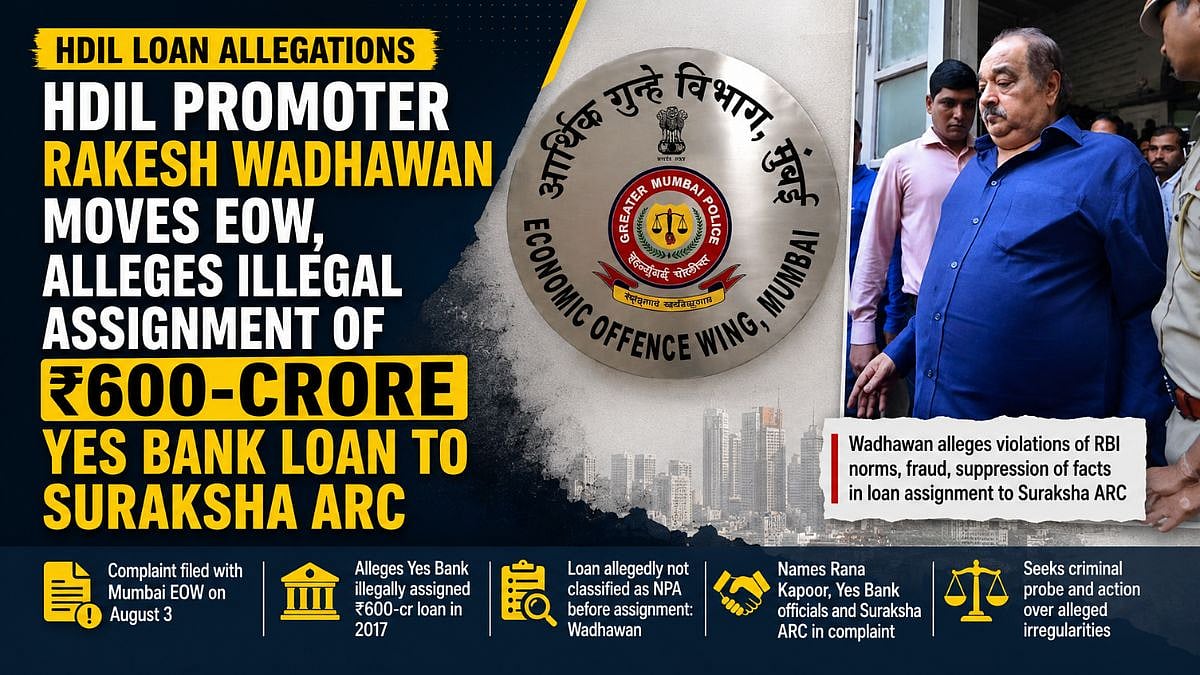
Rakesh Wadhawan has approached the EOW alleging irregularities in Yes Bank's assignment of PPIPL's ₹600-crore loan to Suraksha ARC | AI Generated Image
Mumbai, August 3, 2026: Former Housing Development and Infrastructure Ltd (HDIL) promoter and suspended director of Privilege Power and Infrastructure Private Limited (PPIPL), Rakesh Kumar Wadhawan, has approached the Mumbai Police's Economic Offences Wing (EOW), alleging that Yes Bank illegally assigned the company's Rs 600-crore loan account to Suraksha Asset Reconstruction Company (ARC)-11 Trust in 2017 despite the account allegedly never being classified as a Non-Performing Asset (NPA).
Complaint Seeks Criminal Probe
In a detailed 16-page complaint dated August 3, Wadhawan has sought a criminal investigation against former Yes Bank Managing Director Rana Kapoor, officials of the bank and Suraksha ARC, including its promoter-director Sudhir Valia and others allegedly involved in the assignment of the loan and the transfer of underlying securities. He has alleged that the loan account was transferred illegally despite never being classified as a non-performing asset (NPA), and accused those involved of suppressing material facts, creating unlawful charges over valuable assets, fraudulently acquiring security interests and violating Reserve Bank of India (RBI) regulations governing the assignment of stressed assets.
The complaint relates to a Rs 600-crore term loan sanctioned by Yes Bank to PPIPL for developing an affordable housing project at Kopri-Virar. According to Wadhawan, the loan was secured against development rights, receivables and immovable properties worth more than Rs 2,000 crore, along with corporate and personal guarantees. The bank’s sanction letter had provided for a 48-month moratorium on principal repayment and a total repayment tenure of 96 months.
Questions Over Loan Assignment
According to the complaint, Yes Bank subsequently assigned the PPIPL loan account to Suraksha ARC-11 Trust under an Assignment Agreement executed on March 31, 2017. Wadhawan has challenged the legality of this transfer, contending that the assignment could not have been made under RBI norms because the account had allegedly never been classified as an NPA before it was transferred to the asset reconstruction company.
He alleged that when the assignment took place, the contractual moratorium was still in force, substantial interest payments had already been made and the account had not been declared an NPA. He further claimed that neither any notice classifying the account as an NPA nor any prior intimation of the proposed assignment was served on the borrower before the transfer of the loan account. According to the complaint, these circumstances raise questions over the legality of the assignment.
The complaint also questioned the process through which the loan was transferred to Suraksha ARC. Wadhawan alleged that the assignment was carried out without an independent valuation of the secured assets, a transparent price discovery mechanism or a competitive bidding process, despite the securities allegedly being worth several times the outstanding dues. He contended that these omissions were inconsistent with RBI guidelines governing the sale of stressed assets to asset reconstruction companies.
Funding And Court Observations
Relying on what he described as an internal Yes Bank forensic review report, Wadhawan claimed that outstanding dues of about Rs 213.6 crore were assigned to Suraksha ARC for Rs 155.3 crore. According to the complaint, only Rs 23.3 crore of the consideration was allegedly paid in cash, while the remaining amount comprised security receipts retained by Yes Bank. He further alleged that the cash component originated from entities financed by Yes Bank, raising questions about an alleged circular funding arrangement used to facilitate the acquisition of the loan account.
The complaint also referred to recent judicial observations made by a Mumbai sessions court while rejecting anticipatory bail of Suraksha ARC promoter Sudhir Valia in another matter relating to Sapphire Land Development Pvt Ltd, another HDIL group company.
According to Wadhawan, the court had made prima facie observations regarding alleged collusion between officials of Yes Bank and Suraksha ARC, violations of banking procedures and RBI guidelines, and the need for custodial interrogation in that case.
While acknowledging that those observations related to a separate transaction, Wadhawan contended that they reinforced the need for a detailed probe into the assignment of the PPIPL loan account as well.
Also Watch:
EOW Asked To Investigate
In his complaint, Wadhawan has urged the EOW to examine the legality of the assignment, verify the source of funds used by Suraksha ARC to acquire the loan account, scrutinise valuation reports, board approvals, RBI compliance records and bidding documents, and investigate the role of all officials and entities connected with the transaction. He has also sought criminal action, wherever warranted, against former Yes Bank officials, Suraksha ARC executives and others allegedly connected with the transaction.
To get details on exclusive and budget-friendly property deals in Mumbai & surrounding regions, do visit: https://budgetproperties.in/
RECENT STORIES
-
-
-
-
-