FPJ Special: Mumbai Water Crisis Looms As Reservoir Storage Falls To 17.85 Per Cent; BMC Relies On Reserve Stock Amid Monsoon Uncertainty
Mumbai's water reserves have dropped to 17.85% capacity, prompting a 10% water cut as BMC battles evaporation losses, leakages and monsoon uncertainty. Officials say reserve stock from Upper Vaitarna and Bhatsa lakes should sustain supply until August 19, though further restrictions may be considered if rainfall remains below expectations.

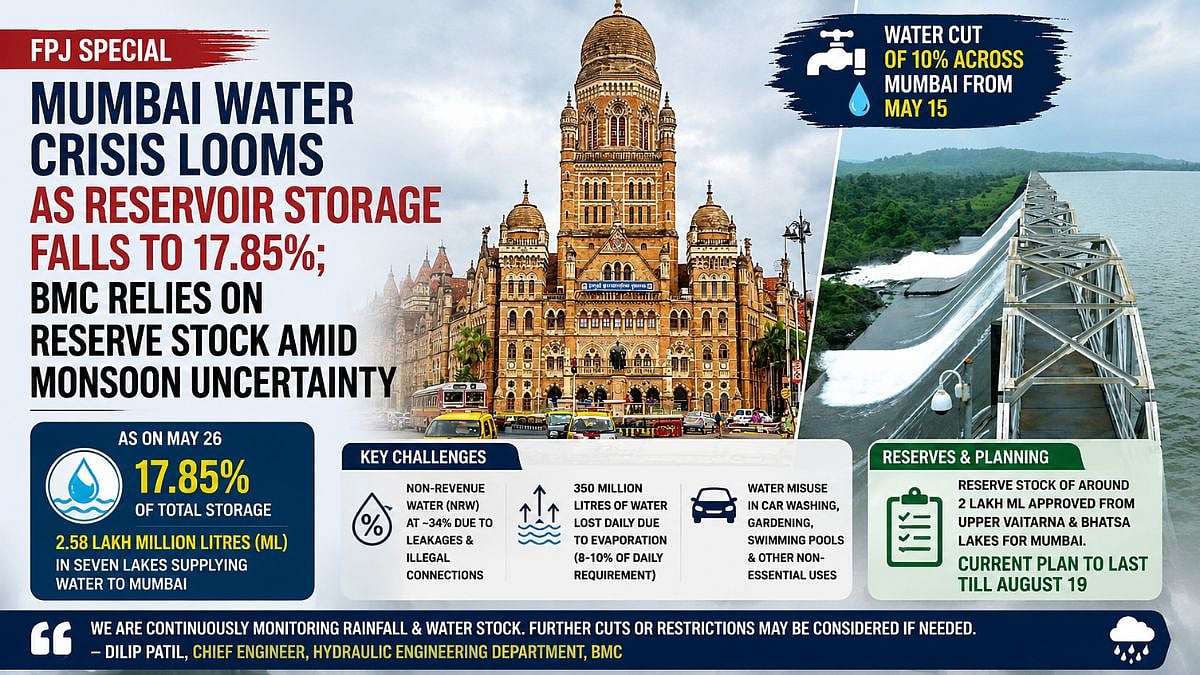
BMC officials closely monitor Mumbai's water reserves as falling lake levels and high evaporation intensify concerns ahead of the monsoon | AI Generated Image
Mumbai, May 27: In the corridors of the BMC Hydraulic Engineering Department at the Engineering Hub near Worli Naka, the mood is unusually grim this May.
On Tuesday afternoon, even within air-conditioned offices, the strained expressions of engineers were clearly visible as officials remained on their toes. Depleting water stock and rapid evaporation have turned every drop into a matter of urgency.
Officials were seen working through supply graphs, revisiting contingency drafts and recalculating demand against shrinking margins — balancing numbers that carry the weight of an entire city.
Mumbai relies predominantly on the traditional monsoon rainfall pattern for its year-round water supply. After years of facing a severe water crisis, the civic body has taken steps towards developing alternative sources.
Yet, for now, the city may have to wait another three to four years for real relief. As on May 26, the seven lakes supplying water to Mumbai hold 2.58 lakh million litres (ML), or 17.85 per cent of total storage.
Although this is comparatively higher than levels recorded in the past two years, concerns persist over forecasts of below-normal rainfall this season.
All loss, no gain
To conserve available stock until the monsoon replenishes the catchment areas, the civic body has imposed a 10 per cent water cut across Mumbai from May 15. However, over the years, the BMC has struggled to bring down water losses due to leakages, which could have otherwise provided crucial relief during crisis periods.
As per civic data, Non-Revenue Water (NRW) — comprising losses due to leakages, unauthorised connections and metering inaccuracies — currently stands at approximately 34 per cent.
Adding to the worry is the rising rate of evaporation in catchment areas, where roughly 350 million litres of water is lost daily — equivalent to about 8–10 per cent of Mumbai’s total daily requirement. This continuous loss has further intensified concerns over the city’s water security.
“If this can be controlled and saved, it would significantly ease the pressure,” admitted an official.
Lakhs of litres daily down the drain
Water is a precious resource, yet it continues to be used without restraint and often wasted, as its true value is still not widely understood. While the BMC supplies nearly 4,000 ML of water to Mumbai daily, officials claim a significant portion is consumed for non-essential purposes such as car washing, gardening and swimming pools.
Buried in files and supply charts amid the ongoing crisis, an official said the civic body has repeatedly appealed to citizens to conserve water.
“We have urged people to save every drop of water that is being wasted. However, many still fail to understand its importance and continue to use it carelessly,” he said.
When the lakes fall, so does the buffer
Mumbai’s dependence on monsoon rainfall continues to remain its biggest vulnerability. The city has faced repeated water crises over the years, forcing 15–30 per cent water cuts in 2009, 2014, 2015, 2020, 2022 and 2023. Yet despite these recurring warnings, long-term alternatives have moved at a slow pace.
Projects like the 200 ML daily desalination plant at Manori and the 450 ML daily Gargai Dam in Palghar are still far from reality, leaving Mumbai with limited fallback options whenever the monsoon weakens or arrives late.
Also Watch:
Extra reserves bring relief
Dilip Patil, Chief Engineer of the Hydraulic Engineering Department, said, “The state government has approved a reserve stock of around two lakh ML from the Upper Vaitarna and Bhatsa lakes for Mumbai. Along with the water cut already imposed, we have planned the supply in a way that the available stock can last till August 19. We are continuously monitoring the situation, including Indian Meteorological Department forecasts and rainfall response in the catchment areas during June. Based on the situation, further measures such as increasing water cuts or restricting supply to commercial establishments may also be considered if required.”
To get details on exclusive and budget-friendly property deals in Mumbai & surrounding regions, do visit: https://budgetproperties.in/
RECENT STORIES
-
-
-
-
-