'Checkout Shock': Is Food Delivery Duopoly Finally Facing A Reckoning With New Entrants Like Ownly & Toing?
Growing anger over hidden fees and high commissions in India’s food delivery market is opening doors for challengers like Ownly and Toing. Customers want lower prices while restaurants seek fairer terms and better transparency.

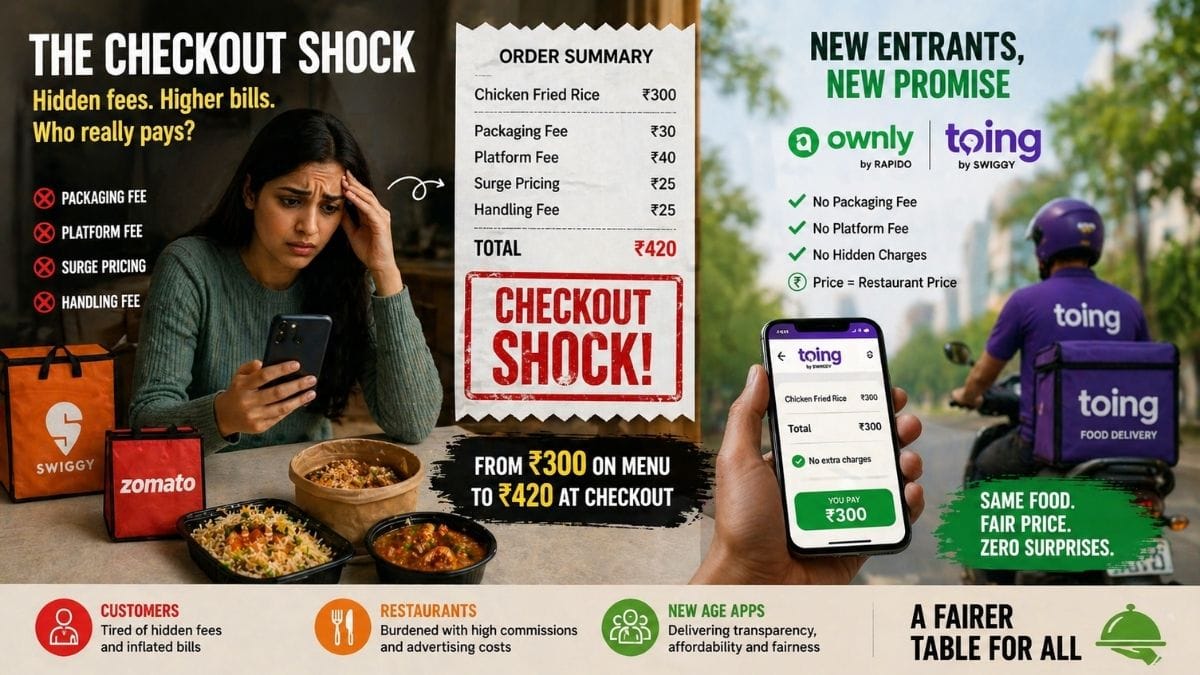
Customers and restaurants push back against rising food delivery charges as new apps enter the market | AI Generated Representational Image
Mumbai, April 30: The Indian food delivery market has been defined by a comfortable duopoly for years, but beneath the surface, a checkout shock crisis is brewing. Customers and restaurant owners alike are reaching a breaking point with the hidden costs that have become synonymous with ordering a meal online.
The industry is currently facing a surge of criticism over a pricing model that often sees a dish’s final price inflate by 25% to 40% between the menu and the payment gateway.
For many, the frustration of watching a Rs 300 meal morph into a Rs 450 bill due to packaging fees, platform charges, surge pricing, and handling costs has created a desperate demand for transparency.
Dora D'Souza, a Bandra resident, said: “Recently I ordered chicken fried rice through a delivery app. The restaurant price was Rs 300, but I was asked to shell out Rs 420. Incidentally, the restaurant is only 1.5 km from my house.”
Restaurants and diners feel the strain
The current ecosystem, dominated by giants like Swiggy and Zomato, is increasingly being viewed as a burden rather than a service. While these platforms offer undeniable reach, the financial toll is felt on both sides of the kitchen counter.
Beyond the base price, customers are hit with a barrage of additional levies. For the restaurateur, the struggle is equally intense. Many restaurant owners report that high commission rates and exorbitant advertising fees on major platforms are cannibalising their profit margins.
According to the National Restaurant Association of India’s vice-president Pranav Rungta, the charges of commission, advertising, and other variable costs eat up around 60% of the order value, making it difficult for cloud kitchens to sustain.
While he highlighted that the contribution margin is still positive, the cost of doing business is very high. “The online food delivery apps have served a purpose by providing additional business that was not there earlier. However, the terms of trade are not in our control, which is unfair,” he said.
Indian Hotel and Restaurant Association's (AHAR) president Vijay Shetty said, “The commission on Swiggy and Zomato is very high and the charges for advertising on their platforms is also on a higher side. Restaurants are fed up with these apps, which now feel like a burden. They charge exorbitantly from us as well as the customers.”
Price-sensitive users seek alternatives
This factor has created a segment of price-sensitive diners, particularly students and young professionals, who feel priced out of the very convenience these apps promise.
“The prices of dishes are already higher on the apps than on the restaurant menu, and then it also charges a lot of additional money. It is a concern for students like me who live away from their families and are also on a budget,” said a Saki Naka-based college student, Meet Bhanushali (20).
Chembur resident Bhakti Chandani (27) said, “In terms of pricing, food delivery apps have changed a lot from what they were earlier. Now, the burden of additional costs has made it a better option to go to the restaurant to collect the order ourselves. The cash-on-delivery orders become mysteriously expensive.”
This widespread dissatisfaction has paved the way for a new era of hyper-niche delivery experiments. A recent example is the emergence of Ownly by Rapido and Toing by Swiggy.
By stripping away packaging fees and platform charges and bundling deliveries into orders, these apps aim to guarantee prices that match or beat the restaurant’s physical menu prices. Rapido and Ownly’s founder Aravind Sanka had called his new app transparent, fair, and value-driven for both restaurants and consumers.
Can new entrants disrupt the duopoly?
Talking to The Free Press Journal, Toing’s chief business officer Sidharth Bhakoo said that the app is built as an affordability-first platform for a large segment of customers who are extremely price-sensitive and also want reliable, high-quality, affordable food options.
Calling it a “niche platform”, he said that Swiggy's model has been redesigned for efficiency, tighter delivery radius, curated menus, and order batching for optimising delivery costs.
However, these new models highlight a growing digital divide in the industry. While newer apps target a value-conscious and Gen Z demographic with curated, budget-friendly menus, they often leave traditional restaurateurs in the dark. Shetty expressed a lack of knowledge about Toing but appreciated the model, saying the industry needs to move beyond Zomato and Swiggy.
Rungta highlighted that Ownly is restaurant-friendly, while Toing is customer-friendly, as the former does not charge restaurants any commission, whereas the latter does not charge any additional fees to customers.
“The current ecosystem is not healthy, as traditional aggregators are also not making money. They need to transparently add cost to the customers. The new apps like Toing and Ownly will only become successful if they can attract a significant number of customers,” he added.
Future hinges on trust and transparency
The customers’ preference clearly tilts towards Toing, which has seen over 50 lakh downloads in the last seven years, against Ownly’s over five lakh downloads in eight months. Customers highlight that the market remains distorted even with pure-price models.
They noted that heavy discounting on major apps can sometimes make the final bill equivalent to that of the "no-fee" apps, keeping consumers locked in a cycle of searching for the lowest net price.
Also Watch:
According to restaurateurs and customers, the success of any new entrant will likely depend on its ability to address core grievances about commission rates and price transparency.
Whether through tighter delivery radiuses, order batching or streamlined menus, there is a need to make food delivery sustainable for the restaurant and affordable for the diner, without the sting of hidden fees.
To get details on exclusive and budget-friendly property deals in Mumbai & surrounding regions, do visit: https://budgetproperties.in/
RECENT STORIES
-
-
-
-
-