Centre Releases Sindhi Constitution In Devanagari Script Alongside Perso-Arabic Version To Boost Accessibility
The Centre has released the Sindhi translation of the Constitution in Devanagari script alongside the Perso-Arabic version, aiming to improve accessibility. The move is expected to benefit younger readers and professionals while preserving traditional script usage within the community.

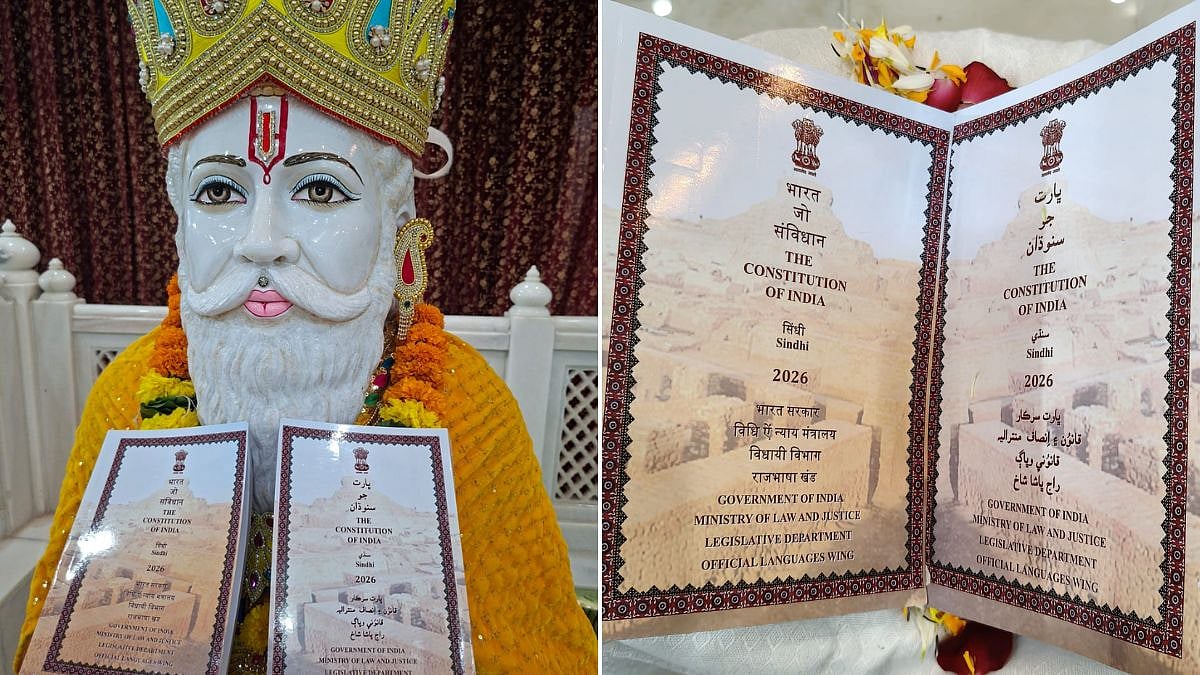
Government introduces dual-script Sindhi Constitution to enhance access for diverse readers and younger generations | File Photo
Mumbai, April 15, 2026: For the first time, the Government of India has released the latest Sindhi translation of the Constitution of India in the Devanagari script alongside the traditional Perso-Arabic script, marking a significant step towards greater linguistic accessibility.
Expansion beyond traditional script
While earlier editions, including the first published in 1998, were available only in the Perso-Arabic script widely used by Sindhi speakers, the inclusion of Devanagari in the new edition has been welcomed as a move to broaden its reach and readership.
History of Sindhi Constitution publication
The first edition in the Perso-Arabic script was released on 27 July 1998 by the then Prime Minister, Atal Bihari Vajpayee. It was translated by the Indian Institute of Sindhology in Gandhidham, Kutch, Gujarat.
Push for Devanagari usage
Dinesh Tahiliani, All-India Secretary of the Bharatiya Sindhu Sabha, who was in New Delhi last week for the release, said the movement to adopt the Devanagari script for writing Sindhi began nearly two decades ago.
“The publication of the Constitution in this script reinforces the sense that Sindhi speakers are an integral part of India despite not having a separate state. The use of Devanagari will help young people and legal professionals unfamiliar with the Perso-Arabic script to access the language. More than 70 per cent of people now read Sindhi in Devanagari,” he said.
Debate over script usage continues
The question of whether Sindhis in India should continue with the Perso-Arabic script—adopted during Arab rule in Sindh—or shift to a script native to India has long been debated within the community, particularly among those who migrated after Sindh became part of Pakistan.
Tahiliani emphasised that there is no dispute over the scripts. “There are two schools of thought. I take a liberal view that both scripts should be used. We should not abandon Perso-Arabic Sindhi, as our older literature is in that script. Many journals are now published in both,” he said.
Community views on language scripts
Asha Chand of Sindhi Sangat, a Mumbai-based cultural group, said, “Perso-Arabic remains best suited to Sindhi, as it has been adapted with additional alphabets for the language. However, we have no objection to the promotion of Devanagari.”
Also Watch:
ALSO READ
Government emphasises inclusivity
The government described the initiative as a significant step towards inclusivity and improving access to the Constitution. The government reiterated its commitment to making the Constitution available in all scheduled languages.
Your voice matters. If you have a community story, issue, or inspiring local experience to share, send it to community@fpj.co.in and be a part of the conversation.
To get details on exclusive and budget-friendly property deals in Mumbai & surrounding regions, do visit: https://budgetproperties.in/
RECENT STORIES
-
-
-
-
-