On World Nature Conservation Day Today, A Look At Bibhab Talukdar And Aaranyak’s Quest To Protect Kaziranga
As the world celebrates World Nature Conservation Day, a look at how Aaranyak evolved from a neighbourhood nature club into a conservation powerhouse, anchoring a 36-year crusade to safeguard Kaziranga’s endangered rhinos from international criminal networks

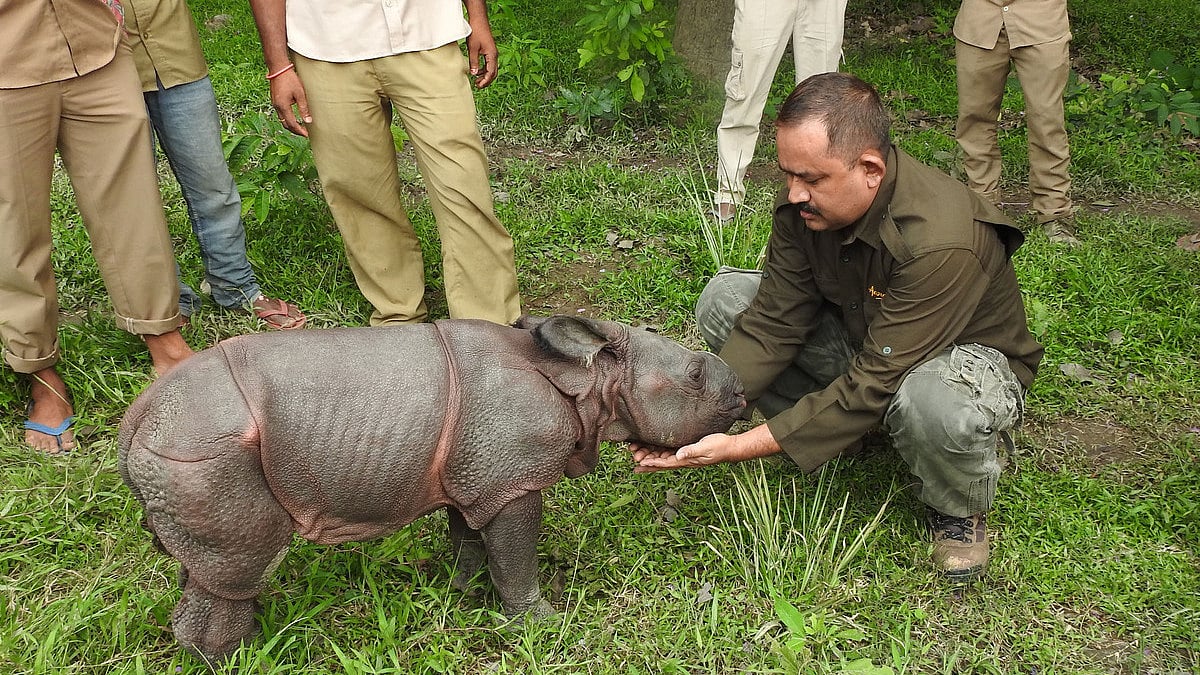
Aaranyak-founder Dr Bibhab Kumar Talukdar with a rhino calf | Bibhab Kumar Talukdar
As the world marks World Nature Conservation Day on July 28, the fight to protect our planet's most vulnerable ecosystems stands at a critical juncture. Few places illustrate the scale of this challenge—and what it takes to overcome it—better than Assam’s Kaziranga National Park.
Nineteen years ago, on May 4, 2007, journalists Adrian Levy and Cathy Scott-Clark published a striking exposé for The Guardian titled "Poaching for Bin Laden." Written after their visit to Kaziranga during a peak period of illegal hunting, the report directly linked the wildlife trade to global terrorism. "In the jungles of India, local animal trappers have a new breed of client: Islamic militants using the trade in rare wildlife to raise funds for their cause," they wrote, revealing how terrorists affiliated with Al Qaeda sponsored poaching in the reserve for profit.
Fast forward to January 2025. Assam's Special Director General of Police Harmeet Singh (who has since become the DGP) echoed these persistent security links while highlighting the state's achievements in curbing wildlife crime.
Kaziranga—a 429-square-kilometre expanse of core dense forest, was recognised as a UNESCO World Heritage Site in 1985. The national park has a rich biodiversity, which includes 480 species of birds, 34 kinds of mammals and 42 varieties of fish—many of which are rare, endangered or near extinction.
Significantly, the years 2022 and 2025 turned out to be rare, historic "no-poaching" years. While the critical role of the state government apparatus cannot be overlooked, independent individuals have also played a vital part in rewriting the fate of conservation in the state.
Anti-poaching efforts go beyond government
One such individual is Dr Bibhab Kumar Talukdar, the founder of Aaranyak—a Guwahati-based non-governmental organisation dedicated to fostering biodiversity conservation across Northeast India.
"The achievement is remarkable and reflects the dedication of the Assam government, forest department, Assam Police especially its Special Task Force, local communities and conservation organisations," Talukdar told The Free Press Journal.
Explaining how Aaranyak plugs into the state's broader anti-poaching network, he noted that the organisation aims to complement government efforts rather than reinvent the wheel. According to Talukdar, collaboration is the true cornerstone of Assam’s conservation model.
A prime example is the Indian Rhino Vision 2020 (IRV 2020) initiative, launched by the Assam government in 2005 with national and international backing. The programme successfully translocated and reintroduced Greater One-horned Rhinos back into Manas National Park between 2008 and 2020.
Talukdar, also served as a member of both the Rhino Task Force of Assam and its Translocation Core Committee.
However, gaining the upper hand against deeply entrenched poaching networks was an uphill battle.
"There was no single solution," Talukdar explained. "The turnaround resulted from the realisation that the rhino horn trade is not merely the trade of a wild animal product or trophy. It has wider consequences for national security. Investigations by the Assam Police unearthed a direct nexus between rhino horn traders and arms smugglers."
Perhaps the most definitive shift was moving from reactive responses to proactive, intelligence-led prevention.
"Assam Police enhanced their vigil in civil areas bordering rhino habitats, where poachers and their illegal arms typically find shelter while waiting for an opportunity to strike," Talukdar said. "This unabated vigil in the fringe areas ensured that containment happened early, intercepting the accused and their weapons before an assault on the rhinos could ever be executed."
Conservation is a constant process
"Conservation success is never permanent. It requires constant vigilance," Talukdar emphasised.
Yet, the battle to protect the forest extends far beyond tracking armed insurgents. There is a deeply human angle to this entire effort, where conservation inevitably collides with complex socio-political realities, from human-wildlife conflict to forest encroachment.
"Conservation cannot succeed without people," Talukdar said. "Every conservation challenge involves ecological, economic and social dimensions. Because of this, dialogue, trust-building and evidence-based decision-making are essential."
The Aaranyak story
When Aaranyak was founded in 1989, Assam was traversing a period of intense socio-political uncertainty, marked by rampant militancy and ethnic unrest.
"Rather than spending my time on larger public issues, including the socio-political unrest, I focused on the grassroots. I engaged local communities, students and young people to instill in them a love for wildlife. I tried to demonstrate that conservation was not merely about protecting animals. It was about securing our water sources, our forests, our climate resilience and our sustainable livelihoods," Talukdar recalled.
Unlike the sprawling, influential institution it is today, Aaranyak had a remarkably humble beginning in Guwahati’s Beltola area, starting out as a modest neighbourhood nature club.
"I never imagined that the small group we set up in 1989 would one day become a premier conservation organisation in Northeast India," Talukdar reflected.
Talukdar’s lifelong dedication has earned him significant global accolades. Most recently, he was elected as a Fellow of the prestigious Linnean Society of London.
A road paved with sacrifice
Reaching this milestone has not been an easy road.
"Every organisation learns through experience," Talukdar noted.
In an environment where funding is notoriously unpredictable, strategic adaptability became Aaranyak's survival mechanism.
"Diversification has been key," he explained. "We have built transparent, high-credibility partnerships with governments, national and international foundations, research institutions, multilateral agencies and responsible corporate partners."
Charting the next chapter
Having built an illustrious legacy, Aaranyak is now actively charting its future path.
"An institution should always be larger than any single individual," Talukdar said. "My aspiration is for Aaranyak to remain a science-driven, professionally managed and globally respected conservation organisation that is rooted firmly in Northeast India."
RECENT STORIES
-
-
-
-
-