Venice Biennale 2026: From Marina Abramović to the Ukraine Pavilion, How The Festival Is Exploring Themes Of War, Memory, Human Connection, & Political Conflict Through Art
Visitors at the Venice Biennale encountered deeply emotional artworks, from Marina Abramović's immersive pieces to tearful moments inside the Ukrainian pavilion. The festival showcased how contemporary art can address war, trauma and healing, with visitors moved by installations centered on memory, endurance and the human cost of conflict.

Deviina Dalmia, who is presently at the Venice Biennale, gives us a low-down on some of the interesting stuff happening there. Her diary is filled with intense observations and anchored by her knowledge and understanding of the art world. She has beautifully narrated and penned her day in a written blog with visuals. Scroll down to get a glimpse of her highlights from Day 2 at the Venice Biennale.
Marina Abramović: The first living woman artist to receive a major exhibition at Gallerie dell'Accademia
Before you enter Gallerie dell'Accademia, they ask for your phone. Then, your watch. A figure in a white coat appears beside you like a secular priest and you surrender both, and something happens immediately — a loosening.
The world I carry everywhere: the schedule, the messages, the next appointment, simply stops. Mark Sanders guided our group through the show with the gravity it deserves: Abramović at 80, the first living woman artist to showcase across the entire Accademia, placed in conversation with the Renaissance masterpieces that built this institution. The significance of the gesture is not lost on anyone who has stood in these galleries before.
Her Transitory Objects — crystal beds embedded in stone — invite you to lie down and close your eyes. The room is dark and very still. You absorb what she calls energy transmission, and whether or not you believe in crystals, you feel something. Nearby, Pietà (with Ulay) (1983) hangs in direct dialogue with Titian's final, unfinished masterpiece from 1576 — on the 450th anniversary of that painting's creation.
The temporal logic of it — two Pietàs across four and a half centuries, the human body as the site of both suffering and elevation — lands with full weight. Across the galleries, the TAEX digital avatar of Abramović at 60 moves slowly through a 30-metre projection: a lifelike digital twin enacting the Slow Walking exercise, infinitely, looping presence into permanence. I felt a little naked. I also felt, reluctantly, completely calm. I am grateful to Saatchi Yates and Soho House for making this possible.
Lunch at Antica Locanda Montin
The red room at Antica Locanda Montin — one of the most Venetian rooms in Venice — was set for the Soho House and Saatchi Yates members in town.
I could spot a long communal table, purple alliums in small vases, candlelight at midday, my name on a card beside a blue photograph of Marina's face.
Spaghetti al pomodoro arrived and the world very slowly re-entered. The conversations around the table were of the kind that only happen here: collectors, curators, writers, all still carrying whatever the exhibition had done to them. Nobody checked their phone. Not immediately. It was, in the context of this Biennale, an act of solidarity.
A Necessary Fiction: Maps, Art, and Models of Our World (Saudi Pavilion, Curated by Sara Almutlaq & Aurora Fonda, Commissioned by the Saudi Ministry of Culture)
The courtyard alone — Gothic windows above, a large steel ring suspended mid-air between ancient brick columns — tells you something serious is about to happen.
Inside, Reena Saini Kallat's Woven Chronicle (2019, ongoing) occupies an entire wall: a monumental world map constructed from coloured barbed wire and yarn, speakers embedded in the continents, balls of thread fallen to the floor like a world mid-unravelling. Beautiful at a distance. Painful up close. The violence and the tenderness are inseparable.
In a separate room, Shilpa Gupta's 100 Hand-drawn Maps of Italy (2007–2023) hums quietly — a fan turning the pages of a sketchbook, each a hand-drawn map, imperfect and human. The repetition is the point. The show also brings together Yoko Ono, Trevor Paglen, Ahmed Mater, and a remarkable international roster. Maps as fictions. Borders as arguments. A show that earns every syllable of its ambition.
The best show outside the Biennale: Lee Ufan - SMAC Venice (Curated by Jessica Morgan & presented by SMAC, founded by David Hrankovic)
There are shows you walk into knowing they will stay with you, and this is one of them. David Hrankovic — founder of SMAC, one of the most discerning eyes working in the art world today — has brought Lee Ufan to the San Marco Art Centre at the Procuratie for what curator Jessica Morgan has assembled as the most complete survey of the artist's six-decade practice I have encountered anywhere. I was at the opening cocktails. I met Lee Ufan himself. He is quiet and precise in person.
The rooms move chronologically, beginning with the groundbreaking From Point (1978) and From Line (1980) canvases — cream-coloured fields holding single or repeated blue brushstrokes, loaded dense at the crown and fading as the pigment depletes downward.
To make these works, Lee laid his canvases on the studio floor and held his breath as he discharged the brush — the breath, the gravity, the physical commitment of the body all present in the mark.
The Correspondence series that follows offers vast white fields interrupted by one or two discrete gray-blue strokes, the unpainted space the real subject, absence doing the heaviest work.
The Response series — his most recent — brings warm amber and rust forms breathing on white grounds, colour finally permitted to be a protagonist.
And then, Relatum (formerly Iron Field, 1969/2026) — thousands of steel rods standing upright in a bed of sand, their surfaces catching the light like a field of silver grass, reconfigured specifically for this space, shown for the first time since Dia Beacon in 2019.
Alongside it, a work in white gravel and granite boulders whose reflections are caught in a dark mirror channel running through the room. Lee has said: "When you look at my paintings, you can feel the breathing and the rhythm." Standing in these rooms, you understand that the whole show breathes. David Hrankovic built something extraordinary here. I am still thinking about it.
The finest show at this Biennale: Still Joy - Ukrainian Pavilion
I did not expect to cry in the Ukrainian Pavilion. But I did not expect Hlib Stryzhko's account — printed on a shaped panel in a room of near-silence — of a Russian conscript guard who, having discovered a shared connection to the same Ukrainian village, secretly placed a strawberry chocolate bar under his prisoner's leg and whispered: Let it warm up first, then eat. You must be hungry.
Hlib had lost several teeth in captivity, some pulled, others knocked out. The guard placed the chocolate carefully. In a city full of pain and fear, he writes, this small act of kindness gave him a joy he still remembers by its exact taste.
Illa Senchenko's testimony hangs nearby: a veteran of the Armed Forces of Ukraine who survived Russian captivity and returned on January 4, 2022. She writes about joy as an act of resistance: Feeling joy in spite of everything is a strength.
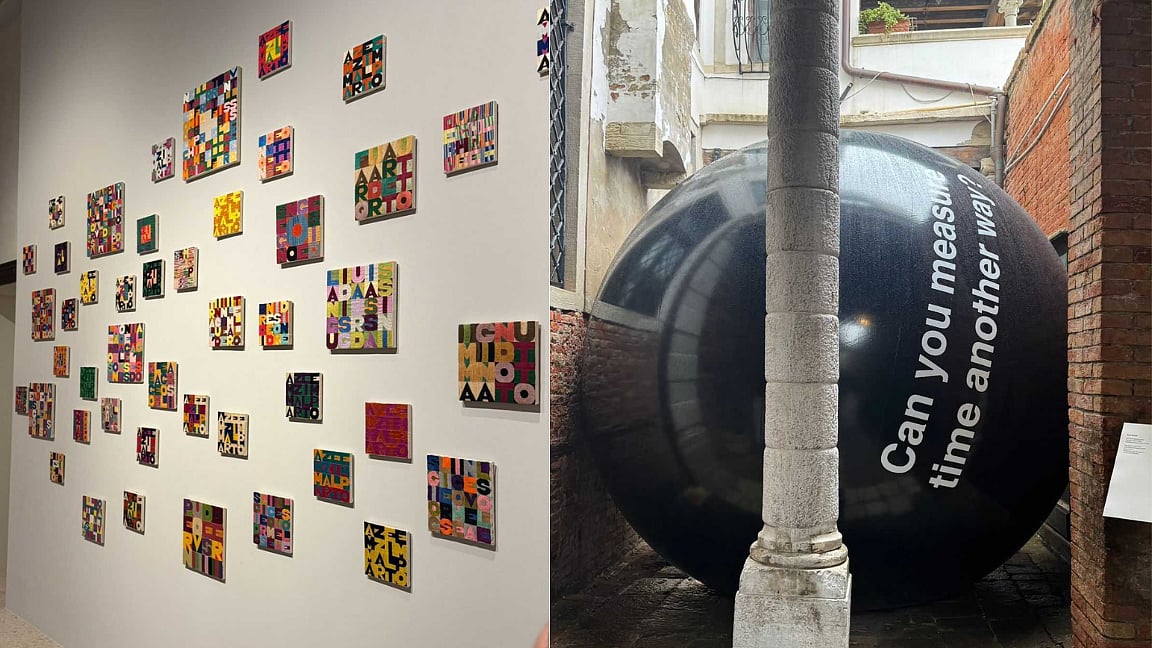
The show builds these individual testimonies into something collective — thousands of brass bells suspended on golden threads over a bed of sand, cascading like a frozen wave in a room hung with Flemish tapestries; a corridor of candy-coloured chandeliers, pastel and absurd and heartbreaking; a black sphere wedged in the courtyard asking, "Can you measure time another way?"; a cabinet of old rotary telephones, each cord hanging limp; large LED screens of women's faces, raw and enormous and close. Niall Ferguson's words on the walls about joy as a weapon of liberation in wartime. This is the show of the Biennale. It is art made from the exact weight of what it costs to remain human during war.
Protesters at the Russian Pavilion
The Russia Pavilion has been contested, every opening since the war began, and this year was no different. All day, protesters gathered outside the sage-green building in the Giardini — banners reading "Venice Biennale = Whitewashing Russian Crimes" and "No EU Money for Biennale with Russia," people in Ukrainian military camouflage holding flags.
During the opening performance, protesters threw milk and parmesan at the performers and audience. The white substance was still pooled on the herringbone floor when I arrived — music stands still standing in the silence. Police eventually blocked entry entirely.
And yet — inside, there were only flowers. A monumental installation of roses, peonies, alliums and trailing greenery hanging suspended from the ceiling like an inverted garden; young conifer trees placed throughout the rooms in ceramic pots; and a sound sculpture by Tatiana Khalbaeva, an artist of Buryat origin — a Mongolic people from a republic within Russia — who recorded the near-silence of deserted villages in Buryatia, her ancestral homeland she has barely lived in.
The work is called I Remember Where to Grow. It is about fragments of belonging, about the acoustic landscape of a place you carry in you without ever quite knowing it. The recordings were made in winter, when snow absorbs sound and the world becomes quieter, denser. The flowers, the trees, the silence, the protesters outside, the powder on the floor: all of it held in a tension the pavilion could not resolve. That too is a form of honesty. A romantic melancholy was the only available response. I felt it.
Dellaluna: Cocktails at Fortuny + Chahan (Hosted by Louvre Abu Dhabi & Dellaluna, with Silvia, Founder of Dellaluna)
Venetian interiors that remind you why this city exists: a private palazzo of impossible elegance, its rooms filled with extraordinary objects — monumental organic textile works layered in silk, embroidery and found material; sculptural wall pieces in bold concentric stripes in every colour imaginable; African ritual objects beside an expressionist canvas beside a Murano glass creature in amber and red.
Silvia, who founded Dellaluna, and whose bags I had chosen for today, is the kind of host who makes a room feel like a private discovery. Louvre Abu Dhabi co-hosted with a lightness and intelligence entirely befitting the institution. I wore the bag. The art on the walls deserved more time than the evening allowed.
RECENT STORIES
-
-
-
-
-