Tea Estate Inside A Wildlife Sanctuary? This Assam Experience Is Straight Out Of A Dream
A day at Amchong Tea Estate tells Assam’s tea story in myriad ways, from an immersive journey of plucking leaves to savouring flavours, all within reach of Guwahati

The road to the Amchong Tea Estate begins with a quiet detour. A veritable threshold between two very disparate worlds, if you may. On the outskirts of Guwahati, my car slowed at the gates of the Narengi Military Camp, where entry is monitored and approved briskly. Beyond it, the city loosened its grip. The air shifted, the traffic thinned, and the terrain began to breathe.
Soon enough, the road disappeared into the folds of the Amchang Wildlife Sanctuary, a forested stretch known for its wild elephants. It felt improbable that a working tea estate lay within this protected wilderness, yet there it was—Amchong, spread across rolling green, its contours shaped by decades of cultivation and care.
Morning above the hills
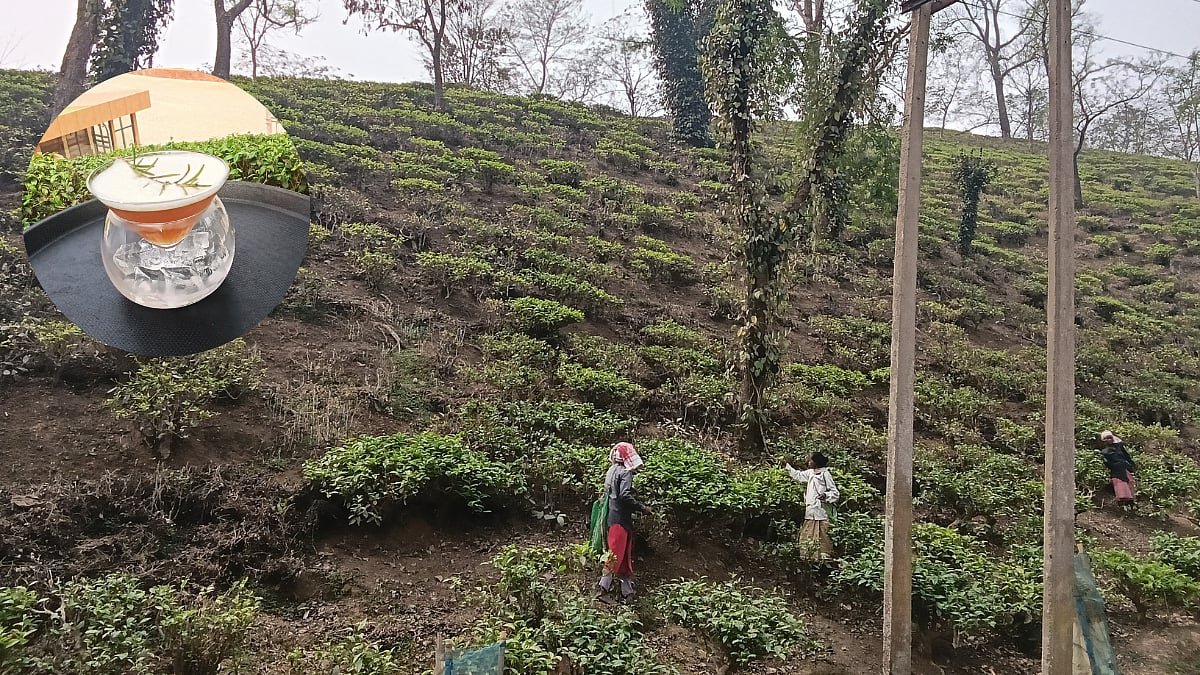
The day began at a hilltop gazebo, where breakfast arrived with a view that needed no embellishment. Below me, tea bushes unfurled in neat rows across slopes softened by mist. The quietude was punctuated only by birdsong and the occasional rustle of leaves.
This was not simply a visit; it was an introduction to a new kind of day trip, one that invites travellers to step into the quotidian rhythms of a working tea estate. Amchong, established in 1958 and now run by a third generation, has evolved into more than a production hub. It is an experience—one that moves from land to leaf, and finally, to cup.
From the gazebo, I descended into the estate for a guided drive. The plucking process, so often romanticised, revealed its precision up close. Workers moved with a practised ease, selecting only the right leaves and buds. There was no haste, only a steady understanding of what makes good tea begin at its source.
Crafting perfection
The estate’s new tea tourism initiative centres around what it calls a “leaf-to-cup” journey, and nowhere is that more evident than in its factory. A short drive brought me to a state-of-the-art processing unit, where freshly plucked leaves begin their transformation.
Inside, the air was warm with the scent of oxidation. Machines hummed steadily as leaves were withered, rolled, and sorted. From robust CTC teas to more nuanced Orthodox varieties, the process was both industrial and intimate—each stage carefully monitored to preserve character.
A viewing gallery offered a clear look at the production floor, while an adjoining audio-visual installation traced the history of tea in India and Assam. It spoke of colonial beginnings, of indigenous knowledge, and of estates like Amchong that have sustained and adapted across decades. Since the 1970s, the estate has produced over a million kilograms of tea annually, yet it now leans into smaller, refined batches as well.
What stayed with me was the diversity of teas grown here. The prized P126 clonal variety yields golden and silver tips—delicate, aromatic, almost silk-like in flavour. Seed varieties like P491 and P520 deliver the robust body Assam is known for. There are experimental plantings too, including a Darjeeling-native R94 and drought-resilient TV23/22 bushes, quietly preparing for a changing climate.
The experience culminated in the tasting room, where tea shifts from product to expression. Here, I was invited to blend my own infusion. I chose a base of Assam tea (what else!?) and added notes of strawberry and lemongrass—fragrant, slightly playful, yet anchored by the depth of the leaf. It was a small act, but one that revealed how tea can be both rooted and even whimsical at the same time.
Tea on a plate?
Lunch awaited at Steep House by Amchong Leaf, the estate’s brand new restaurant and experiential extension. Designed to echo the undulating lines of the plantations, the space felt open and grounded. Bamboo screens filtered light, rattan textures softened the interiors, and the boundaries between indoors and garden seemed almost irrelevant.
Steep House is built around the idea that tea is not just a drink, but an ingredient, a philosophy, a way of structuring a meal. The menu reflects this with quiet confidence.
I began with a tomato and chamomile soup, slow-cooked and layered, its floral note lifting the familiar comfort of tomato. A matcha hummus with pita chips followed—earthy, smooth, and unexpectedly well-balanced.
The mains leaned into both Indian and global influences. The Assam tea peri peri paneer tikka carried a gentle smokiness, the tea acting as a subtle binder to the spice. A jasmine chicken tikka arrived charred at the edges, its marinade fragrant, paired with a fresh pineapple chutney that cut through the richness.
There were other dishes I lingered over—green tea jalapeño croquettes with a hint of heat, and dumplings laced with Earl Grey in a creamy sauce. Even the prawns, served with oolong accents, carried a quiet nod to the estate’s produce.
Dessert was inevitable. A matcha cheesecake offered a soft, earthy finish, while a jasmine and lemon tiramisu brought a brighter, citrus-laced note to close the meal.
What stood out was not novelty, but provenance. The kitchen works with ingredients grown on the estate itself—herbs, flowers, and greens that root the menu in its surroundings.
Quiet return
By late afternoon, the light had shifted again. The same hills I had seen at breakfast now wore a different tone—less mist, more clarity. It was time to leave, though the estate seemed in no hurry to let go.
Driving back through the sanctuary and past the military gates, the city gradually returned. Yet elements of the day lingered in my mind. The care in plucking a leaf, the patience of processing, the thought behind a cup of tea.
Amchong is not far from Guwahati in distance, but it offers a shift in perspective. It forced me to realise that in Assam, tea is not merely consumed; it is lived, shaped by both terroir and time. And for a day, I was privileged to have stepped into that world.
(The writer is a food and travel columnist and editor)
RECENT STORIES
-
-
-
-
-