Remembering Vijaya Mehta: Theatre Legend Who Transformed Indian Stage
From pioneering Marathi theatre to shaping generations of actors and directors, a heartfelt tribute to the remarkable legacy of Vijaya Mehta

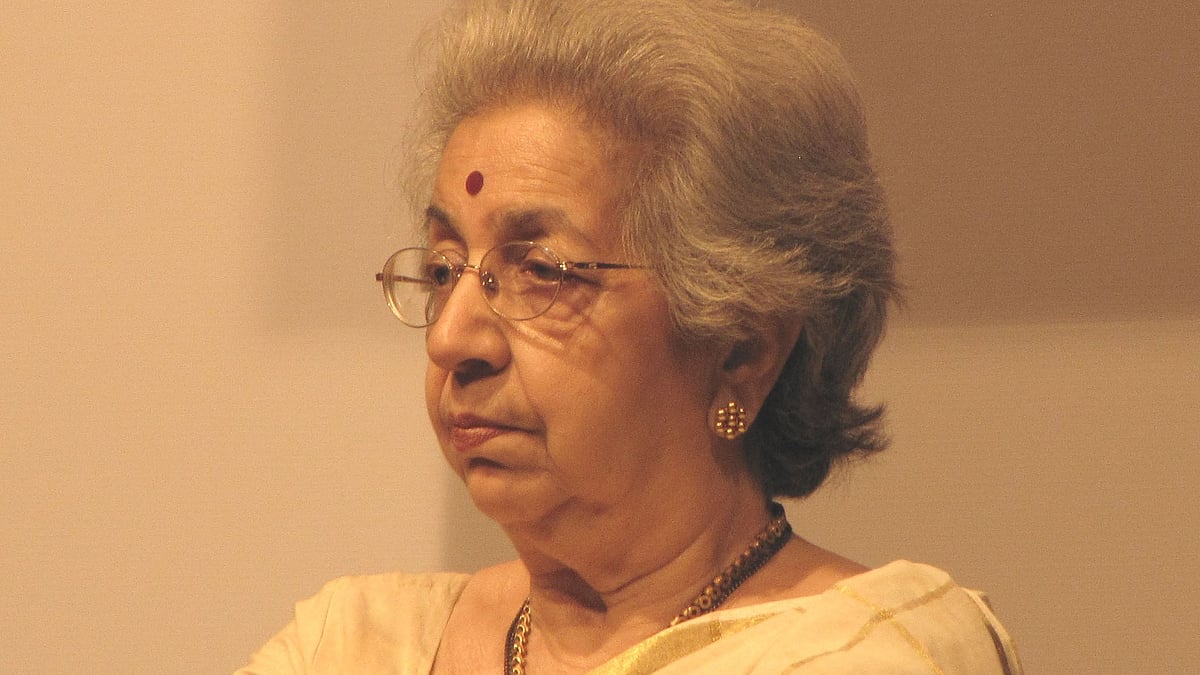
Pic: Wikipedia
Bai!
Actually, a word that can mean any woman… but for most of us, especially Marathi, Hindi, German theater people, it meant only one person – Vijaya Mehta.
It’s difficult to write an obituary for a person who defined electrified living till a few months ago. On November 4th, on her 91st, Nana Patekar, Bharati Achrekar, and Nina Kulkarni visited her. They were among her favourites, always. They were a part of one of the pathbreaking plays she directed – Hamidabaichi Kothi. A play based on kothas – not prostitution but as singers and dancers – was written by Anil Barve. It was a play written on the topic long before people experimented with Umraao Jaan or Mandi. Achrekar and Kulkarni posted a picture of four of them taken during an impromptu visit on Bai’s birthday. Bai’s smile in it was so infectious that it made me give a cheshire cat smile just looking at it; bringing back moments of her signature sarcastic humour.
Vijayabai, probably, was the last of theater doyens in India. A personality who shaped Indian theater movement, across the country, along with masters like Alkazi, Vijay Tendulkar, PL Deshpande, Arvind Deshpande, Girish Karnad and others.
Vijaya Mehta nee Vijaya Jaywant started her career in theater pretty early. Adi Marzban, Ibrahim Alkazi and Durga Khote were her early Gurus in theater. Dr. Bhalerao of Sahitya Sangh, Girgaon was another who helped nurture the passion for theater. Very few are aware that she was also a part of Rashtra Seva Dal – the organization headed by Sane Guruji at that time. She actively participated in cultural programs of Seva Dal which were organized to pass on the message of freedom for India.
It was Durga Khote who recognized the directorial talent in Vijaya Jaywant or Viju as she was often addressed in her younger days. Vijaya always looked up to Durga Khote and minutely observed everything that the senior actress did in theater or on screen. It was during the runs of a Sahitya Sangh play that Durga Khote called young Viju and told her that the time had come that she should now concentrate more on direction. And soon Adi Marzban sent the script of Shrimant, written by Vijay Tendulkar, to Vijaya with Damu Kenkare; with a message that she should read the script as soon as her exams were over.
Shrimant was the first play directed by Vijaya Mehta nee Vijaya Jaywant in which she also played the lead role. “You have made me proud” were the words of Adi Marzban after the first show (as mentioned in Vijaya Mehta autobiography – Jhimma). She mentions in the autobiography that it took a while for her to stress her authority as a director and was quite often in tears because the fellow actors didn’t listen to her. (sic)
Durga Khote played another important role in Vijaya Jaywant’s life. She initiated the match of Vijaya with Harin, her son. And soon Vijaya Jaywant was Vijaya Khote. However, Harin died quite early leaving Vijaya with two sons. It was again Durga Khote who gently, but firmly, pushed Vijaya back into theater. And later encouraged her to remarry Farokh Mehta.
Vijaya Mehta was one of the very few theater personalities who not only transcended language boundaries but also the barriers of media genres and countries. She was the first to experiment with the German theater artists by directing the German version of Mudrarakshasa a Sanskrit play by Vishakhadatta, which she had directed in India. Despite all possible challenges that came her way, she went ahead with it and came back after a very successful Germany tour.
As a director and as an actor, Vijaya Mehta did many professional plays which can be called path-breaking. Shrimant, Shitu, Ek Shunya Bajirao, Sandhya Chhaya, Hamidabaichi Kothi, Barrister, Jaswand… to name a few. As she once admitted, it was somewhere between the amateur Rangayan and professional plays that she became ‘Bai’ from Vijaya Jaywant, Vijaya Khote and Vijaya Mehta.
A theater actor and director by heart and profession, but Vijaya Mehta took a leap into Hindi films as an actress in 1981. She played an important role in Kalyug directed by Shyam Benegal. In 1986, Vijaya Mehta directed her first film based on a very successful Marathi play directed by her – Barrister, written by Jaywant Dalvi. While she continued to play the elderly widow in the film, she chose Anupam Kher instead of Vikram Gokhale to play the protagonist. She did a few more films like Pestonjee and also acted in Govind Nihalani’s Party.
Vijaya Mehta took over the reigns of NCPA as a Director when PL Deshpande stepped down. She admits that it was Jamshed Bhabha who coaxed her into doing that, despite her own apprehensions about being able to step into such big shoes. She was always a PL fan and had performed as an actress in her earlier days in his direction. She found it difficult to imagine filling his shoes as the Director of such an organization.
But Bhabha was insistent. Vijaya Mehta took the position offered to her. Her theatrical experience and being a music aficionado helped her steer the ship in many ways than more.
In her biography, Vijaya Mehta credits Jamshed Bhabha and legendary Marathi literary publisher SP Bhagwat for pushing her to write her autobiography. And she admits that she was a wee too late in listening to them as they had already passed away by the time the book was published.
My first encounter with her was during Nagamandala written by Girish Karnad. I had seen quite a few plays directed by her and where she had played the protagonist. Her stylized acting and nuance-oriented direction had always fascinated me. I was auditioning for a role in Nagamandal. I was selected and even did a workshop with her. The workshop not only taught us theatrical tricks but also corrected our body language and postures otherwise, amongst other things.
However, I didn’t end up doing the play. Reason being, to quote Vijaya Mehta – “Injuring her leg, yet another time!”
This was sometime in 1990. And despite my not doing the play, Bai stayed in touch. We might not have met so often, Bai sporadically connected, scolded and encouraged me last 36 years. She was proud of me when she read my book on Pandit CR Vyas. “You have taken up a herculean task,” she had warned me when she heard that I was writing the biography of the legendary Indian classical singer. “You better do him and me proud with what you end up writing!”
Vijaya Mehta alias “Bai” I was already missing our sporadic tele-conversations since you stopped taking calls last few months.
Now, I will miss them permanently. Thanks for everything.
Why do I feel that you have your signature smile on your face while you read this, with a sure shot typically “you” comment, and you are joined by PL Deshpande as you do so?
RECENT STORIES
-
-
-
-
-