FPJ 98th Anniversary: How Maharashtra's Handloom Weavers Are Keeping India's Textile Heritage Alive
From Paithani and Himroo to Solapur chaddars, Maharashtra's master weavers continue to preserve centuries-old traditions through every handcrafted thread

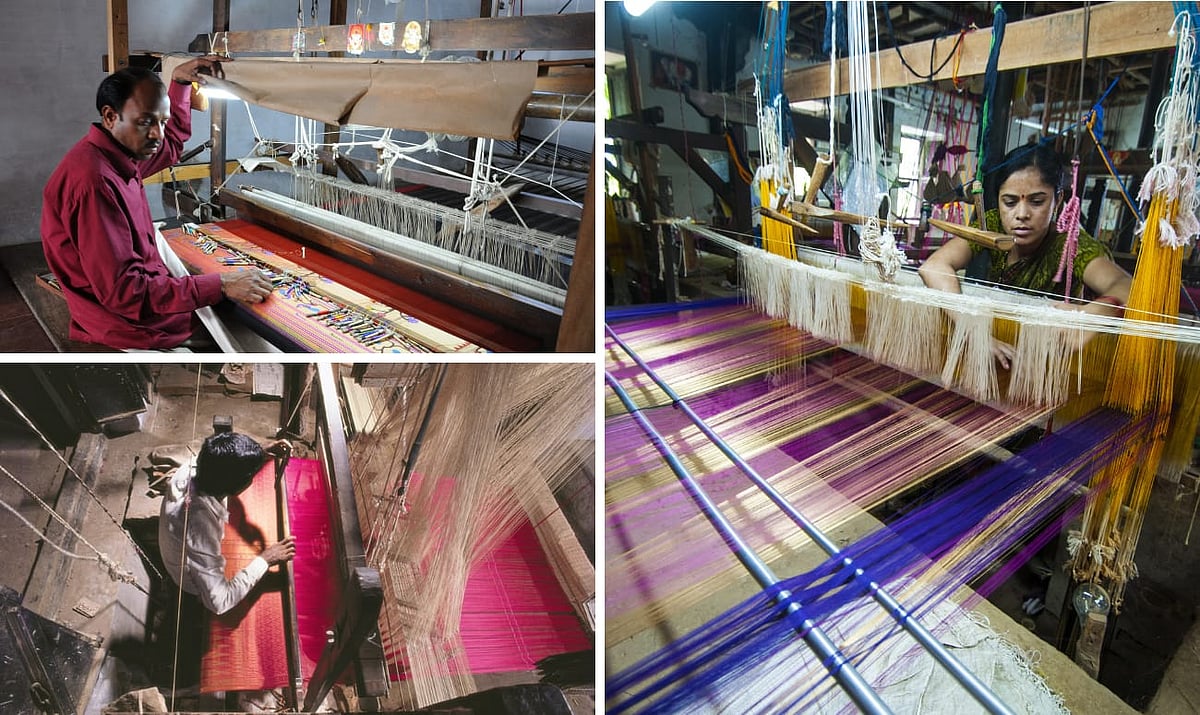
Long before the clarion call for vocal for local, atmanirbhar Bharat (self-reliant India), Kaushal Bharat (Skilled India), the weaving and the artisan communities of the nation became the torchbearers of homemade goods and services in the nooks and corners of their modest homes. Their family-run occupation and trade have not only sown the seeds of earthy aesthetics over the years but have also kept the cultural pride of India — heritage craftsmanship — alive forever.
The Maharashtrian tribe
Maharashtra, a thickly populated and the third-largest state in western India, has been nurturing and springboarding its local skilled labour and indigenous handloom right from their genesis in the factory to a massive display and large-scale sale at the emporiums and crafts councils.
With the invention of handlooms in erstwhile ages, the weaving art came into existence as one of the early artistic expressions and manifestations. Maharashtra’s handloom huts represent one such citadel of technical craft.
Statewide picture
Shedding light on the current condition of the handloom industry in Maharashtra, marketing consultant Saurabh Khanorkar of Indrayani Handlooms (Nagpur-based bonafide government-backed handloom brand spearheaded by the Maharashtra State Handloom Corporation (MSHC) Ltd.) said that “now the status of the sector looks quite stable and impressively promising”.
Much opposed to the common perception that attaches ‘a bleak scenario’ tag to such domestic arenas, the state-specific handloom industry emerges as an integral part of its cultural landscape and folklore.
“Although it has its fair share of stumbling blocks in the form of competition from power looms, rising raw material costs and a shortage of skilled weavers, the sector continues to survive through government funds, cooperative societies, design innovation and an increasing consumer interest,” informs Khanorkar.
Recent findings disclose that the Maharashtra handloom industry supports roughly above 2,800 registered handloom weavers. According to Fourth All India Handloom Census 2019-20 update from the Ministry of Textiles, there are 2,882 handloom weavers, 627 allied workers and 3,509 total handloom workers.
Weaver birds
They are like the master tailor birds spinning and sewing the yarns nonstop. Do weavers enjoy fair-labour practices in terms of working conditions, wages and working hours or do they have to fight to overcome their plight and predicament?
“In my view, a marked progress has been made, which is perceptible. Having said that, there is still a long way to go in terms of challenges that daily labourers face on a regular basis. A weaver’s skill is priceless, yet the earnings he relies on to run his kitchens often belie the hours he devotes and the craftsmanship he puts in behind every specimen,” grouses Ashwinii Ahher, founder of Toshani Enterprises, an MSME registered company dealing in multiple business lines.
The basic process of making a handloom woven saree is elaborate. “It begins with selecting and preparing the yarn, followed by dyeing, drying, warping and setting up the loom. The weaver then hand-weaves the saree, incorporating intricate borders, motifs and the pallu. After weaving is done, the saree undergoes finishing, quality inspection and packaging,” narrates Gangadhar Gajbhiye, joint managing director, MSHC.
“Depending on the complexity of the design and the intricacy of the weave, a handloom saree may take seven days (or a week’s time) to six months to complete. Highly intricate Paithani sarees may require even longer periods,” he updates.
“Normally, one or two master weavers work on the loom itself for a single creation, further assisted by adroit artisans handling preparatory stages like dyeing and warping,” sums up designer Rima Mishra who works on handloom weaves and is founder of her namesake fashion label.
Designer take
Walking us through the method of fashioning a Maharashtrian handloom weave, designer Gautam Gupta of Asha Gautam label says “We first develop a concept, study possible motifs and understand how those ideas can realistically be translated into weaving. Detailed artwork is then prepared before discussions start with the master weavers. For example, a Rangkat Paithani saree can take eight to nine months in weaving. Once woven, some pieces may be accentuated with polished embroidery or other handcrafted techniques but the weave itself always remains the hero,” he expands.
Couturier Gaurang Shah emphasises that “every handloom creation, say a saree, takes shape from an idea, followed by a detailed design development. Colours are selected, yarns are dyed and the loom is prepared. This process itself is time-consuming. Warp setting, graph preparation, border planning and motif calculations require tremendous meticulousness and exactness. Once weaving begins, each motif is inserted by hand. Every inch reflects patience, discipline and human skill.”
Fashion pundits incorporate a slew of specialities in their handloomed creations in terms of patterns, colours, motifs, textures, techniques of weaving the yarns, etc.
Indian sarees, the caskets of attractive handloom pieces still draw accolades worldwide. They are worn as a heritage badge on the collar to be proud of and are seen as flagbearers on an international stage.
RECENT STORIES
-
-
-
-
-