Did You Know Darkness Is Utah’s Biggest Attraction? Explore Its Magical Night Skies
From stargazing beneath star-studded skies to exploring Dark Sky Parks, a journey through Utah reveals why preserving natural darkness matters

Utah |
The sun has set behind the towering sandstone cliffs hours ago, but our guide insists the day isn’t over yet. Driving into the wilderness when barely anything is visible to the naked eye seems an odd proposition. “What you can’t see in the big cities, you can see here,” he says.
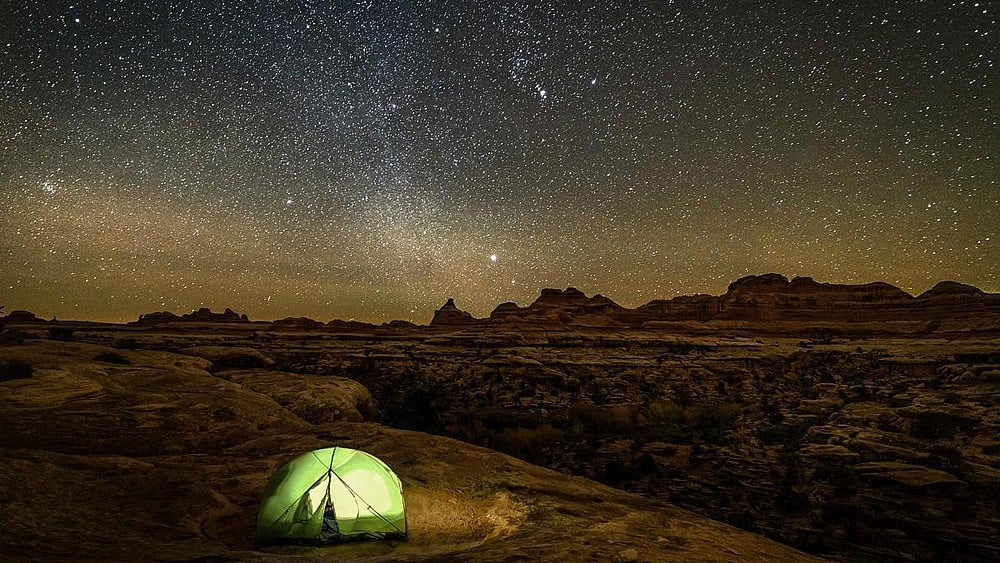
When we signed up for a road trip across Utah’s rust-red, cinematic landscapes, escaping insufferable AQI levels was the plan. Little did we know we’d find ourselves perched on a rocky ledge at night, staring into a pitch-black sky dotted with a few twinkling stars. We patiently set up our camera and, after a couple of long attempts, its screen finally lights up with an astonishing multitude of stars!
The realisation that this sprawling darkness holds the very origins of our existence is humbling. Studies on the psychology of awe suggest that such experiences make us less self-absorbed and more considerate of others. Perhaps that is why stargazing holds particular relevance in our increasingly chaotic lives. Under an infinite sky, even our seemingly overwhelming worries begin to assume smaller proportions.
Conversations with our guide reveal just how much of the night sky is already lost. We learn that more than a third of humanity cannot see the Milky Way from where they live. And in the past decade, night skies have been getting brighter by nearly 10 per cent annually.
Constellation of dark-tinations
Utah has played a pioneering role in the global movement against light pollution. In 2007, the protected Natural Bridges National Monument in San Juan County became the world's first International Dark Sky Park. Today, Utah has one of the highest concentrations of internationally certified dark-sky destinations. These include all five of its countryside national parks and even Antelope Island State Park on the outskirts of Salt Lake City.
A glance at this western US state’s dark-sky map reveals that our driving route takes us into the heart of this movement. While sparsely populated stretches may be naturally conducive to stargazing, preserving their skies requires considerable effort.
The small town of Torrey in Wayne County became Utah’s first International Dark Sky Community in 2018. Residents crowdfunded to have their streetlights direct illumination downwards instead of scattering it towards the sky. Their aim is to use outdoor lights judiciously only where needed, at appropriate brightness levels, and preferably in warmer hues.
Further south, Bluff, a town with only 240 residents, has been organising annual ‘star parties’ since 2016, with telescope-viewings, conservation talks, and retelling of star-stories from the region’s Indigenous people. Such public participation, alongside lighting regulations and other ordinances, helped Bluff earn its community certification in 2025.
Looking beyond the landscape
At Capitol Reef National Park, we spend the day exploring the soaring walls of Grand Wash and hiking up to the magnificent Hickman Bridge. But, as the US National Park Service proclaims, “Half the Park is After Dark!” – and indeed, an entirely different world awaits us after sunset.
The night comes alive with creatures such as kangaroo rats, ringtails, owls, and several species of bats. Artificial glows can disrupt their feeding patterns and expose them to predators. It also disorients migratory birds and interferes with the behaviour of nocturnal insects. For protected wilderness areas, dark-sky certification thus entails monitoring sky brightness, managing illumination levels, and sensitising visitors to the significance of natural darkness.
We are surprised to find that all of Utah’s national parks are open to visitors throughout the night. Exploring them after dark, however, comes with its own rulebook. This includes watching out for wildlife on the roads, keeping to designated trails, and using artificial lighting sparingly.
At Arches National Park, home to over 2,000 natural arches, even illuminating these grand sandstone formations for photography is prohibited. The most striking views, after all, are of star-studded skies framed by the arches’ silhouettes. It takes our eyes nearly half an hour to adjust substantially to the darkness. The longer we wait, the more stars we begin to spot. In this delicate environment, even a single torch beam or camera flash can undo much of this adjustment.
Value of nothingness
Our guide shares how the US National Park Service formally recognises natural darkness as a protection-worthy resource, much like forests, wildlife, and geological formations. An entire astrotourism industry is emerging around it, with stargazing excursions, astronomy festivals, and accommodation catering to skywatchers creating new avenues of income for rural communities. Its economic potential is considerable, with a 2019 study projecting that dark-sky tourism could generate approximately USD 5.8 billion in spending across the Colorado Plateau over a decade.
The idea that exercising restraint in construction and illumination can create sustainable income presents a curious contrast to our approach back home, where conspicuous ‘development’ and excessive lighting have increasingly become visual markers of progress. India’s hinterlands are blessed with dark skies, yet growing affluence threatens their presence. Encouragingly, conservation efforts are gathering momentum – from India’s first Dark Sky Reserve at Hanle in Ladakh to the Dark Sky Parks in Pench Tiger Reserve and in Tamil Nadu’s Kolli Hills.
For urban-fatigued travellers like us, the simple pleasure of looking up clearly feels deeply enriching. Should a shooting star streak across the sky tonight, we know exactly what to wish for.
RECENT STORIES
-
-
-
-
-