When AI Joins The Workforce: What Leaders Must Do To Adapt
AI is shifting enterprises from copilots to agentic systems that act within workflows, raising leadership issues of autonomy, accountability and relevance. Ravi Kumar Dikshit (Kyndryl) urges decision-led AI strategy, workflow redesign, and clear human-AI roles. Value comes from scaling beyond pilots into governed enterprise execution. at enterprises

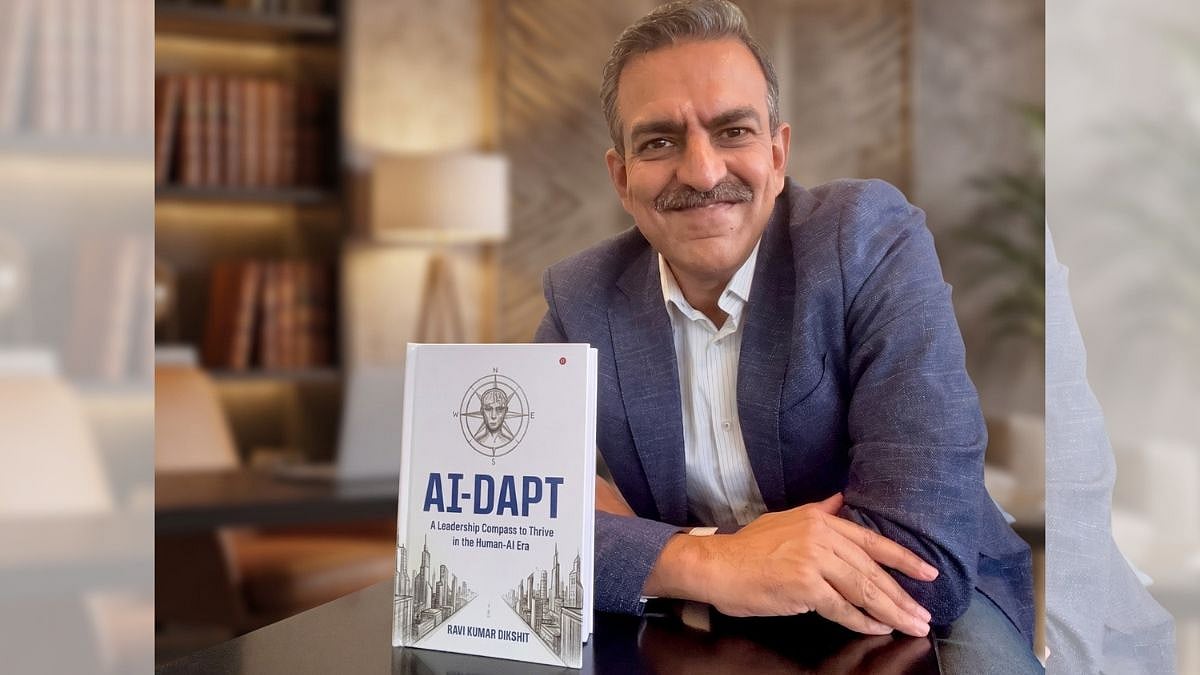
When AI Joins The Workforce: What Leaders Must Do To Adapt | file photo
AI is entering a new phase inside enterprises. The conversation is moving from copilots and productivity to agentic systems that can plan, act, use tools and trigger workflows. That shift changes the leadership question itself, because the harder decision now is where AI should act, how much autonomy it should have, and how humans will keep ownership and control of the outcomes everyone is still accountable for. I sat down with Ravi Kumar Dikshit, Global Leader at Kyndryl and author of AI-DAPT: A Leadership Compass to Thrive in the Human-AI Era (available here), to speak about what leaders must do to adapt to this new world.
You have seen many technology shifts. What feels different about this AI moment?
Earlier waves changed the enterprise around the work itself. ERP standardised our processes and cloud changed the scale we could operate at, while digital opened up customer access, automation removed repetitive effort and analytics gave us visibility we never had before.
AI is different because it is entering the cognitive layer of work. With agentic AI, systems have moved well past assisting humans, because they can now pursue goals, call tools, move across steps and operate with some level of autonomy, and they get better at it every day.
That changes the leadership challenge. AI is moving closer to the places where options are prepared, trade-offs are surfaced, and actions may be triggered. Yet the final judgement, the accountability and the responsibility for outcomes still remain human.
What are leaders most anxious about now?
The fear I hear most often is about relevance.
For many professionals, expertise was built over years. They had seen situations, solved problems, read signals and developed judgement. Now someone using AI well can produce a strong first-cut view in minutes, and that can feel unsettling.
That does not make experience irrelevant though. It simply changes where experience matters, because the premium shifts from producing the first answer to judging the right answer, shaping the context and owning the consequences.
Another worry is learning. AI is changing so fast that many leaders feel they are falling behind no matter how many newsletters they subscribe to. Trying to learn everything is the wrong goal here. What actually works is building a rhythm to sense what is changing, synthesise what matters and apply it back into real work.
What is the biggest shift leaders need to make in AI strategy?
Leaders need to move from AI activity to decision-led AI strategy.
A real AI strategy should not start with “what use cases can we do?” It should start with three sharper questions. Which decision will AI change? Where does that decision sit in the workflow? Which business metric should move because of it?
Most organisations do not have an AI idea problem. They have a prioritisation problem. It is easy to generate a long list of AI use cases, and it is much harder to decide which ones deserve leadership attention because they change a high-value decision, sit inside a critical workflow and create measurable business impact.
A useful lens here is Do Less, Do More, Do Differently. Do Less removes repetitive work. Do More augments human capability and improves quality, speed and reach. Do Differently changes the workflow, the business model or the customer experience itself.
Most organisations start with Do Less because it is easier to measure, while the bigger strategic value often sits in Do More and Do Differently.
Where do AI programmes typically get stuck?
I see this as the gap between proof-of-concept and operating value. The Kyndryl 2025 Readiness Report captures this well: 57% of leaders say innovation efforts often stall after proof-of-concept, while 61% feel more pressure than a year ago to prove ROI on AI.
Stanford’s Enterprise AI Playbook reinforces the same point. In its study of 51 successful AI deployments, 77% of the hardest challenges were around change management, process redesign and data quality. The technology was rarely the hardest part.
That is the real enterprise challenge. A pilot proves something can work once, under controlled conditions, while enterprise value shows up only when you can run the same thing safely, reliably and repeatedly, day after day.
So every AI pilot is best treated as a rehearsal of the full workflow, where the technology is only one of the things being tested. Before scaling, leaders should define the outcome owner, workflow owner, adoption owner and assurance owner. Without adoption ownership, even a technically successful AI solution can remain unused or inconsistently used.
You often speak about Human-AI workflows. What does that mean?
The new unit of performance has shifted from the individual role to the Human-AI workflow.
AI may act as adviser, drafter, analyst, coordinator, executor or monitor, and leaders must decide the autonomy level for each. I think of this as an AI Action Ladder: inform, recommend, decide and execute.
Each level needs different controls. If AI informs, a plausibility check may be enough. If AI recommends, the human must accept or reject with judgement. If AI decides, boundaries and exception rules matter. If AI executes, traceability, rollback and accountability become critical.
I often think of Human-AI workflow design like running a professional kitchen. The execution loop is the main line where work moves quickly between humans and AI. Orders come in, preparation happens, dishes are assembled and outcomes are delivered.
Speed alone is not enough though. You also need the verification loop, like the quality check at the pass before the plate leaves the kitchen, and that loop protects quality, trust, exceptions and accountability. Leaders have to design both loops deliberately, because simply adding AI into the existing process leaves the verification loop to chance.
What remains uniquely human in leadership?
Judgement is the part that stays ours, and it becomes more valuable, not less, as the machines get faster.
When first-level intelligence becomes abundant, leadership value shifts from information access to context, trade-offs and consequences. AI may optimise for a metric, but a leader still has to ask whether the metric captures what really matters.
Human leadership sits in framing the problem, reading stakeholder trust, applying domain context, protecting ethics and carrying accountability.
What should leaders do now?
I would suggest a simple 30-day leadership agenda.
First, pick one important decision and ask whether AI should help the organisation Do Less, Do More or Do Differently. Second, map the Human-AI workflow around that decision and define what AI can inform, recommend, decide or execute. Third, name the owners: outcome, workflow, adoption and assurance.
In parallel, leaders need to build a learning engine that compounds. That means sensing what is changing across workflow, value, people and risk, synthesising what matters, and applying it back into real work through small experiments, team discussions and reusable learnings.
That is enough to move from AI interest to AI adaptation.
The advantage will sit with leaders who redesign the work around AI, protect their judgement inside it, and keep adapting long after the rest have declared victory and moved on.
RECENT STORIES
-
-
-
-
-