Over 170 Blackbucks Rescued In MP's Shujalpur Using South African Boma Technique; Know All About Translocation Method
A specialised wildlife rescue operation in Madhya Pradesh’s Shujalpur region rescued 176 blackbucks over two days using the South African Boma technique. Helicopters guided the animals through a funnel-shaped passage into transport trucks for relocation to Kuno National Park. The operation involved South African experts and local officials, addressing farmers’ concerns over crop damage.

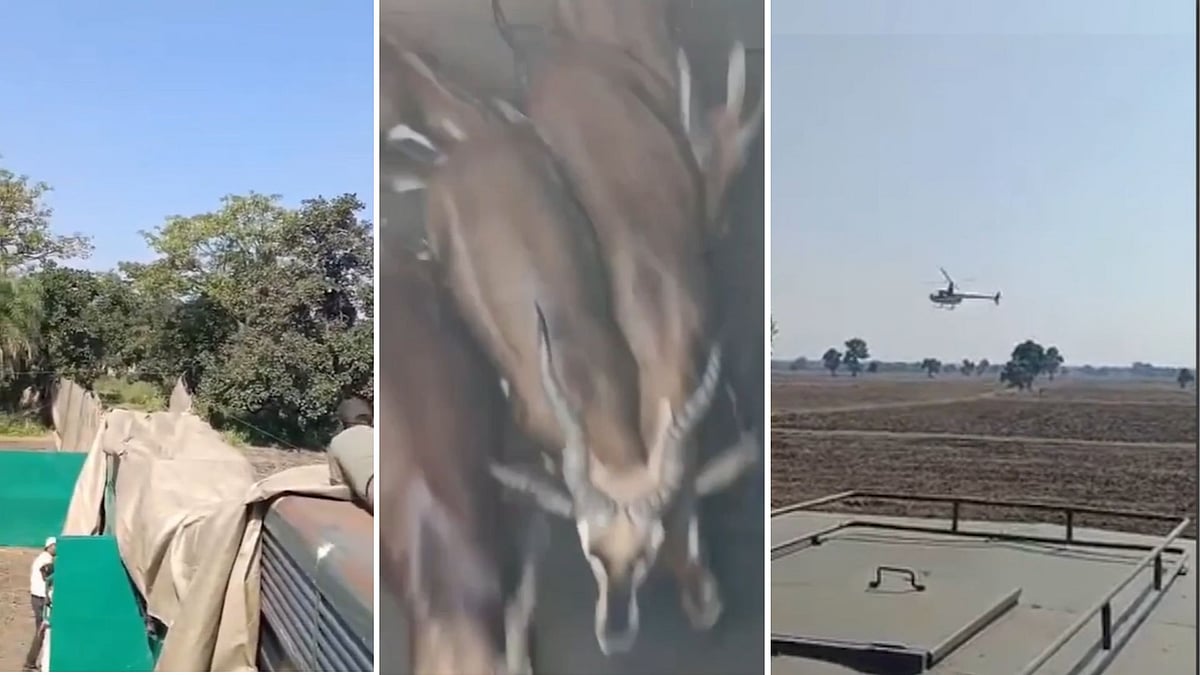
176 Blackbucks rescued with the help of a helicopter and Boma technique in Shajapur's Shujalpur. |
Shujalpur, Madhya Pradesh: As many as 176 blackbucks were rescued over two days using a specialised South African technique in the Shujalpur region of Shajapur district in Madhya Pradesh. The operation, which began on October 10 in Badi Polay village, involved South African experts, forest department personnel and local administration teams.
The rescued animals were transported in trucks towards Kuno National Park in Sheopur district. According to the details provided, 97 blackbucks were rescued on the first day and another 79 on the second.
Helicopters Help Guide Blackbucks Towards Trucks
The blackbuck rescue operation in Madhya Pradesh used helicopters to guide herds towards a specially designed passage leading to transport trucks.
The helicopter flew at a low altitude over agricultural fields, gradually directing the animals towards a designated route. The passage was designed as a funnel approximately one kilometre long and shaped like the letter V, narrowing towards the trucks.
The team used green and black curtains, local grass and bushes to create the passage, instead of solid metal walls. This helped reduce the appearance of hard barriers and guided the animals towards the vehicles.
How the South African Boma Technique Works
The operation used the Boma technique for wildlife rescue, a method that guides animals along a designated route into an enclosed area rather than capturing them individually using nets or tranquilising drugs.
Once the blackbucks entered the passage and reached the trucks, the curtains were closed behind them to prevent them from returning. Forest personnel also took precautions while separating male and female animals inside the vehicles to reduce the risk of injuries from the males' horns.
The trucks were equipped with ventilation openings to allow air circulation during transportation. The team monitored the animals' condition and took steps to minimise stress and physical injuries.
Why Are Blackbucks Being Relocated?
The Shujalpur blackbuck rescue comes amid complaints from farmers in Badi Polay, Hannukhedi, Amsiyakhedi, Banjari and nearby villages about crop damage caused by large herds.
Farmers have reported that blackbucks feed on soybean plants and damage crops, affecting agricultural production and their income.
ALSO READ
Farmers from Badi Polay complained that blackbucks often eat the emerging shoots of soybean plants. Farmers have also reported seeing groups of 50 to 100 animals entering fields at a time.
A Challenging Wildlife Rescue Operation
The helicopter-assisted blackbuck rescue presented several challenges, including high-tension electricity lines, nearby settlements and roads. The team had to carefully coordinate helicopter movements while ensuring the safety of the animals and local residents.
Around 14 South African experts, along with forest, revenue and police personnel, were involved in the operation, according to the sources.
The blackbuck relocation to Kuno National Park is aimed at moving the animals away from areas where they are causing agricultural losses.
The Boma setup is being shifted to other locations as the rescue effort progresses.
ALSO READ
RECENT STORIES
-
-
-
-
-