Indore Water Crisis Looms As Borewells Dry Up Three Months Early, 500-Foot Wells Yield Water For Just 10 Minutes
Indore faces an unusually early groundwater crisis as borewells across several colonies begin drying up three months ahead of schedule. Wells reaching 300 to 500 feet now yield water for barely 10 minutes. Experts blame inadequate rainfall and warn of worsening shortages during summer, urging conservation and municipal intervention.

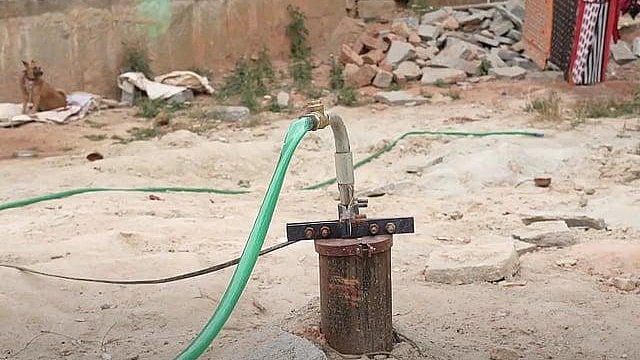
Indore Water Crisis Looms As Borewells Dry Up Three Months Early, 500-Foot Wells Yield Water For Just 10 Minutes | Representative image
Indore (Madhya Pradesh): Summer is still months away, but signs of a water crisis are emerging in the city.
Borewells in several parts of the city have started drying up much earlier than usual. While the problem usually surfaces around February or March, this year borewells are struggling to provide water even in mid-November.
In several residential colonies, borewells ranging from 300 to 500 feet deep are supplying water for barely 10 minutes. Residents say the situation has developed nearly three months earlier than in previous years.
This Free Press correspondent toured across the city and spoke to residents only to find that the problem had been reported in several localities. Residents said borewells usually provided adequate water during winter, with the supply beginning to decline around February as groundwater levels dropped. This year, however, the same situation has emerged in November, raising concerns about the coming summer.
Poor Rainfall Leaves Borewells Without Adequate Recharge
Suresh MG, a water conservation activist and adviser to the Indore Municipal Corporation, said inadequate rainfall this year had prevented borewells from receiving sufficient groundwater recharge.
Borewells are now functioning according to the amount of water that has actually reached the ground. Several are supplying water for only around 10 minutes, even in November. This is an early warning of the crisis ahead, he said.
He cautioned that the period from February onwards, particularly March, April and May, could be extremely challenging for the city.
Daily Water Consumption Must Fall From 200 To 70 Litres
Suresh MG said administrative arrangements alone would not be enough to tackle the situation. Residents would also need to significantly reduce their daily water consumption.
According to him, an average person in Indore uses around 200 litres of water every day. This needs to be brought down to approximately 70 litres per person. He suggested restricting water use for bathing, washing clothes, cleaning vehicles and other household activities. Reusing water and adopting rainwater harvesting measures would also be essential.
City Needs 650 MLD, Narmada Supplies Around 450 MLD
With Indore's population continuing to grow, the city's daily water requirement has also increased. The city needs approximately 650 million litres per day (MLD), of which around 450 MLD is supplied through the Narmada project.
Areas that do not have access to the Narmada pipeline continue to depend on groundwater and other local sources. The declining output from borewells could therefore create serious problems in colonies where residents have limited alternative sources of water.
QUOTE
OFFICIALSPEAK
We are working on a detailed plan to supply water to areas that depend completely on borewells. New hydrants will be installed to facilitate water supply in these localities. We are also making efforts to revive the city's old water sources.
Abhishek Sharma, in-charge of the Municipal Corporation's Water Works Department
Key measures to prevent a water crisis
Household water budgeting: An individual consumes around 135 litres daily, nearly 40% of which goes into toilet flushing. Smaller flush tanks are needed.
Reuse and conservation: Households should optimise washing machine cycles (running full loads only)
Community borewell monitoring: Local public committees should monitor every neighbourhood borewell.
Illegal Pumping: Stringent monitoring of unauthorised commercial extraction.
IMC intervention: The civic body should prevent leakages in Narmada pipelines
Sudhindra M. Sharma, groundwater scientist
Borewell Situation Across Eight Localities
Locality Resident Borewell depth Water availability in November
Nipania Vikram Faujdar 350 ft 10 minutes
Paricharika Nagar Piyush Jain 230 ft 10 minutes
Pipliyarao Ajay Bhayal 350 ft 20 minutes
Mahalakshmi Nagar Ketan Chaudhary 450 ft 10 minutes
Kushwah Nagar Jitendra Yadav 320 ft 12 minutes
Tejaji Nagar Nayan Shah 300 ft 15 minutes
Patnipura Sachin Yadav 450 ft 15 minutes
Byapss Sunil Agrawal 550 ft 20 minutes
Level up your brain the fun way. Play daily games and quizzes on FPJ Smart!
ALSO READ
RECENT STORIES
-
-
-
-
-