Indore High Court: Bhojshala Is Hindu Temple, Not A Mosque
The order was passed in a batch of petitions filed by the Hindu Front for Justice and Kuldeep Tiwari, seeking exclusive Hindu worship rights, restoration of the Saraswati idol, and quashing of the ASI arrangement. The court allowed these petitions while dismissing those filed by Maulana Kamaluddin Welfare Society, Salek Chand Jain, and Qazi Zakullah.

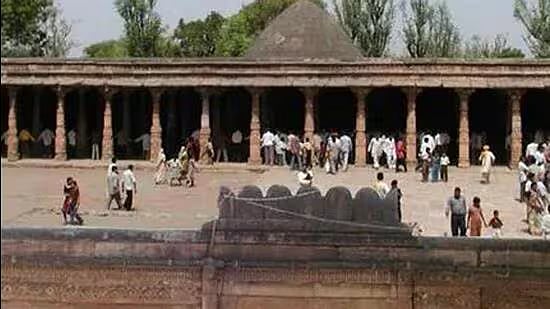
MP High Court: Bhojshala Is A Hindu Temple, Not A Mosque | Representative image
Indore (Madhya Pradesh): In a landmark judgment that settles decades of dispute, the Indore Bench of the Madhya Pradesh High Court on Friday ruled that the Bhojshala complex in Dhar is religiously a Bhojshala and temple of Goddess Vagdevi Saraswati and quashed the Archaeological Survey of India's 2003 order that had permitted Friday namaz while restricting Hindu worship at the site.
The Division Bench of Justice Vijay Kumar Shukla and Justice Alok Awasthi, in a 242-page common order, held that the disputed area was historically established as a centre of Sanskrit learning associated with Raja Bhoj of the Parmar dynasty, with architectural and literary references pointing to the existence of a temple dedicated to Goddess Saraswati at Dhar.
"We have noted the continuity of Hindu worship at the site, though regulated over time, it has never been extinguished. Historical literature establishes that the character of the disputed area was Bhojshala, a centre of Sanskrit learning associated with Raja Bhoj of the Parmar dynasty, and the literature and architectural references indicate the existence of a temple dedicated to Goddess Saraswati," the bench observed.
The court ruled that the ASI's 2003 arrangement, which allowed Hindus access only on Tuesdays and during Basant Panchami while permitting Muslims to offer Friday namaz between 1 pm and 3 pm, was sustainable.
It directed that the ASI would retain overall administration and management of the site under the Ancient Monuments and Archaeological Sites and Remains Act, 1958, with full supervisory control over preservation, conservation, and regulation of religious access.
The bench also directed the Union Government and ASI to take a decision regarding administration, management, and Sanskrit learning activities at the Bhojshala site. It further observed that representations seeking the return of the idol of Goddess Saraswati currently housed in a London museum may be considered by the Government of India.
The order was passed in a batch of petitions filed by the Hindu Front for Justice and Kuldeep Tiwari, seeking exclusive Hindu worship rights, restoration of the Saraswati idol, and quashing of the ASI arrangement. The court allowed these petitions while dismissing those filed by Maulana Kamaluddin Welfare Society, Salek Chand Jain, and Qazi Zakullah.
The judgment drew extensively on historical literature, archaeological reports, gazetteers, and principles laid down by the Supreme Court in the Ayodhya verdict, holding that archaeological findings, inscriptions, sculptures, and architectural features could be relied upon to determine the religious character and historical use of a disputed religious site.
The ASI's scientific survey, submitted following a High Court order, ran to over 2,000 pages and indicated that a massive structure dating to the reign of the Parmar kings predated the mosque, and that the current disputed structure was built using repurposed temple components.
The Hindu side cited coins, sculptures, and inscriptions from the survey as proof of the complex's temple origins. The Muslim side contended that the ASI report was biased and prepared to support Hindu claims.
The dispute has remained contentious for decades, with Hindu groups claiming it is an ancient Saraswati temple built by Raja Bhoj, Muslim organisations maintaining it is the Kamal Maula Mosque.
Consider plea for suitable land for mosque: HC to govt
While ruling in favour of the Hindu petitioners, the bench sought to balance the interests of the Muslim community. It stated that if the Maulana Kamaluddin Welfare Society submits an application for allotment of suitable land in Dhar district for the construction of a mosque or prayer place, the state government may consider it in accordance with law, to "secure the religious rights of the Muslim community and ensure complete justice between the parties."
Ayodhya verdict cited as legal touchstone
The judgment extensively referenced the Supreme Court's Ayodhya verdict, holding that archaeological evidence, inscriptions, evidence, inscriptions, sculptures, coins, and architectural features can be legitimately relied upon to determine the religious character and historical use of a disputed site.
The Bhojshala ruling now joins Ayodhya as a significant legal precedent in India's contested religious property disputes.
RECENT STORIES
-
-
-
-
-