IIT Indore Develops AI Tool HGAST To Fix Gender Bias In Speech Translation From English To Hindi, Marathi And Gujarati
Researchers at IIT Indore have developed HGAST, an AI-based correction tool that improves gender accuracy in speech translation systems. The technology detects speaker gender, identifies incorrect verb usage and corrects translations from English into Hindi, Marathi and Gujarati without retraining existing AI models, addressing a major AI language bias issue.

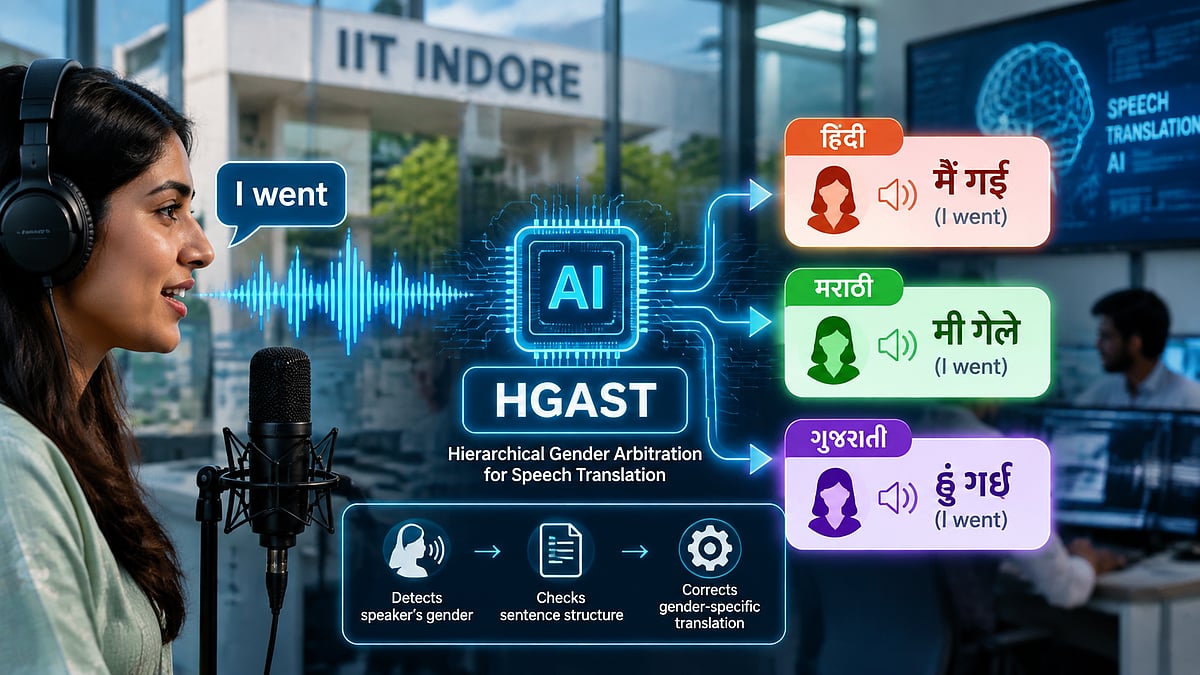
Indore (Madhya Pradesh): Researchers at the Indian Institute of Technology (IIT) Indore have developed a new artificial intelligence (AI)-based speech translation tool to address a common but overlooked challenge in multilingual AI systems — incorrect gender identification during translation.
The newly developed tool, called HGAST (Hierarchical Gender Arbitration for Speech Translation), helps correct gender-related errors when English speech is translated into Indian languages such as Hindi, Marathi and Gujarati.
The research aims to reduce AI gender bias in language translation, especially in languages where verbs and sentence structures change according to the speaker’s gender.
AI Translation Often Defaults To Male Forms
Unlike Hindi, Marathi and Gujarati, English does not use gender-specific verb forms. For example, the sentence “I went” remains the same regardless of whether the speaker is male or female.
However, in Indian languages, the verb changes based on gender. In Hindi, a male speaker would say "गया" (gaya) while a female speaker would use "गई" (gayi) for the same meaning.
Researchers found that many AI speech translation models are trained on datasets that often favour masculine language patterns. As a result, when a woman’s English speech is translated into Hindi, Marathi or Gujarati, AI systems may incorrectly generate male verb forms, leading to gender misrepresentation in AI-generated translations.
HGAST Works As AI Correction Layer
The research team, led by Dr Chandresh Kumar Maurya of IIT Indore, along with Dr Mahendra Gupta from Government College of Engineering, Anuppur, and intern Anjil Kumar Raj, developed HGAST as a correction layer that works with existing translation systems.
Instead of replacing or retraining AI translation models, the tool analyses and improves their output through a four-step process:
Detects the speaker’s gender through voice analysis
Examines sentence structure to identify the correct gender-specific verb form
Applies verified word substitutions using a controlled AI language model
Reviews corrections to ensure the original meaning, grammar and sentence structure remain unchanged
A major advantage of HGAST AI technology is that it can be integrated into existing speech translation systems without expensive and time-consuming model retraining.
IIT Indore AI Tool Improves Translation Accuracy
The researchers tested HGAST on English-to-Hindi, English-to-Marathi and English-to-Gujarati speech translation, using three different underlying translation systems, including Sarvam AI, which also showed challenges in accurately handling gender-specific translations.
The tool maintained almost perfect accuracy for male speakers, ranging between 99% and 100%, while significantly improving results for female speakers:
Hindi translation accuracy: Improved from 83.15% to 98.88%
Gujarati translation accuracy: Improved from around 73–76% to nearly 96–97%
Marathi translation accuracy: Improved from around 90–93% to 100% (independently validated at 98.2% by native Marathi speakers)
The study also involved 500 human reviewers per language, whose evaluations closely matched the automated results.
IIT Indore Researchers Highlight Fairer AI Translation
IIT Indore Director Prof Suhas Joshi said accurate recognition of speakers is essential as more people rely on AI-powered translation tools across India.
Dr Chandresh Kumar Maurya said HGAST demonstrates that gender-related errors in AI translation can be corrected without retraining existing language models.
"HGAST demonstrates that gender-related translation errors can be addressed without retraining the underlying translation model. By combining speech and linguistic information with a controlled correction mechanism, the framework significantly reduces systematic misgendering while preserving translation accuracy," he said.
RECENT STORIES
-
-
-
-
-