IIM Indore Study Finds Women MLAs Drive Higher Forest Growth In Constituencies
A study by IIM Indore finds that constituencies led by women MLAs in India show about 6% higher annual forest cover growth compared to male counterparts. Based on 2000–2014 data, the research links gender representation with better environmental outcomes, especially in SC/ST reserved areas, highlighting the role of inclusive governance in forest conservation and climate impact.

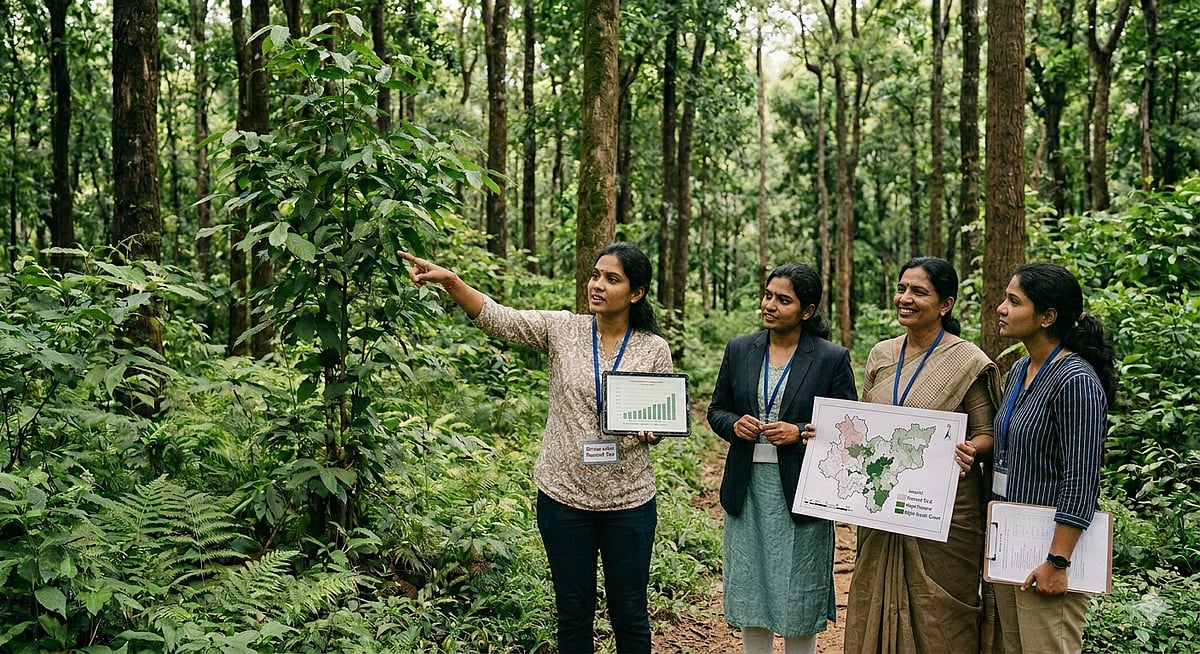
IIM Indore Study Finds Women MLAs Drive Higher Forest Growth In Constituencies | AI
Indore (Madhya Pradesh): A new study by the Indian Institute of Management Indore has found that constituencies represented by women legislators in India tend to see significantly higher forest cover growth, especially in areas reserved for historically marginalised communities.
The research, led by Sutirtha Bandyopadhyay, was recently published in the Journal of Economic Behaviour and Organization. It explores how political representation, specifically gender, can influence environmental outcomes such as forest conservation.
Using election data and satellite-based forest cover records from 2000 to 2014, the study employed a rigorous regression discontinuity design. By examining closely contested elections between male and female candidates, the researchers were able to isolate the impact of legislator gender on forest outcomes.
The study reveals that constituencies represented by female Members of the Legislative Assembly (MLAs) experienced an average 6% increase in annual forest cover growth compared to those led by male counterparts. However, this effect was most pronounced in constituencies reserved for Scheduled Castes (SCs) and Scheduled Tribes (STs). Over a full electoral cycle, the positive impact of women legislators extended across constituencies more broadly, though the strongest gains continued to be concentrated in reserved areas.
Why the difference?
According to the researchers, several factors may explain these results. Women leaders may prioritise environmental protection more strongly, possibly due to greater awareness of climate risks or closer engagement with communities that depend on forests for livelihoods. Additionally, institutional mechanisms like reserved constituencies may amplify the effectiveness of women leaders in driving conservation outcomes.
Policy implications
In India s federal system, forests fall under the Concurrent List, meaning both Central and state governments share responsibility. At the state level, MLAs play a crucial role in shaping environmental outcomes through policymaking, oversight of forest programmes and allocation of development funds.
The findings suggest that increasing women s representation in legislative bodies could strengthen environmental governance. Moreover, combining gender inclusion with policies that ensure representation of marginalised communities may deliver even greater ecological benefits.
Climate impact
Forests are vital carbon sinks and the study notes that the observed increase in forest cover under female leadership could significantly enhance carbon sequestration at the local level, offering a meaningful contribution to climate change mitigation.
ALSO READ
Conclusion
The research adds to a growing body of evidence that political representation matters, not just for social equity, but also for environmental sustainability. As India continues to grapple with climate challenges, the study highlights a compelling link between inclusive governance and ecological outcomes.
RECENT STORIES
-
-
-
-
-