'You Think Women Can't Lift LPG Cylinders?': Supreme Court Awards ₹12 Lakh To Woman Denied Indian Oil Job Over Gender
The Supreme Court has directed Indian Oil Corporation to pay Rs 12 lakh compensation to a woman denied a refilling helper job at an LPG bottling plant despite meeting eligibility requirements. The Court criticised gender-based rejection, observing that assumptions about women’s ability to perform physical duties cannot be a reason to deny employment opportunities.

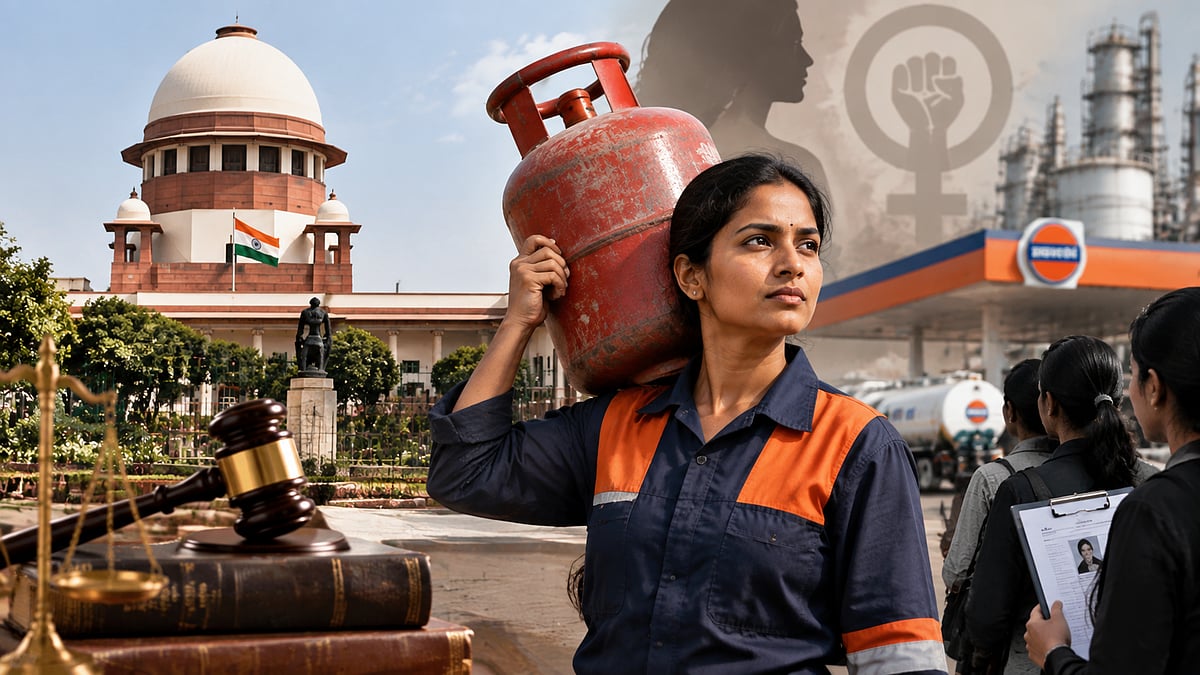
'You Think Women Can't Lift LPG Cylinders?': Supreme Court Awards ₹12 Lakh To Woman Denied Indian Oil Job Over Gender | AI Representational Image
The Supreme Court has ordered Indian Oil Corporation to pay ₹12 lakh as compensation to a woman who was denied a job as a refilling helper at an LPG bottling plant because of her gender, despite meeting the eligibility requirements.
As the woman has already reached the age of retirement, the Court considered compensation appropriate for the discrimination she suffered. A Bench of Justices Aravind Kumar and Vipul M Pancholi strongly criticised the corporation for denying her an equal employment opportunity, Live Law reports.
‘Disrespect To Womanhood’
During the hearing, the corporation argued that the list containing the woman’s name was only a recommendation and did not create a binding obligation to appoint her. Its counsel said the authorities may have found her unsuitable because the job involved manual labour, including lifting LPG cylinders, and required employees to work night shifts.
Justice Kumar questioned the reasoning behind denying her the appointment. “You denied her appointment just because she is a lady? This is disrespect to womanhood. She has now attained superannuation, but she has been prosecuting her right throughout. Award her lump-sum compensation,” he said.
The Court also took exception to such discrimination coming from a Government of India undertaking. “We are from India, and every day we say respect women and that she is a goddess. It is an affront to womanhood, we can say, and that too by a Government of India undertaking,” Justice Kumar observed.
Rejecting the suggestion that women could not perform work involving LPG cylinders, he added, “Day in, day out they [women] lift gas cylinders in their house. When men are not there, it is she who will change the gas cylinder.”
The observations underline a larger problem with employment decisions based on assumptions about what women can or cannot physically do. In this case, the Court’s criticism focused sharply on gender being used to deny an otherwise eligible candidate an opportunity.
Corporation Seeks Mediation
At the outset, Advocate Himanshu Jain, appearing for the petitioner, sought an adjournment. The Court, however, said it would decide the matter that day.
The corporation’s counsel later urged the Court to refer the dispute to mediation, but the Bench refused.
The case dates back to the woman’s attempt to secure employment at Indian Oil Corporation’s LPG Bottling Plant. A resident of Gudha village, she was among 49 people recommended by a local committee headed by the Deputy Commissioner.
She subsequently appeared for an interview for the post of casual khalasi, peon or refilling helper. While 43 other candidates received appointment letters, she did not get the job.
ALSO READ
Trial Court Found Gender Discrimination
The woman challenged the denial before the Trial Court, which found that she had fulfilled the prescribed eligibility requirements. Evidence given by a defence witness also showed that she had been denied the appointment because she was a woman.
The Trial Court consequently directed that she be absorbed as a casual employee or appointed to an administrative or peon post other than that of a labourer.
The First Appellate Court later reversed the decree. It held that her name had merely been recommended and that she had never actually been selected. It also found that the Trial Court had granted relief relating to a post for which she had not been interviewed.
Also Watch:
High Court Had Rejected Her Claim
The woman then approached the Punjab and Haryana High Court. On October 14, 2025, the High Court upheld the First Appellate Court’s decision.
It held that she had no legal or vested right to an appointment because her name had only been recommended. The High Court also held that the alleged rejection on the ground of gender could not by itself justify a mandatory appointment when there was no legal right to the post.
The dispute eventually reached the Supreme Court, where the focus returned to the reason behind the denial of employment. With the woman having crossed retirement age after pursuing her claim over the years, appointment was no longer a practical remedy.
The ₹12 lakh compensation therefore brings monetary relief in a case where the opportunity to actually take up the job has long passed. More significantly, the Court’s remarks send a clear message against denying employment to women merely on assumptions about their ability to perform physically demanding work.
RECENT STORIES
-
-
-
-
-