'Woman Who Had Twins In First Pregnancy Cannot Be Denied Maternity Leave For Second Delivery': Telangana HC
The Telangana High Court has ruled that a woman government employee who gave birth to twins in her first pregnancy cannot be denied maternity leave for her second delivery. The court held that twins are one biological event and directed authorities to grant leave with full salary and allowances.

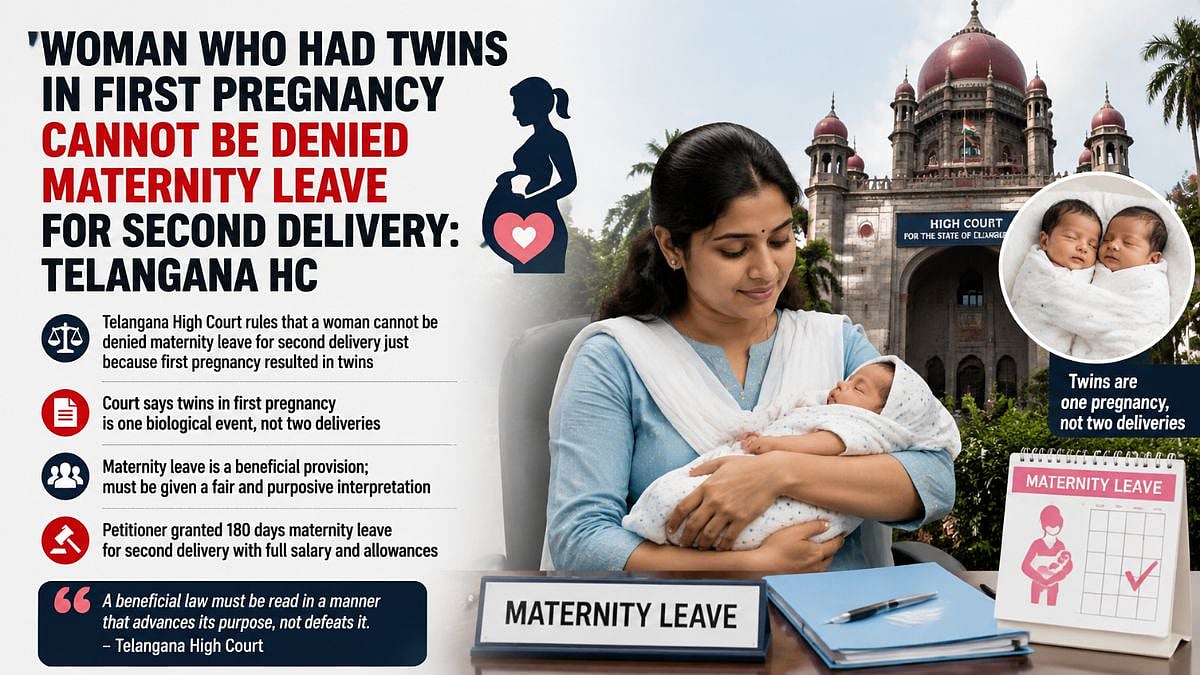
The Telangana High Court ruled that a woman employee who had twins in her first pregnancy is entitled to maternity leave for her second delivery | AI Generated Representational Image
Hyderabad, July 23, 2026: In a significant ruling in favour of working women, the Telangana High Court has held that a woman government employee cannot be denied maternity leave for her second delivery merely because her first pregnancy resulted in the birth of twins.
The court said the condition of having "less than two surviving children" under the Telangana Fundamental Rules cannot be interpreted literally in cases where twins are born during a single pregnancy. It observed that a woman's first pregnancy resulting in twins is one biological event and should not deprive her of maternity benefits for a subsequent pregnancy.
Court Favouring Beneficial Interpretation
Justice K. Sarath relied on the Supreme Court's rulings in Deepika Singh v. Central Administrative Tribunal and K. Umadevi v. Government of Tamil Nadu while deciding the case. The court said maternity leave is a beneficial provision meant to support women in balancing motherhood and employment and should therefore receive a purposive interpretation.
Quoting the Supreme Court's observations in Deepika Singh, Justice Sarath noted that there is no restriction on the number of deliveries for a woman employee under the Central Civil Services (Leave) Rules, 1972. The judge also observed that decisions relating to childbirth are often influenced by family and social circumstances, and that the birth of twins is a biological occurrence beyond the control of the mother.
Petitioner Challenges Denial
The petitioner, a Junior Lecturer (English) with the Telangana Social Welfare Residential Educational Institutions Society (TGSWREIS), gave birth to twins during her first pregnancy in November 2023. She was granted 180 days of maternity leave at that time.
When she became pregnant again, she applied for maternity leave from April 14, 2026. During the pendency of the writ petition, she delivered her third child. However, the authorities rejected her request, saying she already had two surviving children and was therefore not eligible for maternity leave under Rule 101(a) of the Telangana Fundamental Rules and G.O.Ms. No. 50 dated May 17, 2014.
The petitioner argued that the authorities had mechanically applied the two-child norm by treating the birth of twins as two separate confinements. She contended that her first pregnancy was a single biological event and should be treated as one delivery for the purpose of maternity leave. She sought 180 days of maternity leave with all consequential benefits for her second pregnancy.
The respondents opposed the plea, arguing that the applicable rules permit maternity leave only to women government employees having less than two surviving children. Since the petitioner already had two surviving children from her first pregnancy, they said she was not entitled to maternity leave again. They also submitted that granting leave contrary to the rules could invite audit objections and lead to irregular payment of salary and allowances.
Court Relies On Precedents
Examining the legal framework, the High Court noted that Rule 101(a) of the Telangana Fundamental Rules is identical to Rule 43 of the Central Civil Services (Leave) Rules, 1972. Referring to Deepika Singh, the court observed that maternity leave is intended to ensure women's continued participation in the workforce and forms part of the rights guaranteed under Articles 21 and 42 of the Constitution.
The court also relied on the Madras High Court's decision in J. Sharmila v. Secretary to Government, which held that maternity leave for a second pregnancy cannot be denied where the first pregnancy resulted in twins. It observed that any other interpretation would lead to "ridiculous results", especially in cases involving multiple births during one pregnancy.
Justice Sarath further noted that after the J. Sharmila judgment, the Tamil Nadu government amended its Fundamental Rules to permit maternity leave for one more delivery if twins were born during the first delivery. The court also referred to the Andhra Pradesh government's 2025 amendment, which removed the condition of having less than two surviving children for availing maternity leave.
Holding that the respondents' reliance on the two-child condition was contrary to the law laid down by the Supreme Court and various High Courts, the court said it could grant relief under Article 226 of the Constitution even though the petitioner had not specifically challenged the relevant government orders.
Relief Granted
Allowing the writ petition, the High Court declared that the petitioner was entitled to maternity leave for her second delivery from April 14, 2026, to October 11, 2026. It also directed the respondents to pay her full salary and allowances for the entire period of leave.
Also Watch:
The ruling reinforces the principle that maternity benefit laws should be interpreted in a manner that advances their purpose rather than defeats it. By recognising that the birth of twins is one biological event, the court has emphasised that technical interpretations should not override the welfare objective of maternity legislation.
To get details on exclusive and budget-friendly property deals in Mumbai & surrounding regions, do visit: https://budgetproperties.in/
RECENT STORIES
-
-
-
-
-