With Samrat Chaudhary Set To Become Bihar CM, BJP Now Governs Nearly Two-Thirds Of India's Population
Following political realignment in Bihar, the Bharatiya Janata Party now governs states accounting for nearly two-thirds of India’s population. With control over key high-population regions, the party’s demographic advantage has significantly expanded. This shift highlights how state-level power is translating into a broader national footprint ahead of future electoral battles across India.

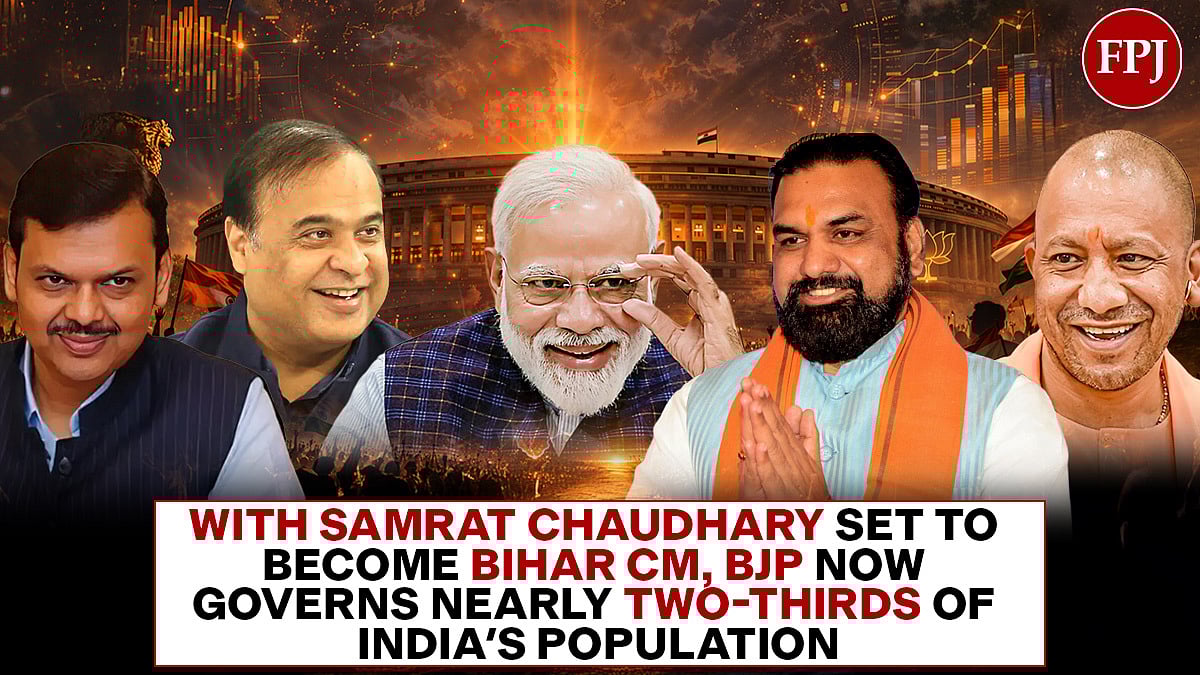
With Samrat Chaudhary emerging as a central figure in Bihar’s shifting political landscape, the Bharatiya Janata Party appears to have crossed a significant milestone. By most reasonable estimates, the party now directly governs or leads governments in states that together account for nearly 65–67% of India’s population, underlining the scale of its dominance.
The Numbers Behind BJP’s Population Advantage
The significance of this figure becomes clearer when viewed through India’s population distribution. The BJP governs several of the country’s most populous states, including Uttar Pradesh, Maharashtra, Bihar, Madhya Pradesh and Rajasthan. Among them, Uttar Pradesh alone contributes roughly one-sixth of India’s population, making it the single biggest electoral prize.
When combined with other large states such as Maharashtra, Bihar and Madhya Pradesh, the population share rises sharply. The BJP’s presence in smaller but strategically important states from the Northeast to western India adds further weight, pushing its overall governance footprint close to two-thirds of the country.
A Nationwide Political Spread
From the Hindi heartland to the Northeast, the BJP’s reach today spans a wide geographical arc. Leaders such as Yogi Adityanath in Uttar Pradesh, Devendra Fadnavis in Maharashtra, and Himanta Biswa Sarma in Assam represent a network of leadership that reinforces the party’s administrative and political hold.
In states like Gujarat, Rajasthan, Odisha and Chhattisgarh, BJP governments further consolidate this presence, creating a continuous belt of governance across large parts of India.
What The Opposition Still Controls
Despite the BJP’s expanding footprint, a significant portion of India remains under opposition parties. Key states such as West Bengal under Mamata Banerjee, Tamil Nadu under M. K. Stalin and Karnataka under Siddaramaiah continue to remain outside the BJP’s direct control, which is not point of notices as these states.
Southern and eastern states, along with pockets in the north such as Punjab and Himachal Pradesh, ensure that roughly one-third of the population is still governed by non-BJP parties, maintaining a competitive federal political structure.
With Bihar adding to this momentum and leaders like Samrat Chaudhary gaining prominence, the party’s expansion narrative appears far from over. The coming months will reveal whether this dominance translates into sustained electoral success across the country.
RECENT STORIES
-
-
-
-
-