'We Watched Our Homes Disappear': Mud, Misery And Mounting Outrage Against BJP Govt in Flood-Hit Assam
Opposition leaders spearhead relief efforts as residents allege illegal coal mining, poor disaster preparedness and lack of early warnings worsened the devastating floods

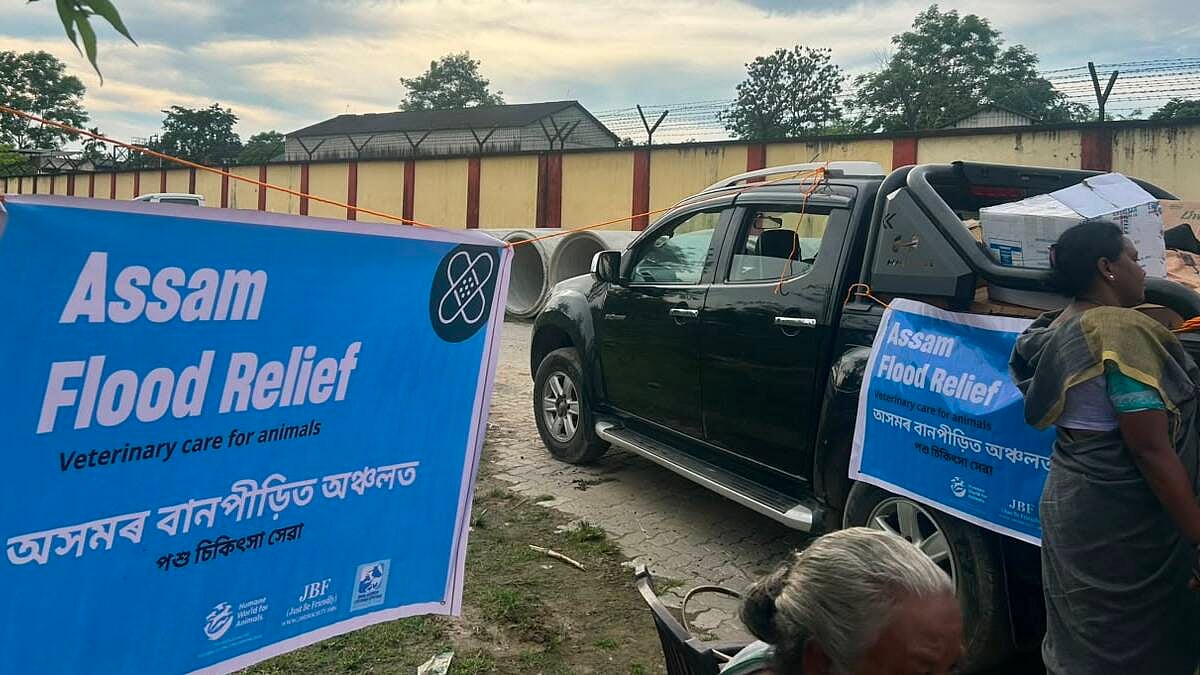
A veterinary flood relief camp in Upper Assam | Free Press Journal
As unprecedented floods dump three to four feet of thick sludge across many places in Upper Assam, public anger against the BJP-led state government is reaching a boiling point. Across Sivasagar, Charaideo and Jorhat, residents grappling with submerged homes and lost livelihoods are increasingly pointing fingers at ruling party ministers, alleging their involvement in illegal border coal syndicates that exacerbated the disaster.
Nearly 7,000 villages across the state were hit by the disaster. In Sivasagar district's Bihubar Panchayat alone, one village reported the death of 1,500 cattle within minutes, while almost all 200 houses were completely wiped out.
With opposition leaders like Raijor Dal chief and Sivasagar MLA Akhil Gogoi and AIUDF chief and Binnakandi MLA Badruddin Ajmal actively coordinating relief on the ground, state ministers face accusations of corruption and absence.
Is the BJP's mass appeal taking a hit in Upper Assam?
The contrast in visible political leadership during this disaster has struck a deep nerve among voters across Upper Assam.
Highlighting this shifting political sentiment, social media user alice1994 noted how local communities have rallied around opposition leaders.
"I thank Sivasagar MLA Akhil Gogoi for standing with the people during this calamity. While I don't agree with MLA Gogoi on everything, at least he showed up for the people in their time of need. Many ruling politicians did nothing beyond showing up in branded clothes, let alone providing relief. Even AIUDF chief Ajmal has stood up for the people," alice1994 said on Instagram.
This shift reflects a growing impatience among citizens who view the disaster not as an unavoidable act of nature, but as an administrative failure compounded by greed.
What triggered public outrage against ruling ministers?
Addressing the media, Sivasagar MLA Gogoi directly named senior ministers and a legislator, "(Minister) Sushanta Borgohain once told me directly to my face in Dispur, in front of the then-(Sivasagar) DC Aditya Vikram, that he takes Rs5 lakh monthly from this coal syndicate. (Minister) Pijush Hazarika, (Minister) Jayanta Malla Baruah and Sadiya MLA Bolin Chetia, all these people ran syndicates, collected illegal taxes, mined illegal coal from Nagaland and hollowed out the bases of the hills, creating artificial lakes."
Gogoi further claimed that "the Chief Minister of Assam gave permission for illegal coal mining in Nagaland, destroying entire hills in the process," concluding that "this mega-disaster happened because of these looting ministers, MLAs and syndicate masters. They are criminals and an investigation must be launched against them."
Public sentiment on social media strongly echoes these allegations. Commentary from local observer Prangana Gogoi emphasised that citizens are no longer buying official explanations.
"People are acutely aware and furious and they won't let the government simply wash its hands of this by calling it a natural disaster. People realise that if they stay silent now, they will only face a similar disaster in the future," Prangana said.
Why the flood turn into a mega-catastrophe
While seasonal monsoon swelling is familiar to Assam, the sheer velocity and mud content of this year's deluge caught entire districts unprepared. Though state officials initially pointed toward a potential cloudburst in Nagaland, India Meteorological Department (IMD) data confirmed that no cloudburst took place, forcing even the chief minister to revise his statement.
MLA Gogoi questioned why the devastation was concentrated so heavily in three specific districts. "Why did this mega-catastrophe hit Sivasagar, Jorhat and Charaideo the hardest? The IMD has clearly stated that no cloudburst took place in Nagaland. Now that the IMD has debunked that claim, no one can hide behind the false excuse of a cloudburst anymore."
Gogoi broke down the catastrophe into three specific factors:
Torrential rains and collapsing hills: He acknowledged that "it rained continuously for 10 to 15 hours," but explained that in Mon district, Tizit and Naginimora, illegal miners "kept digging and mining coal continuously, completely hollowing out the bases of the hills." Underneath, "artificial lakes or ponds were created" where water accumulated over years. When heavy rain struck, "the hills started collapsing," and "all that water stored in those illegal coal mines rushed down together."
Choked riverbed mouths: He noted that contractors "extracted stone boulders from the mouth of every river flowing down from Nagaland," leaving rivers "choked and silted up due to coal mining and stone extraction."
Unannounced hydroelectric water releases: Gogoi pointed to ongoing construction on Phase 3 of the Dikhu Hydroelectric Project since February 2025, stating: "I am certain that while constructing the dam on the Dikhu River, they had to release all that accumulated water at once... Therefore, the released dam water, the water from the coal mines and the torrential rain all combined."
Lack of early warnings, ground relief collapse
Beyond the cause of the flood, residents have expressed deep anger over the complete absence of advance warning systems that could have saved lives and property.
Digital content creator Cynee (__cynee) posted an emotional plea on Instagram detailing the suddenness of the disaster: "Never in our lives have we witnessed a disaster like this in Sivasagar... We are watching our homes disappear beneath the water right before our eyes... And amid all this, one question continues to haunt us: Where were the early warnings?"
Citizens step up relief effort
With official relief slow to reach interior areas, ordinary citizens organised massive private drives. Prangana described seeing a "traffic jam on Upper Assam roads towards Sivasagar, Charaideo and Jorhat as people in very large numbers rushed to affected areas with relief material."
However, self-organised relief has suffered from severe distribution bottlenecks.
Social media posts from user _wanderlust__moyur46 highlighted the anger of people who were "deprived of relief materials as a few unscrupulous people kept the materials for personal use." Other field reports noted "high-handedness in some areas where people wanted to keep all the relief materials for themselves."
How severe is the physical and economic loss
The physical scale of the destruction has left long-term economic damage across rural communities. Ground documentations by local creator Krishnalens showed homes in Nepalikhuti village in Sivasagar district where there was "a minimum of one feet sludge inside the house and all furniture destroyed," alongside another house that "was taken possession less than 20 days back" and was "submerged in over 4 ft of flood waters."
In his address, MLA Gogoi emphasised the overwhelming material loss suffered by families:
"People have suffered losses worth crores of rupees. Homes, farmland, belongings, cars, motorcycles, tractors, power tillers, refrigerators, TVs—everything is gone. Nothing is left. Everything is destroyed."
When will accountability replace relief?
The current crisis has brought long-standing questions regarding state expenditure and disaster management into sharp focus. Significantly, while the Assam government announced Rs111 crore for immediate flood relief, it spent Rs452 crore on media publicity and advertisements surrounding high-profile political visits since 2021.
When MLA Gogoi attempted to raise the flood devastation inside the Legislative Assembly, he was temporarily suspended, leading many to ask why political debate took precedence over urgent public suffering.
As one widely shared public appeal concluded: "Assam doesn’t need sympathy every monsoon. It needs accountability... Floods are no longer an annual disaster in Assam, they have become an annual reminder of administrative failure."
While the BJP government maintains that extreme weather events were the primary trigger and points to ongoing official relief operations, the narrative of minister-led syndicates causing a man-made environmental crisis has taken firm root.
RECENT STORIES
-
-
-
-
-