'Verify Before You Vilify': India Rejects UN Rapporteur’s Claims On Youth Rights As 'Hearsay' | VIDEO
India has rejected UN Special Rapporteur Gina Romero’s claims about young people facing retaliation for discussing mental health and gender justice, calling them “hearsay dressed up as a UN report”. Indian diplomat Anuj Swarup questioned the evidence cited, defended constitutional safeguards and highlighted youth protests as examples of democratic participation amid recent demonstrations.

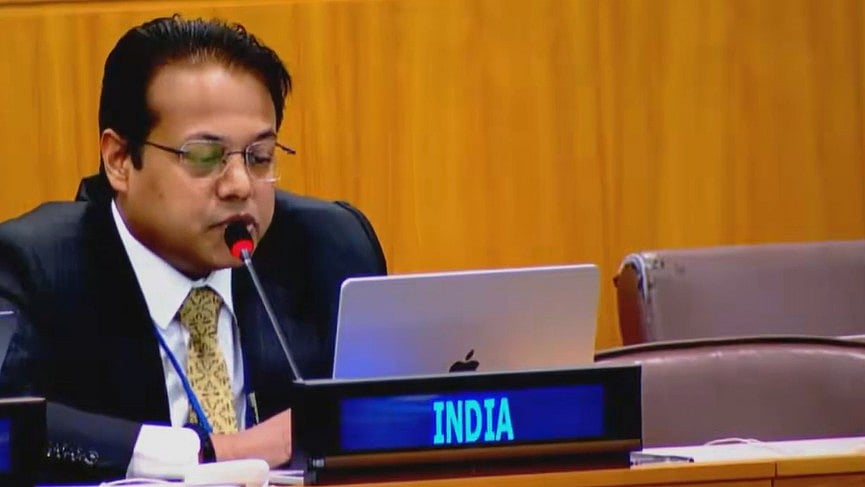
India has rejected allegations made by United Nations Special Rapporteur Gina Romero regarding the treatment of young people in the country, questioning the credibility of the evidence cited in her report and accusing her of making sweeping claims based on anonymous submissions.
Speaking at an interactive dialogue with Romero before the United Nations General Assembly’s Third Committee in New York around October 17 Anuj Swarup, First Secretary at India’s Permanent Mission to the UN, criticised the report on the rights to freedom of peaceful assembly and of association.
Swarup said allegations concerning India’s youth population were based on unverified claims and urged the Special Rapporteur to establish the credibility of her sources before drawing conclusions about the country.
India Questions Evidence Cited In UN Report
Romero’s report stated that “Young people from India reported retaliation or stigmatisation for discussing mental health or gender justice.” However, the footnote supporting the statement cited an unnamed submission, prompting India to question the basis of the allegation.
Describing the claim as a sweeping charge against the world’s largest youth population, Swarup said it rested on anonymous and unverified inputs rather than established evidence.
He termed the report’s assertions “hearsay dressed up as a UN report” and criticised what he described as arbitrary report-writing by mandate holders.
Swarup argued that generalising about a country of approximately 1.4 billion people on the basis of anonymous submissions undermined the credibility of the UN and its institutions. India rejected the allegations outright and called on Romero to “verify before she vilifies”.
India Cites Constitutional Safeguards And Democratic Institutions
Defending India’s record on civil liberties, Swarup referred to Article 19 of the Constitution, which guarantees freedoms including speech and expression, peaceful assembly and association, subject to constitutional restrictions.
He also pointed to the role of the independent judiciary, the free press and the National Human Rights Commission as safeguards for citizens’ rights.
India’s response emphasised that the country’s democratic institutions provide avenues for citizens, including young people, to question the government, organise collectively and participate in public debate.
Swarup also cited examples of youth-led civic engagement, including satirical political movements that have questioned the government, organised demonstrations and interacted with senior political leaders.
Student Protests Cited As Examples Of Democratic Participation
Swarup pointed to the government’s response to student protests over alleged irregularities in public examinations as an example of democratic engagement.
The response, as outlined in his remarks, included amendments to the Public Examinations Act, systemic reforms and the establishment of fast-track courts to address concerns surrounding examination-related irregularities.
He also referred to recent positive remarks by the UN High Commissioner for Human Rights regarding engagement with young leaders in India.
These examples were cited to counter the suggestion that young people in the country face systematic retaliation or stigmatisation for raising public-interest issues.
UN Criticism Comes Amid Youth-Led Protests In India
The exchange comes against the backdrop of recent youth-led demonstrations in India, including protests over alleged irregularities in public examinations and opposition to the Special Intensive Revision (SIR) of electoral rolls.
Demonstrations linked to the satirical Cockroach Janta Party (CJP), which has demanded the resignation of Chief Election Commissioner Gyanesh Kumar, have also drawn attention to youth participation in political dissent.
Around October 10, Romero had posted on X raising concerns about alleged excessive force and arbitrary detention involving peaceful young protesters in India.
ALSO READ
Separately, the UN Human Rights Office (OHCHR) had criticised mass detentions during recent protests in Delhi. India rejected that criticism as unwarranted interference, accusing the UN body of selective scrutiny.
Romero has acknowledged India’s position as the world’s largest democracy while continuing to raise concerns about the exercise of civil liberties.
India’s latest response underscores the disagreement between New Delhi and UN human rights representatives over how civic freedoms and youth participation should be assessed, with the government questioning the evidence underpinning the allegations and defending the country’s constitutional and democratic framework.
RECENT STORIES
-
-
-
-
-