Why Pakistan’s Role As US-Iran Mediator Is A Strategic Puzzle For India
Pakistan's successful mediation of a two-week ceasefire between US and Iran has reopened the Strait of Hormuz, providing India with critical energy security while simultaneously challenging New Delhi’s regional influence as Islamabad gains significant diplomatic leverage with Washington

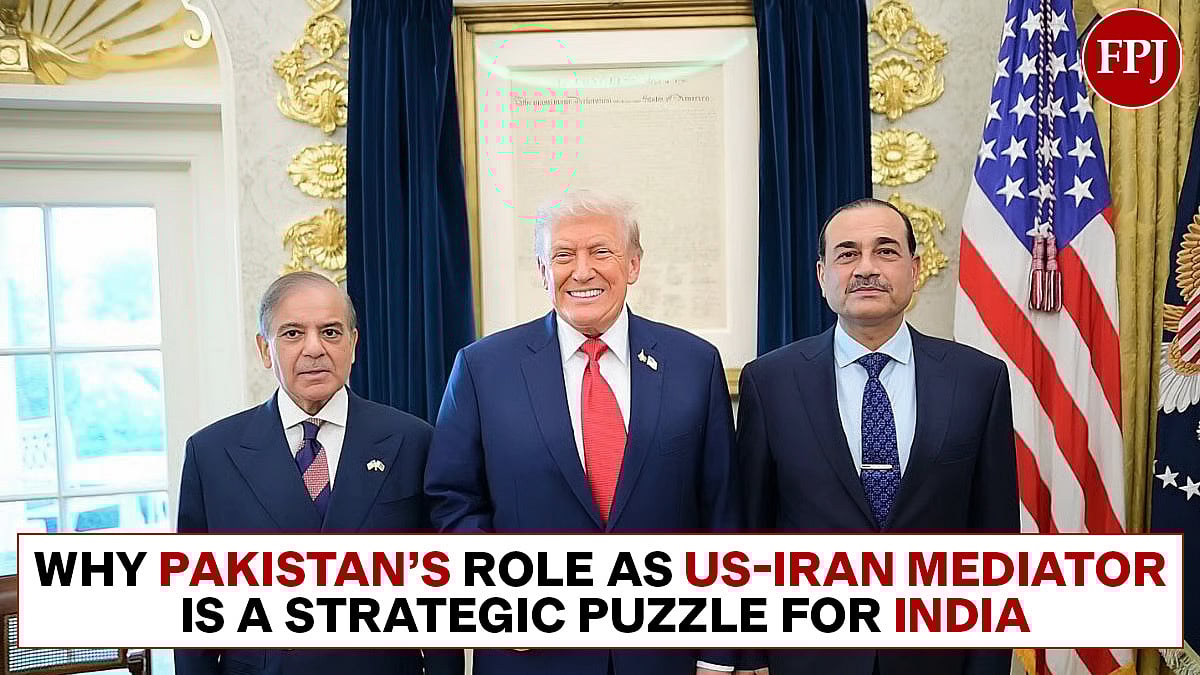
(File) US President Donald Trump with Pakistan Prime Minister Shehbaz Sharif and Asim Munir |
Despite the social media faux pas involving a leaked draft statement from Prime Minister Shehbaz Sharif, Islamabad’s diplomatic achievement remains significant. Successfully brokering a two-week ceasefire between US and Iran—at a moment when President Donald Trump’s rhetoric threatened the very survival of Iranian civilisation—is a feat that cannot be ignored.
There is little doubt that the global community breathed a collective sigh of relief on Tuesday evening, or Wednesday morning for many, depending on respective geographical locations, as the United States and Iran reached an 11th-hour ceasefire deal, narrowly averting a catastrophic escalation.
The agreement comes on the heels of a severe ultimatum from President Trump, who had threatened the destruction of Iranian civilisation if commercial shipping remained blocked in the Strait of Hormuz. Pakistan emerged as the pivotal mediator in this crisis, with Prime Minister Sharif and the country's Chief of Defence Forces and Army Chief Field Marshal Asim Munir successfully pitching a two-week "diplomatic window" that has now silenced the guns and reopened one of the world's most vital economic arteries.
What are the core terms of the agreement
The deal centres on a reciprocal two-week cooling-off period designed to allow diplomacy to replace military engagement. Under the terms brokered by Pakistan, US has halted its military strikes against Iranian targets. In exchange, Iran has committed to ceasing its "defensive operations" and, crucially, has agreed to allow safe passage for oil, gas, and commercial vessels through the Strait of Hormuz.
While Iran maintains that passage must be coordinated with its armed forces, the immediate threat to global energy security has been significantly downgraded. This period is intended to serve as a bridge to a permanent peace agreement, with negotiations set to begin in Islamabad as early as this Friday.
How did Pakistan successfully broker the deal
Pakistan’s role in this breakthrough was defined by a unique "dual-track" diplomacy involving both its civilian and military leadership. While Prime Minister Sharif provided the public diplomatic framework, earnestly requesting a deadline extension from President Trump and a "goodwill gesture" from Tehran, General Munir operated as the critical back-channel.
Leveraging long-standing ties with the Iranian military, Munir acted as a courier for sensitive messages between Washington and Tehran. The turning point occurred shortly after 5 pm, Tuesday, when President Trump held direct consultations with General Munir, signalling that the White House viewed Pakistan’s two-week ceasefire proposal as a viable exit ramp from total war.
Tel Aviv and Islamabad on the same call list
By engaging in high-level consultations with both Israeli Prime Minister Benjamin Netanyahu and Pakistan's leadership, President Trump effectively elevated Pakistan to a strategic standing comparable to Israel within the context of the Iran-West Asia crisis. While Israel remains the primary military partner and a co-belligerent in the recent hostilities, the reliance on Islamabad as the indispensable diplomatic conduit to Tehran has granted Pakistan a "gatekeeper" status.
This dual-track approach acknowledges that while the ceasefire secures Israel’s immediate security concerns and maritime interests in the Strait of Hormuz, its actual implementation was only made possible through the leverage and mediation provided by the Pakistani establishment.
By placing the Pakistani leadership on the same "pre-announcement" call list as Netanyahu, the Trump administration signalled a pragmatic shift, recognising that regional stability now depends as much on Islamabad's back-channel influence as it does on traditional Middle Eastern alliances.
Why this marks a shift in Pakistan’s global image
For Islamabad, this successful mediation is a major public relations victory that reframes Pakistan as a constructive, stabilising force in the Middle East rather than just a regional player preoccupied with its own borders. By positioning itself as the only nation capable of talking to both a populist White House and a hardline Iranian leadership, Pakistan has demonstrated "strategic autonomy."
This role as a peacemaker enhances its leverage with the Trump administration, potentially opening doors for economic cooperation and a "Golden Age" of regional trade that President Trump alluded to in his victory announcement. It effectively moves Pakistan from a diplomatic isolation to the very centre of global crisis management.
Who stands to gain and who remains sceptical
The White House has already claimed a total victory, with Press Secretary Karoline Leavitt asserting that the US achieved its core military objectives in just 38 days. President Trump has framed the reopening of the Strait of Hormuz as a win for global commerce and "big money."
Conversely, Iran’s National Security Council is framing the ceasefire as a "victory on the battlefield" that now needs to be consolidated politically. Meanwhile, Israel remains a cautious observer. President Trump consulted Israel's Prime Minister Benjamin Netanyahu just before the announcement, acknowledging the pressure Israel had placed on US to maintain a hardline against Tehran.
What the deal means for India’s regional interests
The ceasefire presents a complex landscape for New Delhi. On one hand, India is a primary beneficiary of the reopening of the Strait of Hormuz, as it relies heavily on the waterway for its energy imports and its trade links via the International North-South Transport Corridor. However, the diplomatic optics are more challenging.
India’s traditional rival, Pakistan, has now gained significant diplomatic capital with the Trump administration and established itself as an indispensable intermediary in the Middle East. As Islamabad prepares to host the peace talks on Friday, India will be watching closely to see if Pakistan’s heightened influence translates into shifted US priorities in South Asia, particularly regarding regional security and investment.
When will we know if the peace will hold
The immediate litmus test for this deal occurs this Friday in Islamabad. The arrival of high-level US and Iranian delegations for formal talks will determine if the two-week pause is a genuine path to "long-term peace" or merely a tactical breather for both sides to rearm.
With the Strait of Hormuz reopened and the US military "hanging around" to monitor compliance, the world remains in a state of guarded optimism. The success of the "Islamabad Track" over the next 14 days will ultimately decide if this is the beginning of a new regional order or a temporary reprieve from an inevitable conflict.
RECENT STORIES
-
-
-
-
-