Tamil Nadu Stands Firm On Two-Language Policy, Refuses Land For Navodaya Schools After SC Remarks
Tamil Nadu reaffirmed its Tamil-English two-language policy and refused to provide land for Jawahar Navodaya Vidyalayas after the Supreme Court urged it to reconsider its approach towards Hindi. Minister Rajmohan Arumugam said the state's position would not change. The court had given Tamil Nadu three months to identify suitable land while asking the state and Centre to continue discussions.

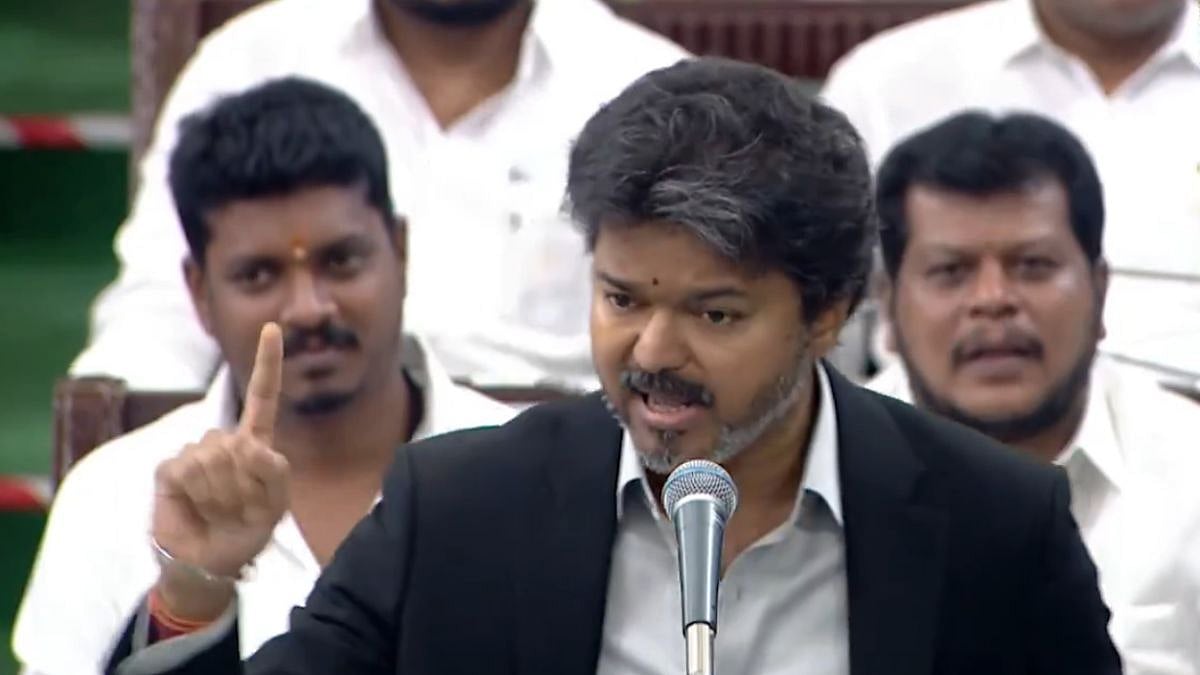
Tamil Nadu Stands Firm On Two-Language Policy, Refuses Land For Navodaya Schools After SC Remarks | X / PTI
Tamil Nadu has reaffirmed its commitment to the Tamil-English two-language policy and refused to allot land for Jawahar Navodaya Vidyalayas (JNVs), despite the Supreme Court urging the state to reconsider its position on Hindi. The dispute centres on the three-language formula followed by Navodaya schools and the state's concerns over language policy and educational autonomy.
Supreme Court urges reconsideration
The Supreme Court on September 17, 2026, urged the Tamil Nadu government to change its approach towards Hindi while hearing a case concerning the establishment of centrally funded Jawahar Navodaya Vidyalayas in every district of the state.
A bench of Justices B.V. Nagarathna and A.G. Masih made the observations while hearing Tamil Nadu's challenge to directions related to setting up the schools, which follow the CBSE syllabus and a three-language formula that includes Hindi.
Justice Nagarathna observed that “it can’t be that Hindi will not be taught in the soil of Tamil Nadu” and said individual states could not function like separate countries. The court also stressed that establishing additional schools would not lower Tamil Nadu's existing educational standards.
The bench urged Chennai and New Delhi not to alienate each other over differences in language and education policy, emphasising the need for dialogue between the state and the Centre.
The Supreme Court declined to recall its earlier direction and granted Tamil Nadu three months to identify suitable land for the proposed schools, while directing the two sides to continue discussions.
Tamil Nadu reaffirms two-language policy
A day after the court's observations, Tamil Nadu School Education Minister Rajmohan Arumugam reiterated that the state would continue to follow its long-standing two-language policy of Tamil and English.
Speaking on September 18, the TVK minister said the government's position remained unchanged and that it would not provide land for establishing Navodaya schools.
“As far as Tamil Nadu is concerned, we follow the two-language policy, and we will continue to do so. There will be no change in our stand,” Arumugam said.
He also clarified that the state was not opposed to Hindi or any other language, but maintained that Tamil's importance and the state's existing educational approach had to be protected.
The minister described the Supreme Court's remarks as observations made during the hearing and not a final verdict in the matter.
Why Tamil Nadu opposes Navodaya Vidyalayas
Tamil Nadu has consistently opposed the establishment of Jawahar Navodaya Vidyalayas, primarily because these institutions follow a three-language formula that includes Hindi.
The state's two-language policy has historical roots in the anti-Hindi agitations and was formalised through a 1968 Assembly resolution under then Chief Minister C.N. Annadurai.
Successive governments in Tamil Nadu have maintained that language education should remain a matter of choice and that the state should retain the authority to determine its educational policies.
The government has argued that implementing the Navodaya school model could undermine its existing language framework and lead to what it views as the indirect imposition of Hindi.
Tamil Nadu remains the only state in India without Jawahar Navodaya Vidyalayas.
What are Jawahar Navodaya Vidyalayas?
Jawahar Navodaya Vidyalayas are centrally funded, co-educational residential schools administered by the Navodaya Vidyalaya Samiti under the Union Ministry of Education.
The institutions follow the CBSE curriculum and aim to provide educational opportunities, particularly to talented students from rural areas.
The proposed establishment of these schools in Tamil Nadu has become a point of disagreement between the state and the Centre because of their language framework and the state's objections to adopting the three-language formula.
Dispute continues between Centre and state
The latest developments highlight the continuing disagreement between Tamil Nadu and the Centre over language policy, educational autonomy and the implementation of centrally sponsored educational initiatives.
While the Supreme Court has called for dialogue and directed the state to identify land for the proposed schools, Tamil Nadu has reiterated that it will not change its two-language policy or provide land for Navodaya Vidyalayas.
The matter remains under judicial consideration, with discussions between the state and the Centre expected to continue.
RECENT STORIES
-
-
-
-
-