Supreme Court Rules Tamil Nadu Govt Cannot Accept Temple Land As Gift, Orders ₹31,000 Monthly Rent
The Supreme Court has declared illegal the gift of 1 acre and 10 cents of temple land to the Tamil Nadu Government for a Taluk Office. Allowing the office to remain under a lease, it ordered Rs 31,000 monthly rent, Rs 1 lakh in costs and payment of arrears within three months.

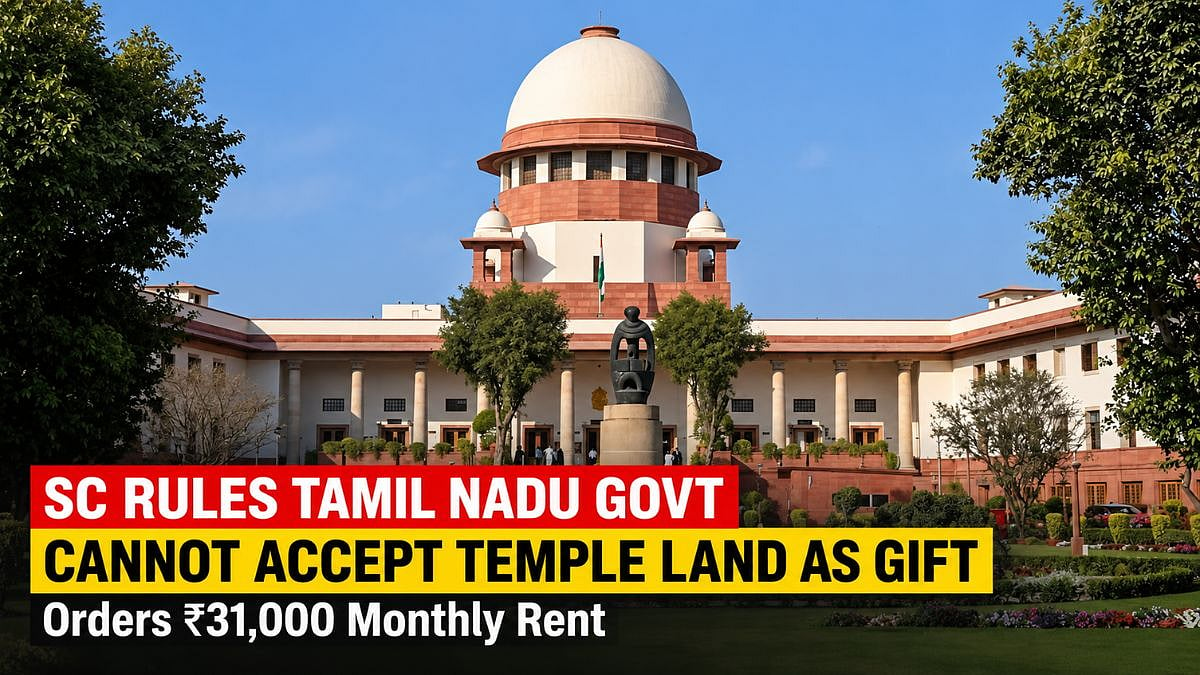
The Supreme Court has ruled that the Tamil Nadu Government cannot claim ownership of temple land gifted for a Taluk Office and has ordered monthly rent of ₹31,000 | AI Generated Image
New Delhi, October 17, 2026: The Supreme Court has ruled that the government is only a custodian of temple properties and cannot claim ownership of land dedicated to a deity, even for a public project.
The Supreme Court has ruled that the Tamil Nadu Government cannot accept temple land as a gift from a trustee, even if the land is intended for public use.
The court made it clear that the government is responsible for protecting temple properties and cannot treat them as its own. It also declared a gift deed transferring temple land for the construction of a government office illegal, LiveLaw and Bar & Bench report.
A bench of Justices PS Narasimha and Alok Aradhe set aside a Madras High Court judgment that had upheld the transfer of 1 acre and 10 cents of land belonging to the Nagapalayam Mariamman-Ponnachiamman Temple in Tamil Nadu’s Erode district.
The land had been transferred to the State Government for the construction of a Taluk Office. The Supreme Court held that the transfer violated the Tamil Nadu Hindu Religious and Charitable Endowments (HR&CE) Act, 1959.
How Temple Land Ended Up With Government
The dispute began on August 30, 2017, when a temporary trustee of the temple executed a gift deed transferring the land at Kodumudi village to the Tamil Nadu Government. The land was meant to be used for constructing a Taluk Office.
The transfer was challenged before the Madras High Court on the grounds that the trustee had no authority to give away temple property without following the legal safeguards.
However, in March 2019, the High Court dismissed the petition, observing that Section 34 of the HR&CE Act did not expressly prohibit the transfer of temple property through a gift deed. Devotees subsequently approached the Supreme Court.
Why Supreme Court Declared The Gift Illegal
The Supreme Court found that the land was an inam property granted for the support and maintenance of the deity. Under Section 41 of the HR&CE Act, such land cannot be transferred through a gift deed. The provision also makes it clear that the government cannot subsequently approve such a gift to make it legally valid.
Justice Alok Aradhe, who authored the judgment, observed, “The State, acting through the Commissioner and other functionaries under the 1959 Act, is a custodian and regulator of temple properties, not their owner.”
The court further stated, “An acceptance of a gift of temple land by a Revenue functionary, however laudable the public purpose it is intended to serve, offends the object of the 1959 Act.”
The bench explained that Section 41 specifically prohibits gifts of inam land dedicated to religious institutions. Although the law allows the government to approve certain transactions that benefit an institution, gifts are excluded from this provision.
The court held that the gift was void from the beginning and could not be made valid through any subsequent government sanction.
It also observed that the gift deed could not have been legally registered under Section 22-A of the Registration Act, 1908, as applicable in Tamil Nadu, without the necessary statutory sanction.
Even if Section 34 had applied, the transfer would still have been invalid because the trustee had not obtained the required sanction from the Commissioner and prior approval from the government.
Temple Property Belongs To Deity, Not Trustees
The Supreme Court emphasised that property dedicated to a deity is meant for the deity and the worshippers. Neither the trustee nor the government can dispose of such property simply because they believe the transfer serves a public purpose.
“A temple property is held for the deity and not for gratuitous disposal by whoever happens to hold the office of trustee, however well-intentioned,” the court observed.
The bench referred to Sections 27 and 28 of the HR&CE Act, which require trustees to manage religious properties with the care and responsibility expected of a prudent person.
It explained that giving away temple property without receiving anything in return cannot ordinarily be considered responsible management because the religious institution receives no corresponding benefit.
The ruling reinforces an important principle: public interest cannot be used to bypass legal protections meant to safeguard religious properties.
Court Questions Tamil Nadu Government’s Conduct
The Supreme Court also criticised the Tamil Nadu Government for defending the transfer despite its own HR&CE Department acknowledging that the land belonged to the deity and that the trustee lacked the authority to give it away.
The Revenue Department had changed the land records, reclassified the property as government land and proceeded with the construction of the Taluk Office using public funds.
Despite the legal objections, the State continued to defend the transaction until the Supreme Court sought clarification from the Secretary in charge of Endowments in February 2022.
The court observed that the government should have recognised its responsibility to protect temple property without requiring judicial intervention.
“The State, as custodian, cannot unilaterally usurp, nor permit any of its officers to usurp, the property of the religious/charitable institutions it is charged to protect,” the court held.
The bench made it clear that the government’s role as a regulator does not give it ownership rights over temple properties.
Why Court Allowed Government To Retain Land
Despite declaring the gift deed illegal, the Supreme Court decided not to disturb the government’s continued occupation of the land under a lease arrangement.
The bench considered that a Taluk Office had already been constructed using public funds and was serving the administrative needs of the area. Removing the government from the property would have affected an existing public facility.
However, the court made it clear that the government could retain the land only as a lessee and not as its owner.
The decision strikes a balance between protecting the temple’s property rights and allowing an already constructed public office to continue functioning.
Tamil Nadu Govt Ordered To Pay ₹31,000 Monthly Rent
The Supreme Court directed the Tamil Nadu Government to pay ₹31,000 as monthly rent for the temple land, increasing the amount from ₹13,235 fixed earlier by a committee.
The court arrived at the revised amount by applying the State Government’s prescribed valuation formula. Under this formula, religious institution land was valued at 225% of its guideline or market value, whichever was higher.
The combined value of the land and building was calculated at ₹3.04 crore. Applying the committee’s rental formula of 0.1% of the total value, the court calculated a monthly rent of approximately ₹30,438 and rounded it to ₹31,000.
The enhanced rent will apply retrospectively from March 8, 2019, when the land was handed over for construction.
The government has been directed to clear all outstanding rent within three months after adjusting any amounts already paid.
The court also imposed costs of ₹1 lakh on the State Government, payable to the temple within eight weeks.
Temple Trust To Decide Lease Terms
The Supreme Court clarified that the temple trust would retain the authority to decide the lease period, renewal and other conditions in accordance with the HR&CE Act.
It directed that the temple’s interests must remain the primary consideration while determining these terms.
The monthly rent must be revised once every three years and cannot be reduced below ₹31,000.
The bench also directed the State Government and the HR&CE Department to strictly follow Sections 34, 34-A and 41 of the Act and the relevant rules before approving or carrying out transactions involving religious institution properties.
It stressed that decisions involving such properties must benefit the religious institution rather than merely serve the government’s administrative convenience.
Who Represented The Parties In Court?
Advocate S Ravi Shankar represented the appellants, while Additional Advocate General Haripriya Padmanabhan and advocate Kanika Kalaiyarasan appeared for the Tamil Nadu Government.
Senior Advocate M Sathayanarayan represented the HR&CE Department along with advocates B Karunakaran and Jeyasri. Advocate KL Janjani appeared for the temporary trustee.
Also Watch:
Senior Advocate Shailesh Madiyal assisted the Supreme Court as amicus curiae, along with advocates Anchit Singla, Amit Pai, Pankhuri Bhardwaj, Muktha Rao and Ananya Mehrotra.
The judgment makes clear that government control over temple administration does not amount to ownership of temple assets. Even when land is required for public purposes, authorities must follow the law and protect the interests of the religious institution to which it belongs.
To get details on exclusive and budget-friendly property deals in Mumbai & surrounding regions, do visit: https://budgetproperties.in/
RECENT STORIES
-
-
-
-
-