Supreme Court Questions Medicine Markups, Suggests Uniform 16 Per Cent Cap Above Retailer Price
The Supreme Court questioned steep medicine markups and suggested a uniform 16% cap over the price to retailer. The bench cited a cancer drug costing about ₹3,000 to retailers but carrying an MRP of ₹27,000. The Centre said any pricing solution must balance competing interests. The matter will be heard again on October 12.

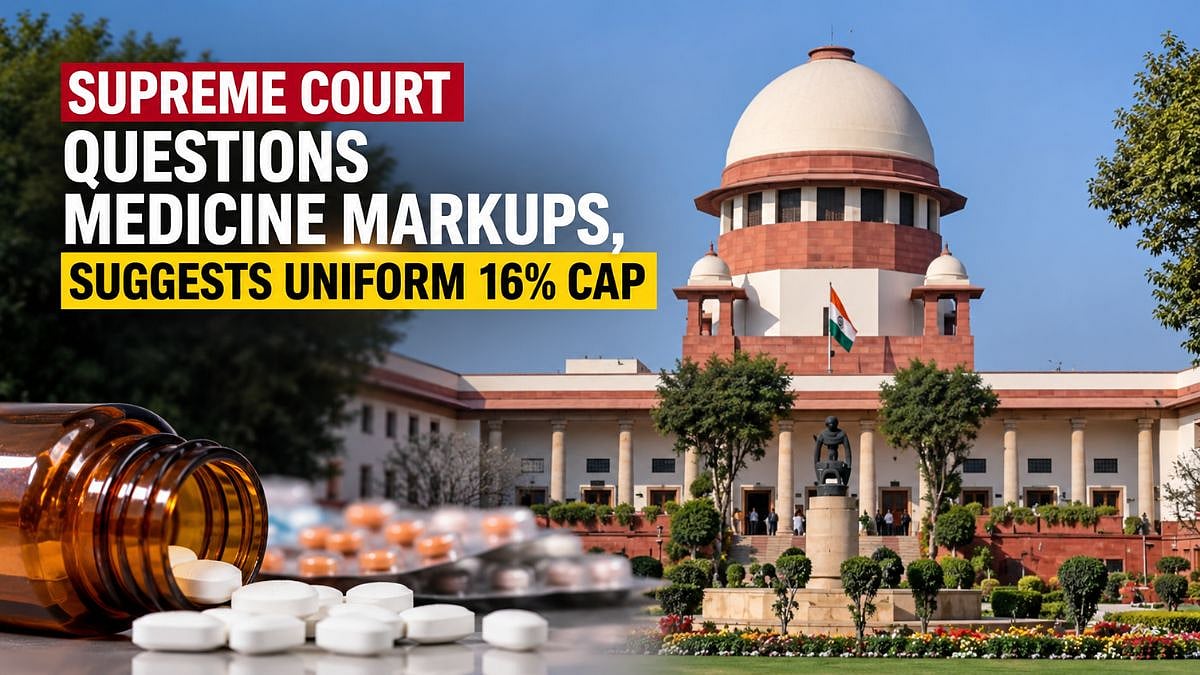
The Supreme Court has questioned wide gaps between retailer prices and MRPs of medicines, including cancer drugs | AI Generated Image
New Delhi, September 29, 2026: The Supreme Court on Tuesday questioned the Centre over steep markups on cancer drugs and other medicines, asking why there could not be a uniform rule limiting the maximum retail price (MRP) to 16% above the price to the retailer (PTR).
A bench of Justices Vikram Nath and Sandeep Mehta was hearing petitions concerning the regulation of medicine prices, generic prescriptions and controls on medical devices under the Drugs (Prices Control) Order (DPCO), 2013.
The court’s questions put the spotlight on the wide gap between what retailers pay for some medicines and what patients may ultimately be charged, Live Law reports.
Medicine Price Disparity
Justice Mehta highlighted the disparity by referring to a cancer drug with an MRP of around Rs 27,000 despite its price to the retailer being only about Rs 3,000.
“Just see the drastic difference,” he observed, reiterating concerns raised in earlier hearings about markups reaching 10 times or more.
The bench also questioned the distinction between essential and non-essential medicines under the DPCO.
“Why not a uniform criteria of 16% and nothing beyond that? Every medical device, every medicine is covered under the Essential Commodities Act. If it is an essential item, can it be left out of the DPCO?” the bench asked.
The questions go to the heart of the petitions before the court: whether medicines and medical devices can remain outside tighter price controls despite their importance to patients.
Taxpayer Burden
The bench also pointed out that corporate hospitals often insist that patients buy medicines from their in-house pharmacies. When treatment is covered under government schemes such as Ayushman Bharat or other public health programmes, inflated costs are ultimately borne by taxpayers.
This means the impact of steep markups may extend beyond individual patients. Where the government reimburses treatment costs, higher medicine prices can also put pressure on public funds.
Solicitor General Tushar Mehta, appearing for the Centre, acknowledged the issue but said a balanced solution would have to be found.
“I am not saying the petitioners are wrong, but some way which balances equities will have to be found. As I understand, pharma companies are not the ones benefiting from it,” he submitted.
Price Controls Under Scrutiny
The petitions, including those by advocate Kishan Chand Jain and others, highlight the difference between scheduled and non-scheduled medicines.
Scheduled medicines, which constitute a relatively small portion of the market, face ceiling prices. Non-scheduled formulations, estimated at around 80% or more by number and value, give manufacturers greater freedom to set initial MRPs, subject mainly to an annual increase limit of 10%.
The petitioners argue that this system allows steep markups that burden patients, some of whom sell assets or jewellery to afford treatment. They also contend that the higher prices drain public funds through reimbursements.
The court has kept the matter for further hearing on October 12.
Court’s Sharp Words
The same bench had last week criticised such pricing gaps in unusually strong terms, describing them as “broad daylight dacoity”, “extortion” and “absolute rampage and carnage” against patients while questioning regulatory silence.
Also Watch:
ALSO READ
The latest hearing has now sharpened the focus on whether a uniform 16% limit above the retailer price could address these gaps, even as the Centre says any solution will have to balance competing interests.
To get details on exclusive and budget-friendly property deals in Mumbai & surrounding regions, do visit: https://budgetproperties.in/
RECENT STORIES
-
-
-
-
-