Supreme Court Pulls Up States Over Menstrual Hygiene Gaps In Schools, Orders Surprise Inspections
The Supreme Court has pulled up States and UTs over gaps and inconsistencies in reports on menstrual hygiene facilities in schools. It ordered DEOs to form teacher teams for surprise inspections of all schools and directed future reports to identify gaps, causes and timelines for fixing them.

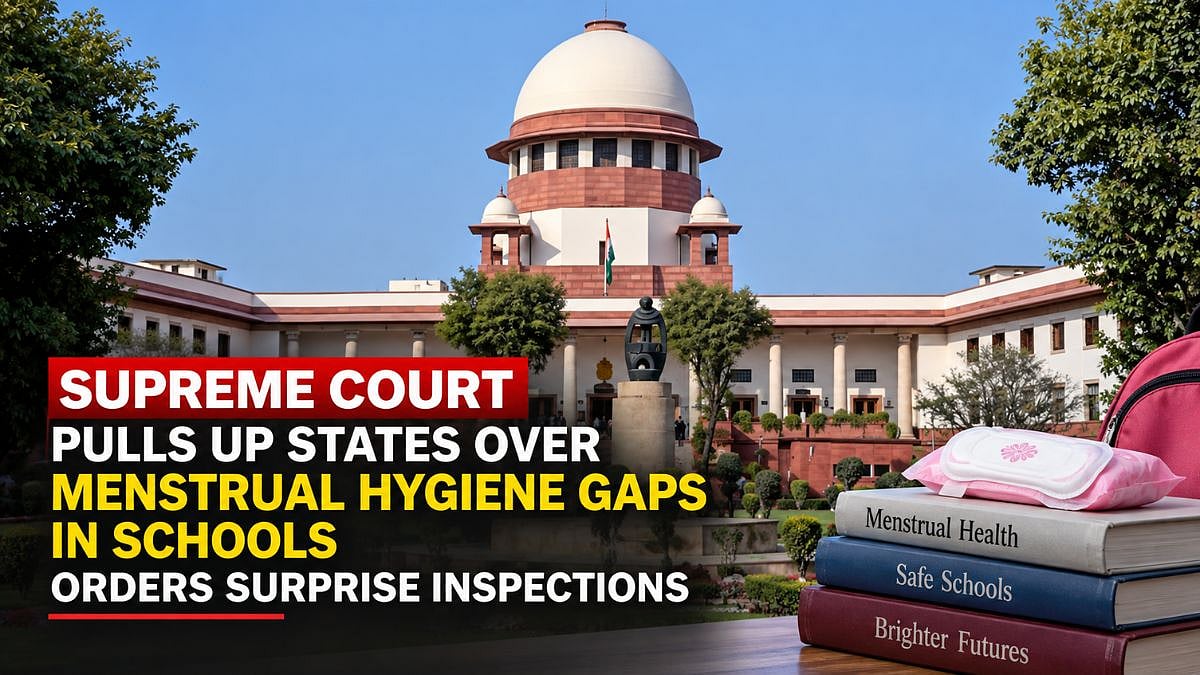
The Supreme Court has ordered ground-level checks of school toilets, menstrual facilities and waste-disposal systems across India | AI Generated Image
New Delhi, September 16, 2026: The Supreme Court has expressed dissatisfaction with the way several States and Union Territories have implemented and reported compliance with its directions on menstrual hygiene facilities in schools, saying some responses appeared to be a “mere formality” and showed “non-application of mind”.
A Bench of Justices JB Pardiwala and R Mahadevan, while monitoring compliance with its judgment in Jaya Thakur v. Government of India and Others, said that although substantial progress had been made, much more needed to be done to make the right to menstrual health meaningful, Live Law and Bar & Bench report.
Numbers Don’t Tell The Whole Story
The Court had, on January 30, ruled that the right to menstrual health was part of the right to life under Article 21 of the Constitution. It directed nationwide implementation of the Union government’s Menstrual Hygiene Policy for School-going Girls for adolescent girls from Classes 6 to 12.
The directions covered government-run and privately managed schools in urban and rural areas. Schools were required to have functional gender-segregated toilets with usable water connections, washing facilities with soap and water, toilets that ensure privacy and accessibility for children with disabilities, free sanitary napkins, menstrual hygiene management (MHM) corners and safe waste-disposal systems.
On May 25, the Court sought fresh reports on the progress made. The Union government subsequently filed a consolidated affidavit on August 31.
According to the affidavit, of the 39,439 girls’ toilets identified as needing to be made functional, 30,458 had been constructed, 4,236 were under construction and a gap of 4,745 remained.
The Union also reported expansion in handwashing facilities, distribution of sanitary napkins, MHM corners, vending machines and waste-disposal mechanisms. Several States and UTs reported complete or near-complete coverage in various categories.
But during the September 1 hearing, the Court made it clear that impressive numbers on paper could not substitute for facilities that actually work and reach students.
“Having carefully gone through the reports by the States/UTs, we are constrained to say that we are discontent with the manner in which compliance is reported. The response by some States exhibit non-application of mind or rather mere formality. For instance, where the response shall be subjective, some States have indicated compliance through mere statistics or objective yes/no responses,” the Court said.
Claims Of Full Compliance Under Scanner
The Court found discrepancies between claims of complete coverage and the figures supplied by several States.
Some States claimed saturation of toilet facilities even though the number of toilets accessible to children with special needs was lower than the total number of schools. Assam’s figures for handwashing facilities did not correspond with its total number of schools, while Tamil Nadu claimed saturation despite having fewer schools with gender-segregated toilets than its total school strength.
The Court also questioned claims concerning sanitary-napkin vending machines and provision in Karnataka, Jammu & Kashmir, Odisha and Arunachal Pradesh, where the reported numbers were lower than the total number of schools. It found discrepancies in waste-disposal data submitted by Bihar, Gujarat, Delhi, Jharkhand, Rajasthan and Uttar Pradesh. Punjab’s report was found to be illegible.
Several States had also said they issued directions or circulars to comply with the Court’s orders but did not explain how the facilities had actually reached students.
“It is one thing to say that policy exists, it is another thing that it is reaching the beneficiaries,” the Court observed.
The distinction is crucial. A circular or a compliance percentage has little value for a schoolgirl if the toilet is unusable, water is unavailable or menstrual products cannot be accessed when needed. The Court’s scrutiny shifts the focus from administrative claims to the everyday reality inside schools.
Future Reports Must Show What Is Missing
The Court has now changed the way States and UTs must report compliance. Instead of concentrating on what they have already achieved, their next reports must identify what remains to be done.
“The responses shall now reflect the gaps instead of what has already been achieved,” the Court said.
States and UTs have been asked to identify schools that still lack functional gender-segregated toilets with usable water connections, adequate accessibility and privacy, menstrual absorbents and functioning waste-disposal systems. They must also identify the reason for each gap and state how much time will be required to address it.
The Court separately sought information about the appointment of cleaners for school toilets. It noted that some States had not appointed cleaners and had left schools to manage the work themselves, while others referred to unspecified internal arrangements or provided no information. States and UTs have been asked to explain how they are ensuring that school toilets remain functional.
“The States/UTs shall not be lethargic in implementing the changes meant for children with special needs. The authorities shall be more vigilant towards such children. These children face barriers that go beyond ordinary challenges of schooling,” the Court observed.
It added that the Union and State governments must work together to make the right to menstrual health more meaningful, saying, “The progress may be slow but it shall be meaningful.”
Surprise Inspections To Test Ground Reality
The Court’s earlier judgment required District Education Officers (DEOs) to periodically inspect school infrastructure, including toilets, washing facilities, menstrual absorbents, sanitary-waste disposal and awareness measures. The inspections were also supposed to collect anonymous feedback from students.
The Court has now directed DEOs to form teams of teachers to carry out surprise inspections of all schools within their jurisdiction. The teams will examine compliance with the directions contained in the January 30 judgment.
States and UTs must also place on record the findings from DEO inspections and the feedback received from students.
“We are directing a change in the manner of collection of data and reflection of responses thereto for the next cycle. To get a better understanding of the situation on ground, the District Education Officer shall form teams of teachers to conduct surprise inspections across districts for all the schools within its jurisdiction,” the Court said.
The move towards surprise inspections could provide a more realistic picture than reports prepared through administrative channels alone, particularly when the Court itself has found inconsistencies in the data submitted by States.
Court Pushes For Greener Menstrual Products
The Bench also modified its earlier direction requiring schools to provide free oxo-biodegradable sanitary napkins manufactured in compliance with ASTM D-6954 standards.
The change followed an application by the Indian Compostable Polymer Association, which informed the Court that oxo-biodegradable sanitary napkins could break down into microplastics and nanoplastics and worsen environmental pollution.
Schools will now be required to provide free “biodegradable, biocompatible and compostable sanitary napkins in compliance with ISO 17088 read with IS 5405 standards”.
The Court referred to products made from materials such as bamboo, jute, banana, starch and corn as sustainable alternatives. State and Union Territory governments have been made responsible for ensuring that the products provided are safe and effective.
The Court said biodegradable sanitary napkins were preferable because they were free from harmful chemicals, bleaching agents and synthetic fragrances that could pose long-term health risks, while also reducing the environmental burden inherited by future generations.
“This is about making sure that the choices we make right now, do not create problem for the young children after a few decades,” it observed.
Sustainability Becomes Part Of The Conversation
The Court also asked States and UTs to gradually move towards environmentally friendly and scientifically validated menstrual absorbents, including biodegradable sanitary napkins, cloth-based or reusable sanitary napkins, menstrual cups and period underwear.
Governments may begin by promoting reusable sanitary napkins and educating girl students about their use and the precautions that need to be taken.
Also Watch:
ALSO READ
“Afterall, sustainability is an act of care for the next generation,” the Court observed.
The direction adds an environmental dimension to an issue that is fundamentally about health, dignity and access. But the Court’s wider message remains clear: standards and policies must translate into facilities that students can actually use, and compliance must be measured by conditions on the ground rather than paperwork alone.
The matter will next be heard on September 29.
To get details on exclusive and budget-friendly property deals in Mumbai & surrounding regions, do visit: https://budgetproperties.in/
RECENT STORIES
-
-
-
-
-