'Social Media Users Must Get Copies Of Content Blocking Orders': Punjab And Haryana High Court
The Punjab and Haryana High Court ruled that social media users must receive copies of notices seeking to block their content. It set aside a Haryana Police notice to Meta over Haryana 24 News Network’s Facebook page, ordering restoration within 24 hours and holding that the issuing officer lacked the required authority.

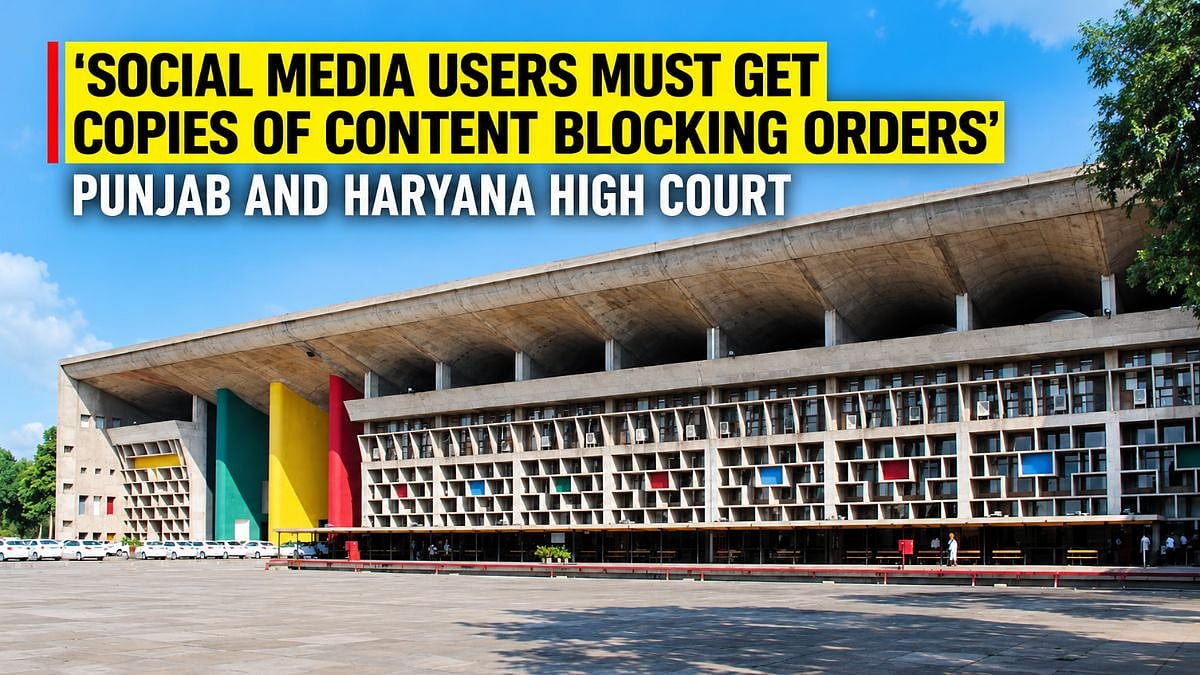
The Punjab and Haryana High Court has directed authorities to inform affected users about social media blocking notices to protect their right to a fair hearing | AI Generated File Image
Chandigarh, October 20, 2026: The Punjab and Haryana High Court has ruled that authorities must provide social media users with a copy of any notice sent to an online platform seeking to block their content or page. The court said users must be informed of such action to ensure they have a fair opportunity to challenge it.
Justice Tribhuvan Dahiya made the observation while setting aside a notice issued by the Haryana Police to Meta Platforms Inc., directing it to block the Facebook page of Haryana 24 News Network Private Limited in India.
In its judgment delivered on October 5, the court held that denying users information about such action violated the principles of natural justice, Live Law and Bar & Bench report.
What Led To The Facebook Page Ban?
The case arose after the Facebook page of Haryana 24 News Network Private Limited was blocked in India on August 21, 2026, following a communication from the Superintendent of Police, Yamuna Nagar, to Meta under Section 79(3)(b) of the Information Technology Act.
The company approached the High Court, arguing that it had received neither prior notice nor a copy of the communication sent to Meta. It said it was unaware of the reasons behind the blocking of its page and the material relied upon by the authorities.
Police Cite Alleged Intimidation
The Haryana government defended the action, submitting that one of the company’s directors was facing an extortion case and had allegedly used the Facebook page to intimidate the victim and witnesses through videos and messages.
According to the police, the Superintendent of Police had issued the notice to Meta to disable access to the page. The state government also argued that the officer had been delegated the authority to issue such a communication.
Court Questions Police Officer’s Authority
The High Court found that the Superintendent of Police did not have the authority to issue the notice under the Information Technology (Intermediary Guidelines and Digital Media Ethics Code) Rules, 2021.
The rules require such communications from the police administration to be issued by an officer not below the rank of Deputy Inspector General of Police (DIGP), specifically authorised by the appropriate government.
The court rejected the state’s argument that this power could be delegated to an officer of a lower rank, noting that no legal provision permitting such delegation had been identified.
“Thus, it is evident that the Superintendent of Police usurped the power not vested in him in issuing the said intimation in flagrant violation of statutory provisions; this is sheer highhandedness and arbitrary exercise of power,” the court observed.
Users Have A Right To Know
The High Court also examined whether authorities were required to inform users when asking social media platforms to block their content.
It noted that Rule 3(2) of the 2021 Rules does not explicitly require the government to notify an affected user before sending such a communication to an intermediary. However, the court held that providing a copy of the communication was necessary to protect the user’s right to a fair hearing.
“Accordingly, a copy of the intimation must be furnished to the user when it is sent to the intermediary. This will make the procedure of sub-rule (2) to Rule 3 compliant of the primary tenets of natural justice and constitutionally valid,” the court said.
The ruling highlights the importance of transparency in online content restrictions. Without knowing why their content has been blocked, users cannot effectively question the decision or present their defence.
Why Grievance Redressal Was Not Enough
The Haryana government argued that the company should approach Meta’s grievance redressal mechanism to seek restoration of its Facebook page.
However, the High Court rejected the argument, pointing out that the company had not received a copy of the notice from either the police or Meta. It said a user could not effectively challenge a blocking decision without knowing the reasons and material behind it.
“In such a situation, approaching the grievance redressal mechanism by it will be a futile exercise and seriously impair its right to defend,” the court observed.
Referring to the Supreme Court’s 2023 decision in Madhyamam Broadcasting Ltd. v. Union of India, the court reiterated that the right to a fair hearing and protection against bias are fundamental principles of natural justice.
Facebook Page To Be Restored Within 24 Hours
The High Court set aside the notice issued by the Superintendent of Police, Yamuna Nagar, on August 21, 2026, and directed the officer to instruct Meta to restore the company’s Facebook page to its original status within 24 hours of receiving a certified copy of the court’s order.
The court also clarified that authorities could take action if they found any content on the page that was prohibited by law or being used for illegal activities. However, any fresh notice must be issued by a duly authorised officer, and a copy must be provided to the company immediately after it is sent to the intermediary.
A Reminder On Digital Rights
The judgment underlines that government action against online content must follow the procedure laid down by law. It also makes clear that access to a grievance redressal mechanism has little value if the affected user is kept unaware of the reasons for the restriction.
The ruling reinforces the principle that the power to restrict online content must be accompanied by procedural safeguards, giving affected users a meaningful opportunity to defend themselves.
Also Watch:
Who Represented The Parties?
Advocates Namit Khurana and Gagan Budhiraja represented Haryana 24 News Network Private Limited.
Senior Panel Counsel Dheeraj Jain and Central Government Counsel Amrita Singh represented the Union government, while Additional Advocate General Bhupender Singh appeared for the Haryana government.
The High Court disposed of the petition after issuing the directions.
To get details on exclusive and budget-friendly property deals in Mumbai & surrounding regions, do visit: https://budgetproperties.in/
RECENT STORIES
-
-
-
-
-