Punjab Blasts: Busy With Handling AAP Crisis In RS, CM Bhagwant Mann Blames BJP For Explosions, Forgets He Holds Home Portfolio In State
As Punjab reels from coordinated explosions near Jalandhar and Amritsar security hubs, Chief Minister Bhagwant Mann faces intense backlash for prioritising his party’s Rajya Sabha crisis over his official duties as the state’s primary custodian of law and order

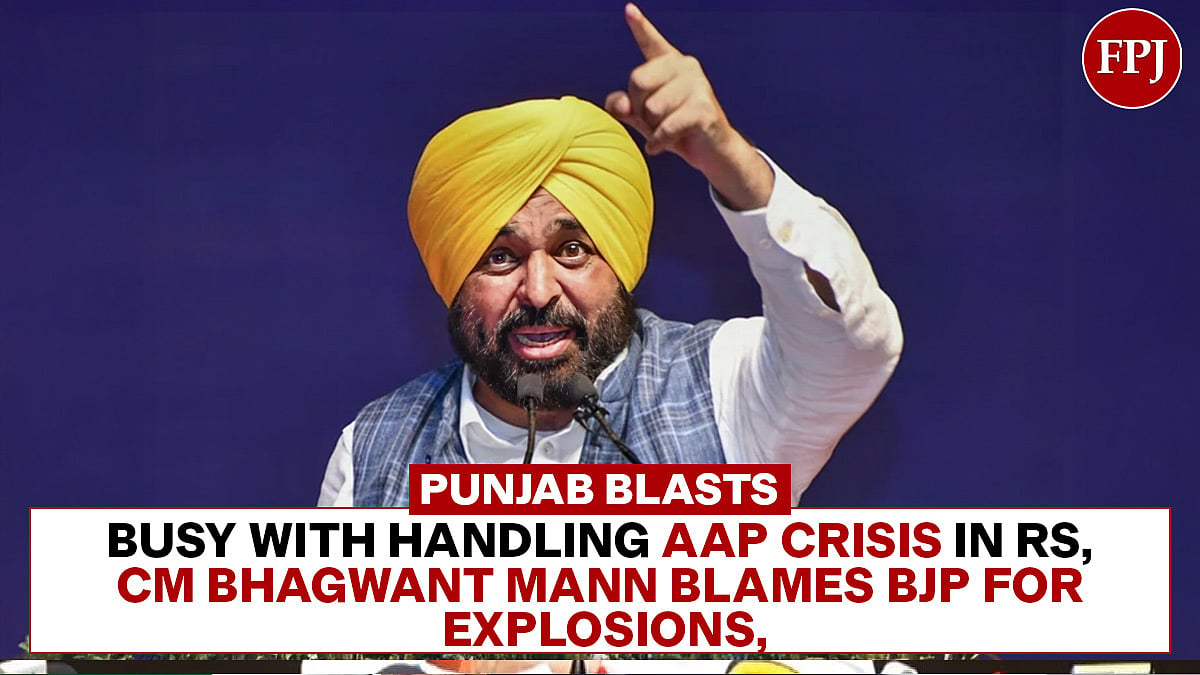
A day after Punjab was shaken by two separate explosions occurring in high-security zones near Jalandhar and Amritsar, Punjab Chief Minister Bhagwant Mann on Wednesday instead of admitting security lapses in his state has resorted to politicising the issue to cover up his failures.
Mann, who also holds portfolio of home affairs in his government, alleged that the blasts were "designed by the BJP" as a strategic manoeuver to polarise voters ahead of the Punjab Assembly elections scheduled for next year. The chief minister claimed the BJP intends to "take votes with these blasts" and publicly demanded that the party "stop these blasts" immediately.
These incidents, taking place within hours of each other and targeting the perimeters of defence establishments, have plunged the state into a state of high alert. However, the physical security breach is only half of the story.
Regardless of the gravity of the situation, Mann is currently embroiled in a desperate fight for the survival of the Aam Aadmi Party’s legislative strength following a mass defection of its Rajya Sabha MPs to the BJP.
Coordinated blasts near security installations
The first incident unfolded at approximately 8:00 pm on Tuesday outside the main gate of the Border Security Force Punjab Frontier headquarters in Jalandhar. A scooter belonging to a food delivery worker, Gurpreet Singh, suddenly caught fire and exploded with such violence that the shockwave shattered the glass panes of shops and cars up to 300 metres away.
While Jalandhar Police Commissioner Dhanpreet Kaur initially adopted a cautious tone, stating it was too early to confirm a conspiracy, the sheer intensity of the blast sent waves of panic through the high-security district.
Just two hours later, the situation escalated further 100 kilometres away in Amritsar. An explosion occurred along the outer boundary wall of the Army’s Khasa Camp on the Attari Road. Amritsar Rural SSP Suhail Qasim Mir provided details said fragments resembling metal sheets were found embedded in the wall, indicating that an explosive device had been intentionally hurled at the camp. Preliminary reports suggest that masked individuals were seen fleeing the scene immediately after the detonation.
These incidents do not exist in a vacuum. They echo the dark history of the 2016 Pathankot Airbase attack and the 2015 Gurdaspur (Dinanagar) strike, both of which targeted security infrastructure.
Munir strategy and shadow of Operation Sindoor
According to reports, Intelligence Bureau on May 1 warned that Pakistan’s Army Chief, Field Marshal Asim Munir, has activated a two-layered terror plan to internationalise the Kashmir issue. First, is to reviving home-grown terror modules in the valley to disrupt tourism and divert security forces, followed by a spectacular cross-border attack using Pakistani operatives from launch pads.
It is not clear if the Punjab blasts are linked to Rawalpindi's evil designs on Kashmir but the timings of the incidents cannot be ignored.
The blasts come at a time when India marks the first anniversary of Operation Sindoor, a 2025 Indian military campaign that successfully dismantled terror launch pads across the International Border and Line of Control.
The blasts in Jalandhar and Amritsar follow a disturbing pattern of hybrid terror incidents seen over the last year, including a grenade attack on the Crime Investigation Agency office in Moga in November 2025 and an IED detonation on the Sirhind railway track in January 2026. Investigations into these events, including the premature IED blast at Shambhu in April 2026, have consistently pointed toward handlers located in Pakistan and Malaysia, suggesting a coordinated, cross-border effort to destabilise Punjab.
Absent state's home minister
While the border state grapples with these security threats, the man responsible for its internal safety, Bhagwant Mann, has been largely absent. Mann is currently busy handling a political crisis after seven AAP Rajya Sabha MPs merged with the BJP.
The chief minister’s preoccupation with party priorities has provided significant ammunition to his political rivals. Punjab Congress chief Amrinder Singh Raja Warring and Shiromani Akali Dal leader Bikram Singh Majithia have been vocal in their criticism, asking if the state’s security has been sacrificed at the altar of political optics. BJP general secretary Parminder Singh Brar also lashed out at Mann for poor law and order in the state.
With memories of Pathankot still fresh, Punjab cannot afford a lapse in its security.
RECENT STORIES
-
-
-
-
-