‘Our Nation Has Been Driven Back’: Supreme Court Criticises Its Own 1987 Ruling On Delayed Appeals
The Supreme Court criticised the repeated use of its 1987 Collector, Land Acquisition v. Katiji ruling to justify delayed appeals. Dismissing appeals by Karvy Stock Broking and C Parthasarathy, the Bench stressed that SEBI, government bodies and private litigants must follow legal deadlines, with no preferential treatment for public authorities.

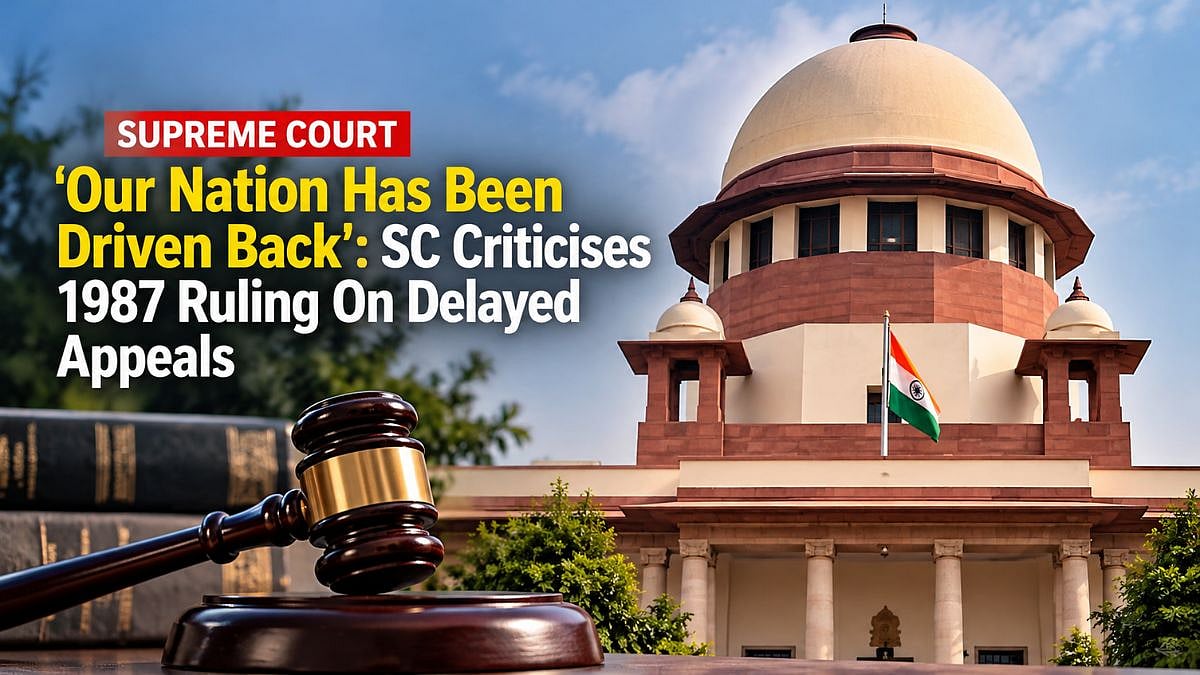
The Supreme Court stresses strict compliance with appeal deadlines while questioning the repeated use of a landmark judgment on condonation of delay | AI Generated Image
New Delhi, October 9, 2026: The Supreme Court on Friday, October 9, expressed strong displeasure over its own 1987 judgment that allowed a delay of just four days in filing an appeal. The court observed that the ruling had been repeatedly used by litigants to justify delays in legal proceedings, even though it was originally delivered in a case involving a minor delay.
A Bench of Justices Dipankar Datta and Sheel Nagu made the remarks while dismissing appeals filed by Karvy Stock Broking Limited and its former Chairman and Managing Director C Parthasarathy. The appeals challenged orders passed by the Securities Appellate Tribunal (SAT), which had refused to excuse delays in challenging penalties imposed by the Securities and Exchange Board of India (SEBI), Live Law reports.
‘Our Nation Has Been Driven Back’
Expressing concern over how the 1987 ruling had been used over the years, the Supreme Court questioned its continuing influence on cases involving delayed appeals.
“Our nation has been driven back because of the decision in 1987, when for condoning a delay of only four days, this Court wrote about 15–16 pages. And that is the decision in Collector, Land Acquisition v. Katiji, which has now been used so long as if this is the panacea for all ills in condonation of delay applications,” the Bench remarked.
What Did The 1987 Judgment Say?
In its 1987 judgment in Collector, Land Acquisition v. Katiji, the Supreme Court had supported a liberal approach towards condoning delays in legal proceedings. It held that substantial justice should take priority over technical considerations.
However, the court has now raised concerns about the way this judgment has been relied upon in subsequent cases. Its observations highlight the difficulty of balancing flexibility in legal procedures with the need to ensure that appeals are filed within prescribed deadlines.
Court Draws A Line On Delayed Appeals
The Bench also referred to subsequent Supreme Court judgments, including Sheo Raj Singh, while explaining how courts should deal with applications seeking condonation of delay.
It emphasised that there is a difference between a court exercising its discretion to excuse a delay and an appellate court reviewing how another judicial forum has exercised that discretion. The distinction is important because an appellate court must consider the earlier forum’s decision rather than simply treating every request for condonation of delay in the same manner.
‘We Will Be Equally Harsh With SEBI’
The Supreme Court also made it clear that government authorities and private litigants cannot expect different treatment when they approach courts after missing legal deadlines.
“We will be equally harsh with the SEBI when it comes up before us with time-barred appeals. We will not recognize any distinction between a private litigant or a public litigant or a government...From now onwards, you will come in time,” the Bench remarked.
The observation sends a clear message about the importance of following legal timelines. The court’s position was that public authorities should not receive special consideration merely because they represent the government or a regulatory body.
What Is The Karvy Stock Broking Case?
The matter arose from a SEBI order dated April 28, 2023, concerning the misuse of clients’ securities by Karvy Stock Broking Limited.
According to SEBI’s findings, Karvy had misused clients’ securities to raise funds and diverted approximately Rs 1,442.95 crore to related group companies. Following these findings, the regulator imposed a penalty of Rs 13 crore on Karvy and Rs 8 crore on Parthasarathy. Both were also barred from accessing the securities market for seven years.
Tribunal Refused To Excuse Delay
Karvy and Parthasarathy challenged the penalties before the Securities Appellate Tribunal. However, on September 9, 2026, the tribunal refused to condone the delays in filing their appeals.
The matter subsequently reached the Supreme Court, which dismissed their appeals against the tribunal’s orders. As a result, the tribunal’s decisions remain undisturbed, and the Supreme Court did not examine the merits of SEBI’s findings.
Who Represented The Parties?
Senior Advocates Mukul Rohatgi and Balbir Singh represented the appellants, Karvy Stock Broking Limited and C Parthasarathy.
Additional Solicitor General N Venkataraman appeared on behalf of SEBI.
Also Watch:
The Supreme Court’s observations bring renewed attention to a key question in the justice system: how much flexibility should courts allow when litigants fail to meet legal deadlines? While the 1987 judgment placed substantial justice above technical considerations, the latest remarks underline the need to prevent that flexibility from becoming a routine justification for delayed appeals.
To get details on exclusive and budget-friendly property deals in Mumbai & surrounding regions, do visit: https://budgetproperties.in/
RECENT STORIES
-
-
-
-
-