Nepal Landslide Threat: Viral Video Shows Huge Debris Flow Temporarily Blocking Chaulani River In Darchula
A massive landslide in Nepal’s Darchula district partially blocked the Chaulani River on September 4, triggering temporary flash-flood fears downstream. A dramatic video of the mountainside collapsing and sending huge debris into the river has gone viral. Authorities moved several families to safer locations and deployed security teams.

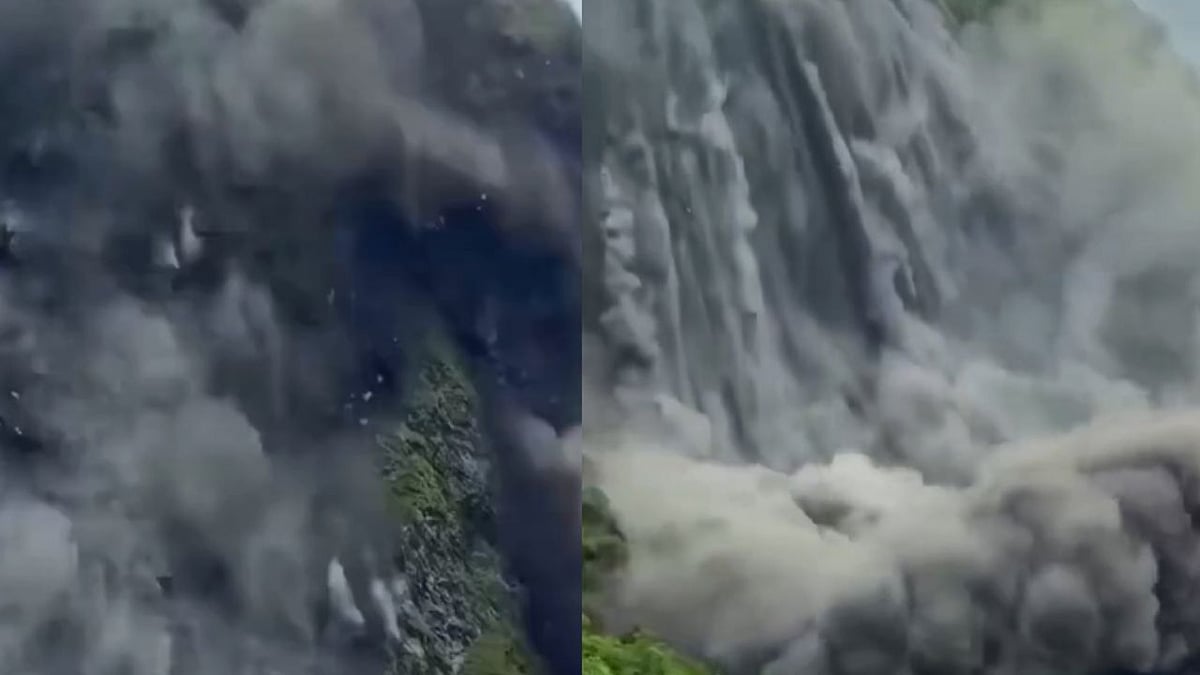
A massive landslide in Nepal’s far-western Darchula district triggered temporary flash-flood fears on Friday, September 4, after huge volumes of debris cascaded into the Chaulani River, partially obstructing its flow and raising concerns for communities living downstream.
The landslide occurred in the Bhattar area of Api Himal Rural Municipality, where a section of the steep Himalayan mountainside gave way and sent rocks, soil and other debris plunging into the river valley.
Dramatic videos of the incident are now circulating widely online. The viral video shows a huge section of the mountainside collapsing in a torrent of debris, sending thick clouds of dust through the valley as material crashes towards the river below. The scale of the landslide has drawn attention online, although the footage depicts a localised incident and should not be confused with Nepal’s much larger August disaster.
River temporarily blocked
The landslide debris disrupted the Chaulani, also known as the Chameliya, with reports indicating that the river was partially blocked for a period. One local account said the water was completely obstructed for around 30 minutes before the river gradually forced its way through the accumulated debris.
However, continued landslide activity raised concerns that additional material could fall into the river, potentially creating a larger natural dam. Authorities feared that a sudden breach of such a blockage could send a surge of water downstream with little warning.
The District Administration Office in Darchula subsequently alerted residents living along the riverbanks and urged them to remain vigilant and move to safer locations if necessary. Several families were reportedly shifted as a precaution, while security personnel were deployed to monitor the situation.
Officials in Sudurpashchim Province also directed authorities to remain prepared and closely watch the river and surrounding slopes.
Flash-flood threat eases
By Friday evening, the immediate threat appeared to have reduced as the Chaulani gradually cleared the landslide material. Officials said the river had begun flowing freely again after washing away debris and sediment.
Despite the improvement, monitoring continued because of the possibility of further landslides in the mountainous region. Limited mobile connectivity in the remote area also made it difficult to obtain continuous real-time information after dark.
The Chaulani-Chameliya river system originates in the Api Himal region before eventually joining the Mahakali River, which forms part of the Nepal-India border. Because of this, authorities have also remained attentive to downstream areas, including regions near India’s Pithoragarh district.
Not linked to August's catastrophic floods
The latest incident is separate from the catastrophic disaster that struck parts of Nepal in late August following a high-altitude rock-and-ice avalanche near the Nepal-Tibet border.
That disaster unleashed massive volumes of water and debris into the Trishuli River system, causing widespread destruction and a huge loss of life. The fresh landslide in Darchula, while serious, is a separate and more localised event.
The incident has nevertheless once again highlighted the vulnerability of Nepal’s steep Himalayan terrain, particularly during and after the monsoon, when saturated slopes can suddenly collapse and temporarily block rivers.
For now, the Chaulani River is flowing again, but authorities continue to monitor the area for further landslide activity and any renewed threat to communities downstream.
RECENT STORIES
-
-
-
-
-