'Faced Challenges Before By Staying United During COVID-19': PM Narendra Modi Tells Lok Sabha Amid West Asia Crisis
Prime Minister Narendra Modi informed the Lok Sabha that the "concerning" West Asia conflict has created "unforeseen challenges" for India's economy and national security, while affirming that the "safety of Indians is our highest priority" amid ongoing global trade disruptions

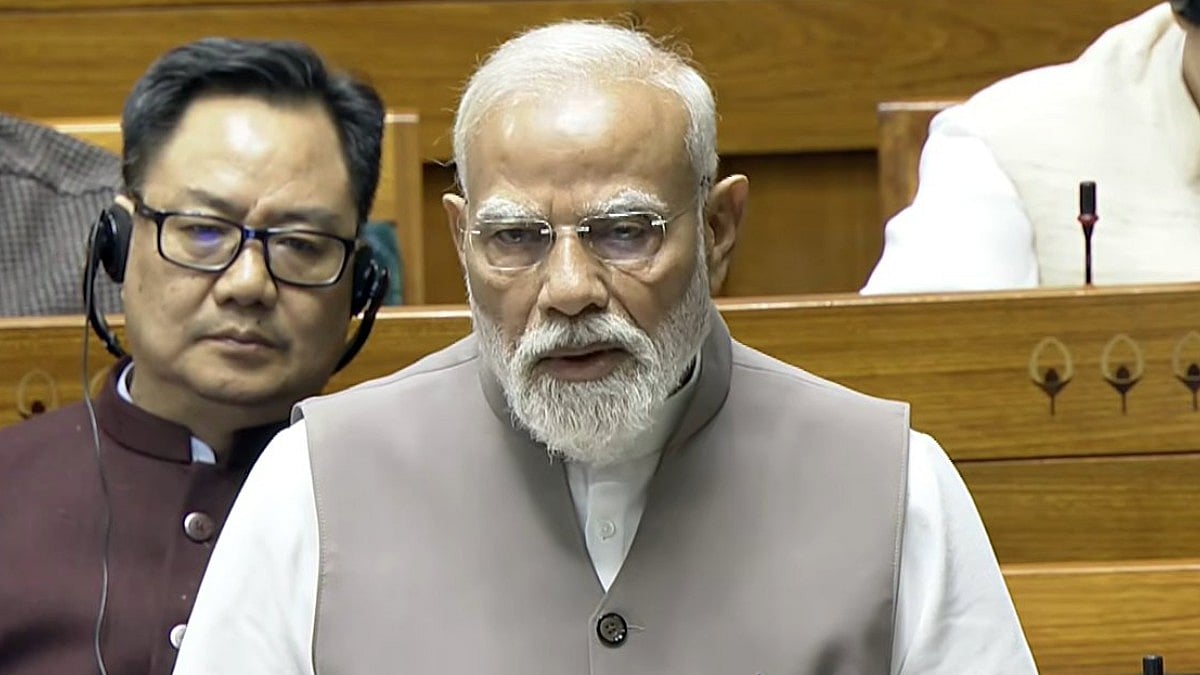
Prime Minister Narendra Modi addressed Lok Sabha on Monday on Middle Crisis |
Prime Minister Narendra Modi addressed the Lok Sabha on Monday, delivering a comprehensive statement on the escalating conflict in West Asia and its multifaceted impact on India.
The prime minister’s address serves as a definitive outline of India’s position on the evolving situation, detailing the government’s diplomatic engagements, deep-seated concerns over regional stability and the tangible threats posed to global energy security and trade routes. "From the very beginning, we have expressed deep concern about this conflict," he stated.
This formal address follows a critical high-level meeting chaired by the prime minister on Sunday, during which he reviewed the nation's preparedness across the petroleum, crude oil, natural gas, power and fertiliser sectors.
The speech comes at a time of heightened global anxiety, as the conflict enters its fourth week. With maritime corridors facing unprecedented disruptions and the safety of Indian nationals becoming a central concern, the prime minister emphasised that India must act with both sensitivity and strategic vigilance. He noted that the Cabinet Committee on Security (CCS) has been actively assessing the short, medium, and long-term implications for the Indian economy, ensuring that the country remains resilient against external shocks.
Gravity of humanitarian and global crisis
Opening his remarks, the Prime Minister acknowledged the severity of the current geopolitical climate, noting that the window for a quick resolution is narrowing as the violence persists. “Today I am here to talk about the ongoing conflict in West Asia. West Asia is going through a difficult time,” the Prime Minister stated. He informed the House that the executive branch has remained transparent, noting that “Shri Hardeep Puri and Shri S Jaishankar have informed the Houses on this matter.”
The prime minister expressed grave concern over the duration of the hostilities, observing that “the situation and the escalation have now passed three weeks, creating adverse effects on the global economy and livelihoods.” He further elaborated on this sentiment by adding, “The situation in West Asia at this time is concerning. The situation in West Asia is worrisome. This conflict has been going on for more than three weeks. It has a severe impact on the global economy and the lives of the people, and that is why the world is urging all sides for an early resolution to this conflict.” "I have spoken to the leaders of West Asia and requested them to end the escalation," he added.
Strategic importance of conflict zone to India
A significant portion of the prime minister’s address focussed on why the stability of West Asia is inextricably linked to India’s national interest. He reminded the House that the region is not merely a distant geography but a vital economic partner and a home to millions of Indians. “This war has also posed unprecedented challenges before India. These challenges are economic, related to national security and humanitarian as well. India has extensive trade relations with the warring and war-affected countries,” he said.
Prime Minister Modi highlighted the region's role as a transit hub, noting that “the region where this war is taking place is also an important route for our trade with other countries of the world.” He specifically drew attention to India's energy dependence, stating, “In particular, a large part of our needs for crude oil and gas is met by this very region.” He emphasised that the stakes are high because “this region is also important because around 1 crore Indians live and work there.”
Given these factors, he asserted, “It is essential that a unanimous and united voice from India's Parliament on this crisis reaches the world.” He specifically pointed to the risks involved in shipping lanes, asserting, “India has opposed attacks on civilian, energy, and transport infrastructure. Attacks on commercial ships and disruptions in waterways such as the Strait of Hormuz are unacceptable. Through diplomacy, India is making continuous efforts to ensure the safe movement of Indian ships in this situation.”
Energy diversification and infrastructure gains
"In this time of crisis, the country has another preparation as well, which is proving very useful," Prime Minister Modi said, referring to India's internal infrastructure strengths.
“Over the past 11 years, unprecedented work has been done on ethanol production and its blending. Until a decade ago, the country had only one to one-and-a-half percent ethanol blending capacity. Today, we are nearing 20 per cent ethanol blending in petrol. As a result, we are able to reduce oil imports by about 45 million barrels per year.”
He linked these structural gains directly to the current crisis, noting: “Because of such efforts, many of our ships that were stranded in the Strait of Hormuz have also arrived in India. Due to ethanol blending, we are saving the import of about 4.5 crore barrels of oil every year. Similarly, railway electrification is also bringing great benefits. If such large-scale railway electrification had not happened, an additional 180 crore litres of diesel would have been required every year. We have also expanded the metro network. In 2014, the metro network was less than 250 km, which has now increased to more than 1100 km.”
Managing power demand and coal reserves
The prime minister also addressed the seasonal pressures facing the nation. “One of the biggest challenges of war is also that the summer season is beginning in India. In the coming times, with the increasing heat, the demand for electricity will keep rising,” he warned.
“Due to the war, and as the summer season has begun in India, electricity demand has increased. At present, all power plants in the country have adequate coal stock available. India has created a record by producing more than 1 billion tonnes of coal for the second consecutive year. Continuous monitoring of all our systems from power generation to power supply is also being done. In the last decade, the country has also taken major steps towards renewable energy.”
Food security and agricultural preparedness
“Another question is the impact of the war on agriculture,” the prime minister observed. He reassured the nation that food reserves remain robust. “The farmers of our country have filled our food grain reserves, so India is well prepared in terms of food security. We are also making efforts to ensure that the Kharif sowing takes place properly. For this, the government has made adequate arrangements for fertilisers to deal with any emergency situation. In the past as well, our government did not let the impact of global crises fall on our farmers.”
Safeguarding Indian diaspora and evacuation efforts
The prime minister provided a detailed update on the safety of Indian citizens, describing a massive logistical and diplomatic effort to protect them. “Since this war began, every Indian in the affected areas has been provided with necessary assistance,” he assured the House. He shared details of his personal diplomatic outreach, stating, “I myself have spoken over the phone in two rounds with most of the heads of state in West Asia. All have given full assurance of the safety of Indians.”
However, the prime minister did not shy away from the human cost of the conflict, expressing his condolences for those caught in the crossfire. “Unfortunately, during this time, some people have tragically lost their lives and some have been injured. In such difficult circumstances, help is being provided to the affected families,” he said.
He further detailed the scale of the return mission, announcing, “Since the war began until now, more than 3 lakh 75 thousand Indians have safely reached India. From Iran alone, nearly 1,000 Indians have returned safely so far, of which over 700 are medical students.” He noted that the government has established “24/7 control rooms and emergency helplines” both in India and abroad to provide rapid information to all affected individuals. "In recent days, several of our ships that were stuck in the Strait of Hormuz have also returned to India," he added.
Energy resilience and Strait of Hormuz crisis
Turning to the economic front, the prime minister addressed the specific challenges regarding the Strait of Hormuz, a critical chokepoint for global energy. “It is a challenge for cargo movement through the Strait of Hormuz from the start of the war. Despite this, our government is ensuring that gas and fuel supplies remain least affected,” he stated.
He acknowledged the difficulty of the situation, noting, “Movement of ships through the Strait of Hormuz has become difficult. Crude oil and fertilisers are affected by stress in the Strait of Hormuz region. Our focus is to reduce the difficulties faced by people.”
Prime Minister Modi also spoke to the specific concerns regarding Liquefied Petroleum Gas (LPG), noting that “India imports 60 per cent of its LPG requirement. Due to uncertain supply, the government is prioritising domestic supply.” To counter these disruptions, he informed the House that “LPG production in the country is also being increased.” He urged the public and the states to remain vigilant against hoarding and black marketing, reiterating that the government is "sensitive as well, vigilant as well, and also ready for every assistance."
Strengthening India’s long-term strategic reserves
Prime Minister Modi also highlighted the long-term strategic investments India has made to withstand such global volatility. “Over the past decade, India has also prioritised the storage of crude oil for times of such crises. Today, India has a Strategic Petroleum Reserve of more than 5.3 million metric tonnes, and the country is working on arrangements for reserves of more than 6.5 million metric tonnes,” he declared. "Apart from this, the reserves held by our oil companies are separate. In the last 11 years, our refining capacity has increased significantly. The government is in constant contact with suppliers from different countries. The effort is to ensure that oil and gas supplies continue from wherever possible."
National vigilance and unity
"When such crises arise, some elements try to take advantage of the situation. Therefore, all agencies responsible for ensuring law and order have been put on alert, including coastal security, border security, and cyber security," the prime minister warned.
He reiterated that while the conflict is an "evolving situation" that impacts the entire world, India’s primary mission remains the protection of its people and the preservation of its economic stability. "Because of this war, the difficult global situation may continue for a long time. Therefore, we must remain prepared and stay united. We have faced such challenges before as well by staying united during the coronavirus pandemic. We must remain very careful and alert. Some people will try to spread rumours to take advantage of the situation. We must not allow such people to succeed."
Prime Minister Modi closed by calling for a "whole-of-government approach," directing various ministries to work in consultation with all stakeholders to ensure that the "unified voice and consensus" of India is projected clearly to the international community.
RECENT STORIES
-
-
-
-
-