Lok Sabha Speaker Om Birla Says Any Fresh Motion To Remove CEC Gyanesh Kumar Will Be Examined Under Parliamentary Rules | VIDEO
Lok Sabha Speaker Om Birla said any fresh motion seeking CEC Gyanesh Kumar’s removal would be examined under parliamentary rules. Opposition protests over alleged SIR irregularities continue, while notices from its second removal attempt remain pending in the Rajya Sabha.

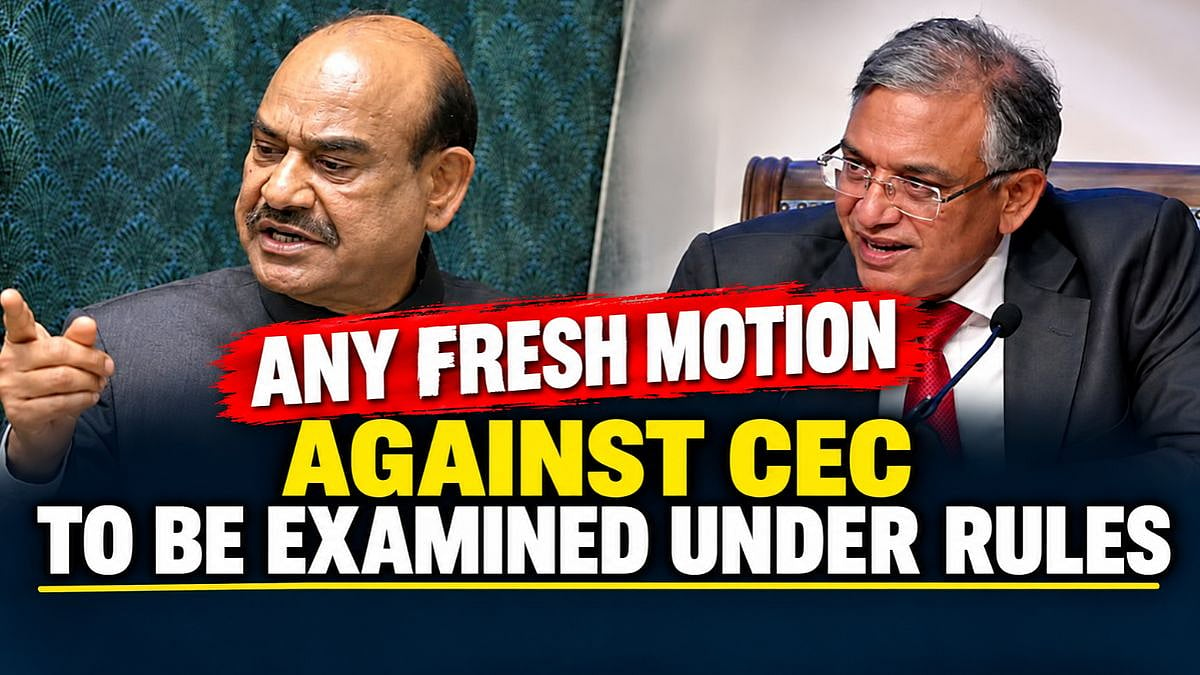
Lok Sabha Speaker Om Birla Says Any Fresh Motion To Remove CEC Gyanesh Kumar Will Be Examined Under Parliamentary Rules | VIDEO |
New Delhi, October 22, 2026: Lok Sabha Speaker Om Birla on Thursday said any fresh motion seeking the removal of Chief Election Commissioner (CEC) Gyanesh Kumar would be examined according to parliamentary rules and procedures. His remarks come amid growing Opposition protests against Kumar over alleged irregularities in the revision of electoral rolls.
The Opposition has already made two attempts to remove Kumar from office. While both the Lok Sabha and Rajya Sabha rejected the notices submitted during the first attempt, the notices filed in the second attempt remain pending in the Upper House.
What Did Om Birla Say?
Responding to a question at a press conference in New Delhi about the possibility of another motion against Kumar, Birla said the matter would be considered according to the established parliamentary process.
“If any fresh notice comes, we will see and examine it accordingly under rules and procedures,” Birla said.
Protests Against CEC Gather Momentum
Over the past fortnight, protests have taken place in different parts of the country demanding Kumar’s resignation over alleged irregularities in the Special Intensive Revision (SIR) of electoral rolls.
The protests have brought renewed attention to the functioning of the Election Commission and raised questions about the process required to remove the country’s top election official.
Can Parliament Remove The Chief Election Commissioner?
Under the Constitution and the law governing the appointment of the Chief Election Commissioner and Election Commissioners, the CEC can be removed only through the same process applicable to a sitting Supreme Court judge, PTI reported.
The Chief Election Commissioner and Other Election Commissioners (Appointment, Conditions of Service and Term of Office) Act, 2023, also allows the CEC or an Election Commissioner to resign at any time by submitting a written resignation to the President.
What Does The Constitution Say?
Article 124 of the Constitution lays down the procedure for removing a Supreme Court judge. Removal requires an order from the President after both Houses of Parliament pass a motion supported by a majority of their total membership and at least two-thirds of the members present and voting.
Both Houses must approve the motion during the same parliamentary session. Removal is permitted only on the grounds of proved misbehaviour or incapacity.
The strict requirements make the removal process a demanding parliamentary exercise, with several stages of scrutiny before a final decision can be taken.
How Is A Removal Motion Investigated?
Under the Judges (Inquiry) Act, 1968, once a motion seeking the removal of a judge is admitted in either House, the Speaker or Chairman must constitute a three-member committee to investigate the allegations.
The committee comprises the Chief Justice of India (CJI) or a Supreme Court judge, the Chief Justice of one of the country’s 25 High Courts and a distinguished jurist.
After completing its investigation, the committee submits a report containing separate findings on each charge, along with its observations on the case. The report is submitted to the Speaker, the Chairman or both, depending on how the committee was constituted.
The report must then be placed before the Lok Sabha, the Rajya Sabha or both, as applicable.
What Happens After The Committee Submits Its Report?
If the committee finds that the judge is not guilty of misbehaviour or does not suffer from incapacity, Parliament cannot proceed further with the removal motion.
However, if the committee finds evidence of misbehaviour or incapacity, the motion and the committee’s report are taken up for consideration by the House or Houses where the motion is pending.
If both Houses approve the motion with the constitutionally required majorities, the charges are considered proved. Each House must then present an address to the President seeking removal during the same parliamentary session.
The Constitution also provides for the removal process under Article 218, read with the relevant provisions of Article 124.
Report On Election Commissioners Fuels Controversy
The Opposition’s protests against Kumar intensified after The Indian Express reported that Election Commissioners Sukhbir Singh Sandhu and Vivek Joshi had raised objections on record at least 14 times over the past 10 months.
According to the report, the two Election Commissioners objected to decisions and orders relating to the Special Intensive Revision that they said had been issued without their knowledge or recommendation.
The reported objections have added another dimension to the controversy surrounding the electoral roll revision exercise.
Also Watch:
ALSO READ
With the Opposition continuing to demand Kumar’s removal and notices from its second attempt still pending in the Rajya Sabha, Birla’s remarks underline that any fresh move against the CEC will have to follow the prescribed parliamentary procedure.
To get details on exclusive and budget-friendly property deals in Mumbai & surrounding regions, do visit: https://budgetproperties.in/
RECENT STORIES
-
-
-
-
-