Kerala HC Says ₹20,000 Cap Cannot Limit Compensation For Wild Animal Attack Victims
The Kerala High Court has ruled that the Rs 20,000 compensation prescribed under the 1980 Rules for wild animal attacks is a minimum and cannot cap court-awarded compensation. The court upheld an additional Rs 1.78 lakh awarded to a family after a man died in a wild elephant attack.

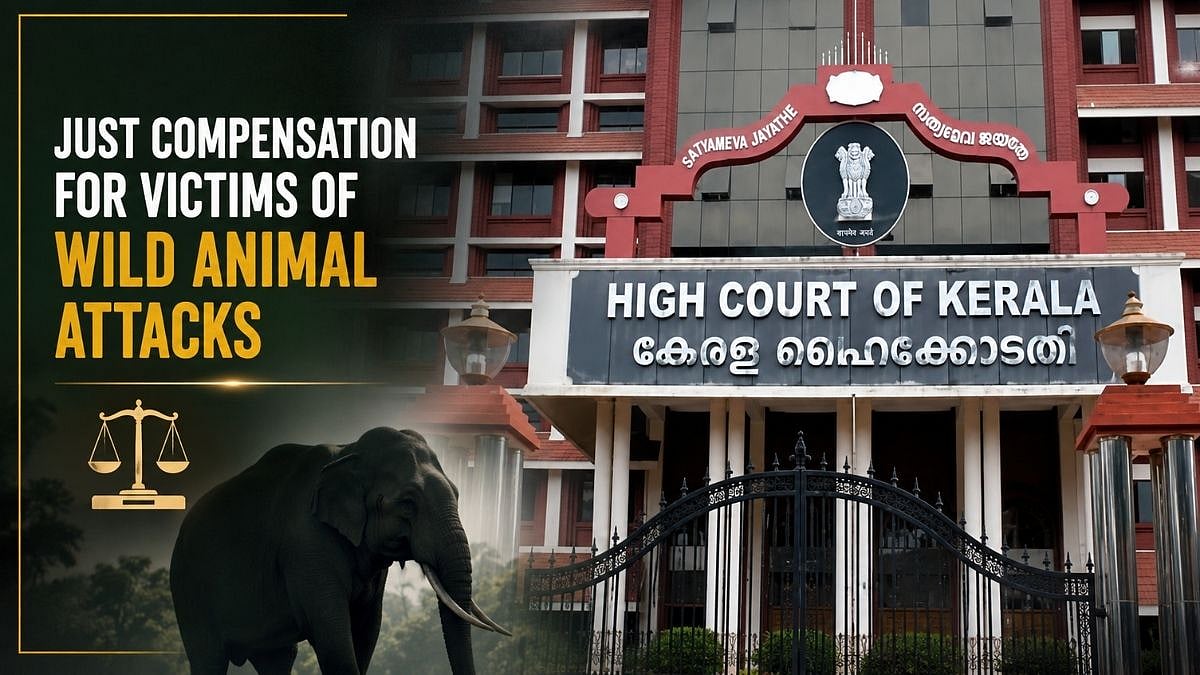
The Kerala High Court held that victims of wild animal attacks can seek compensation proportionate to their actual loss | AI Generated Image
Kochi, August 31, 2026: The Kerala High Court has held that the State must provide just and adequate compensation to victims of wild animal attacks, ruling that the amount cannot be restricted to Rs 20,000 under the Kerala Rules for Payment of Compensation to Victims of Attack by Wild Animals, 1980.
Justice Mohammed Nias CP made the observation while dismissing a regular second appeal filed by Forest Department officials against concurrent findings of the lower courts awarding compensation to the family of a man who died in a wild elephant attack, Live Law reports.
Rs 20,000 Is A Floor, Not A Ceiling
The High Court said the right to claim just and adequate compensation for loss of life or injury can be traced to Article 21 of the Constitution and the common law principle of strict liability. These rights exist independently of any executive compensation scheme, it said.
According to the court, the amount prescribed under the 1980 Rules is only the minimum payable by the State as ex gratia compensation and cannot restrict courts from determining or enhancing compensation based on the actual loss, pain and suffering of a claimant.
“The existence of the Rules only provides a floor. The courts are duty-bound to ensure that the compensation awarded is just, fair and reasonable and commensurate with the nature and extent of the injury suffered,” the court observed.
It added that compensation must reflect the true value of the loss suffered and that the worth of a human life cannot be reduced to an amount that fails to adequately recognise the magnitude of the loss.
The ruling underlines an important distinction between compensation fixed under a government scheme and the power of courts to award an amount they consider just and reasonable. In effect, the Rs 20,000 provided under the Rules cannot become a ceiling when the actual loss warrants higher compensation.
State Has Strict Liability
The High Court also held that the State, as the deemed owner and custodian of wild animals, can be held liable under the principle of strict liability when such animals cause injury or damage.
The court said the State could be liable even in the absence of negligence because the liability was strict. It referred to the principle laid down in The State of Kerala and Ors v VV George while dealing with the responsibility of the State and its officers in cases involving attacks by wild animals.
“The State is deemed the owner and custodian of the wildlife,” the court observed, adding that the government has a duty to take adequate measures to prevent wild animals from entering human habitations or agricultural properties.
The court said failure to protect citizens from such attacks could amount to a failure by the State Government to protect the right to life guaranteed under Article 21 of the Constitution.
It further held that citizens were entitled to seek compensation for damage caused by wild animals regardless of whether such claims were specifically covered by existing government orders, schemes or provisions.
The observation places responsibility on the State beyond merely making ex gratia payments. It links the government's role as custodian of wildlife with its obligation to take reasonable measures to reduce human-wildlife conflict and compensate people when attacks cause loss.
Elephant Attack Led To Suit
The case arose after a man died in a wild elephant attack on a panchayat road. His wife and children filed a suit for damages, alleging that negligence by the Forest Department had resulted in his death. The family was fully dependent on his income.
They sought compensation of Rs 2 lakh, but the department awarded only Rs 20,000. The family subsequently filed a suit seeking the balance amount.
Forest Department officers opposed the claim, alleging that the incident occurred because of the deceased's carelessness and that he was intoxicated at the time. They also maintained that sufficient precautions had been taken to prevent wild animals from entering private property.
Trial Court Awarded Rs 1.78 Lakh More
The trial court found that the attack occurred on a panchayat road and not on a forest road. It also found negligence on the part of the officials as power fencing lines and trenches had not been installed along the forest boundary.
The court awarded the family Rs 1.78 lakh after deducting the Rs 20,000 already paid by the department.
The Forest Department officials challenged the judgment before the first appellate court, which dismissed their appeal. They then moved the Kerala High Court in a second appeal.
Fencing Could Have Prevented Death
The High Court noted that there was no material on record to support the contention that the deceased had been walking on a forest road when the attack occurred.
It observed that the State, as the deemed owner and custodian of wildlife, had a duty to take appropriate steps to prevent human-wildlife conflict.
Turning to the circumstances of the case, the court found that the State had breached its duty by failing to install fencing or trenches along the forest boundary to prevent wild animals from entering private property.
The court observed that the man's death could have been avoided had the necessary precautionary measures been taken.
Also Watch:
ALSO READ
By upholding the compensation awarded to the family, the judgment makes clear that compensation schemes cannot be used to restrict a victim's right to seek an amount proportionate to the loss suffered. It also reinforces the State's responsibility to take preventive measures where wild animals pose a danger to people.
To get details on exclusive and budget-friendly property deals in Mumbai & surrounding regions, do visit: https://budgetproperties.in/
RECENT STORIES
-
-
-
-
-