Death In The Skies: Why India’s Small Aircraft Safety Is Nosediving
A string of fatal crashes involving air ambulances, VVIP charters and flight schools has exposed a dangerous gap in India’s aviation safety. As the DGCA identifies systemic maintenance failures and human error, a new ranking framework aims to enforce accountability

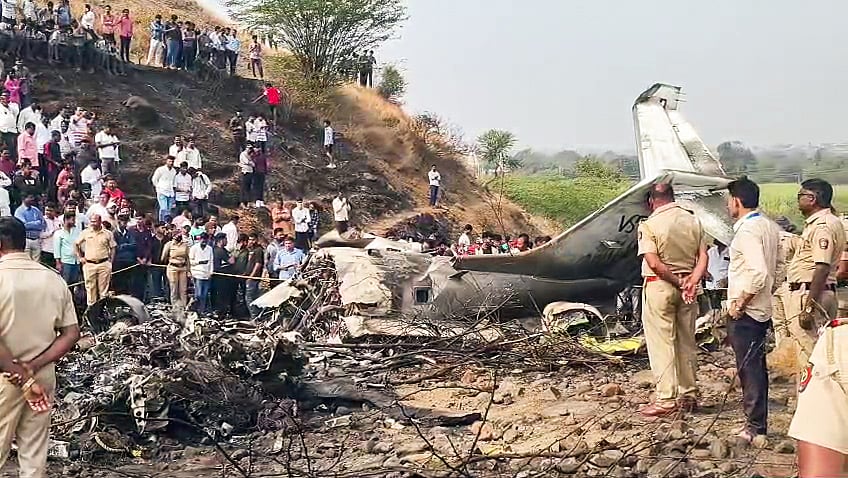
The fatal crash in Baramati last month led to the death of Maharashtra Deputy Chief Minister Ajit Pawar | ANI
With the tragic loss of all seven people aboard a Redbird Airways air ambulance near Simaria, Jharkhand, the safety of India’s small aircraft sector has come under urgent scrutiny. The aircraft, en route from Ranchi to Delhi, crashed just 23 minutes after takeoff—the latest in a chilling string of accidents involving non-scheduled flights. This tragedy follows the high-profile death of Maharashtra Deputy Chief Minister Ajit Pawar less than a month ago, when his charter plane crashed in heavy fog. Together, these incidents raise a critical question: Is India’s rapidly expanding private aviation infrastructure failing to keep pace with its growth?
On February 8, a Cessna 172 crashed in Vijayapura, Karnataka, after an engine glitch. The plane broke into three pieces, however, both pilots survived with serious injuries.
Again on January 10, an IndiaOne Air Cessna 208 Caravan (a small 9-seater commuter plane) made a forced landing in a forest area while on approach in Rourkela, Odisha resulting in one fatality and five injuries. In December last year, a Tecnam P-Mentor crashed near Suktara, Madhya Pradesh, injuring the instructor and trainee. On August 20, 2024, a Cessna 152 operated by Alchemist Aviation took off from Jamshedpur and went missing. After a 40-hour search, the wreckage and the bodies of the instructor and trainee were recovered from the reservoir at Chandil Dam in Jharkhand.
The year 2023 was significantly worrisome for small plane safety in India. In March 2023, a MP Flying Club Cessna 172 crashed during a routine training flight in Indore. The instructor and student sustained injuries. In the same year, two more crash landings occurred in Kalaburagi and Belagavi involving training flights in May and June respectively. In October that year, two separate Tecnam P2008 aircraft crashed near Baramati within one week on October 19 and 22.
A worrying trajectory
The data reveals a rising trend in accidents involving small aircraft, particularly in the flight training and private charter sectors. In a concentrated period between 2023 and early 2026, several academies reported multiple crashes within weeks of each other, often involving engine failures or "loss of control" during student sorties.
Charter operations have also contributed to this frequency, with high-profile accidents involving VVIPs and air ambulances highlighting a pattern of flights operating in marginal weather conditions. These recurring incidents suggest that while the volume of regional and private flying is expanding rapidly, the safety infrastructure is struggling to keep pace.
Systemic risks in charter and air ambulance operations
For the non-scheduled (charter) sector, the DGCA has flagged a dangerous pattern of "mission-oriented" pressure that overrides weather safety protocols. Investigations into the recent Learjet and Beechcraft crashes suggest that pilots are frequently attempting to navigate severe weather or low-visibility conditions (fog) rather than diverting. The regulator noted that many of these small aircraft are ageing—the Jharkhand air ambulance was 39 years old—and may lack the advanced redundant systems found in commercial airliners.
DGCA concerns regarding human factors
A primary concern for the DGCA is the "human factor" in small aircraft operations, which accounts for approximately 60 per cent of documented accidents. The regulator has identified significant skill gaps, particularly in emergency manoeuver handling among trainee pilots and spatial disorientation among charter pilots.
This concern is compounded by a shortage of experienced Flight Instructors and Aircraft Maintenance Engineers (AMEs), which often leads to overworked staff and compromised training quality. The DGCA has noted that many accidents occur during critical phases like approach and landing, frequently due to a lack of adherence to Standard Operating Procedures (SOPs).
Regulatory scrutiny of maintenance and infrastructure
The regulator is increasingly focussed on the "pressure-cooker" environment of private aviation, where the drive for high aircraft utilisation can lead to maintenance lapses. Audits have revealed violations such as improperly secured safety equipment, unserviceable components and inadequate adherence to mandatory maintenance schedules.
Furthermore, the DGCA has flagged the lack of advanced navigational aids and emergency response systems at Tier-2 and Tier-3 airports as a systemic risk. Many small plane crashes occur at these regional strips where pilots have fewer technological "safety nets" compared to major international hubs.
Implementation of the new FTO ranking framework
To address these systemic issues, the DGCA recently launched a mandatory ranking system for all Flying Training Organisations, effective from late 2025. This framework evaluates academies on a scale from A+ to C based on safety standards, fleet-to-instructor ratios and accident history.
Under this new rule, any FTO involved in an accident is automatically penalised in the rankings and those falling into the "C" category are issued notices for immediate self-analysis and improvement. This move represents a shift toward public transparency, forcing schools to prioritise safety metrics to maintain their operational viability and attract new students.
Published on: Tuesday, February 24, 2026, 09:53 AM ISTRECENT STORIES
-
-
-
-
-