Digital Arrest Scams: Supreme Court Directs RBI To Frame Banking SOP, Explores Victim Compensation Framework
The Supreme Court directed the RBI to implement a banking SOP for digital arrest scams, including grievance redressal and money restoration mechanisms, while asking States to strengthen cyber crime systems. It also told an inter-departmental committee to examine a victim compensation framework, CBI investigation thresholds and telecom safeguards.

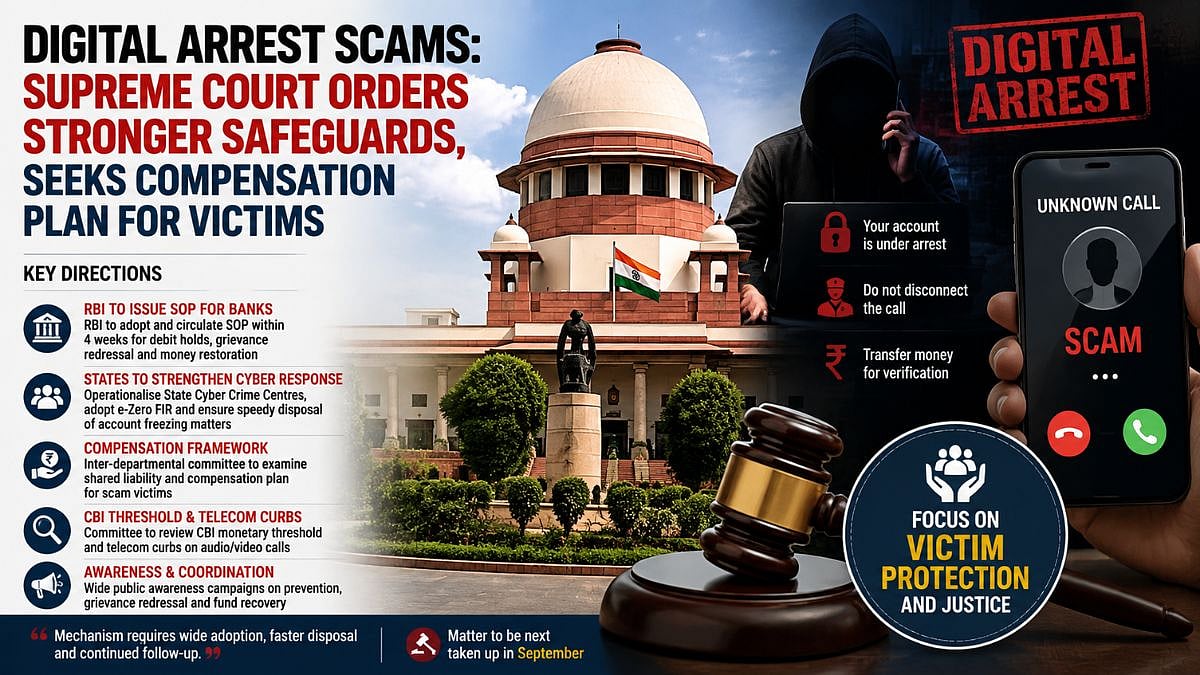
The Supreme Court has ordered stronger safeguards against digital arrest scams, including a banking SOP and examination of a victim compensation framework | AI Generated Representational Image
New Delhi, August 4, 2026: The Supreme Court has issued a series of directions to strengthen measures against "digital arrest" scams, asking the Reserve Bank of India (RBI) to put in place a standard operating procedure (SOP) for banks and operationalise mechanisms for grievance redressal and restoration of defrauded money.
A Bench comprising Chief Justice of India Surya Kant, Justice Joymalya Bagchi and Justice V. Mohana passed the directions on Tuesday while hearing suo motu proceedings concerning digital arrest scams.
The court also asked an inter-departmental committee to examine a shared liability and compensation framework for victims, signalling an attempt to strengthen protection not only against such frauds but also for those who have already lost money, Live Law reports.
Money Restored In Thousands Of Cases
Taking note of a status report filed by the Indian Cyber Crime Coordination Centre (I4C), the Supreme Court recorded that defrauded money has been restored in 36,290 cases. The total amount restored stands at Rs 18.05 crore, with 57 banks and all States and Union Territories participating in the exercise.
The court also noted the progress made by the Central Bureau of Investigation (CBI). The agency has registered digital arrest cases and other connected matters, identified victims through transactions involving 67 first-layer bank accounts and conducted searches at 93 locations across 16 States.
An inter-departmental committee has also asked the CBI to examine whether the existing monetary threshold for taking over cyber fraud investigations can be lowered. It has further sought consideration of cases linked to the same organised network where the cumulative fraud crosses the prescribed threshold.
While appreciating the progress, the Bench said the mechanism already in place requires "wide adoption, faster disposal and continued follow-up". The observation underlines that setting up systems alone may not be enough unless victims can access them quickly and authorities consistently act on complaints.
RBI Asked To Issue SOP
The Supreme Court directed the RBI to formally adopt and circulate, within four weeks, the SOP prescribing the steps banks must take to place temporary debit holds on accounts linked to cyber-enabled financial fraud.
The SOP must incorporate a grievance redressal mechanism, a money restoration module and measures to create public awareness about both facilities.
The court also directed the Registrars General of all High Courts to bring the grievance redressal mechanism to the attention of courts and adjudicating authorities dealing with the freezing of bank accounts. People aggrieved by the freezing of their accounts should be encouraged to first use this mechanism.
The directions could prove significant because banks are often at the centre of efforts to stop the movement of money after a cyber fraud is reported. A standard procedure, coupled with a restoration mechanism, could bring greater consistency to the response.
States To Strengthen Cyber Response
All States and Union Territories have been directed to notify and operationalise State Cyber Crime Coordination Centres within four weeks.
They must also adopt the e-Zero FIR mechanism in consultation with I4C, with the Ministry of Home Affairs (MHA) providing the necessary assistance. Authorities have also been asked to ensure the speedy disposal of matters involving the freezing of bank accounts in cyber-enabled financial fraud cases.
The inter-departmental committee has been directed to issue advisories and directions to States, Union Territories, ministries and government departments for extensive public awareness programmes. These campaigns will cover the prevention of cyber crime and digital arrest scams, grievance redressal and money restoration mechanisms, and the MHA's SOP on the custody and restoration of defrauded money.
The committee must also coordinate with banks on measures to prevent digital arrest scams, facilitate the recovery of defrauded money, assist investigations and ensure compliance with applicable laws.
Victim Compensation Proposed
In another significant direction, the Supreme Court asked the inter-departmental committee to examine a proposal for a shared liability and victim compensation framework for people affected by digital arrest scams.
Legal Services Committees across the country have also been directed to conduct public awareness initiatives covering digital arrest scams, cyber crime, cyber security and mechanisms available for recovering defrauded money.
The proposed compensation framework adds another dimension to the response to digital arrest scams. Prevention and investigation remain crucial, but the court's directions also put the financial impact on victims firmly in focus.
Further Measures Under Review
The Supreme Court further directed the inter-departmental committee to examine a proposal to reduce the existing monetary threshold for CBI investigations into cyber fraud cases.
The committee will also consider whether cases involving the same organised network can be aggregated to meet the prescribed threshold for CBI intervention. Such an approach could help authorities treat connected frauds as part of a larger network rather than viewing each case separately.
The Bench also directed the Ministry of Electronics and Information Technology (MeitY), the Department of Telecommunications (DoT) and I4C to examine a proposal to introduce time-based restrictions on telecom services for audio and video calls.
Also Watch:
The authorities have been asked to submit a brief note to the court examining the feasibility and utility of the proposal, as well as possible alternatives.
The directions indicate a wider approach to tackling digital arrest scams, covering banks, investigative agencies, telecom services, State authorities and victim support. Their effectiveness, however, will depend on how quickly the mechanisms are implemented and how easily victims can use them.
The Supreme Court will next consider the matter in September.
To get details on exclusive and budget-friendly property deals in Mumbai & surrounding regions, do visit: https://budgetproperties.in/
RECENT STORIES
-
-
-
-
-