Development’s Heat Trap: How Ecological Collapse Turned Banda Into India’s Hottest District
Banda recorded 48.2°C this summer, emerging as India’s hottest district amid claims ecological destruction worsened heatwaves. Researchers and activists told local media that deforestation, illegal mining, shrinking rivers and unchecked infrastructure projects, including the Bundelkhand Expressway, weakened the region’s natural cooling systems.

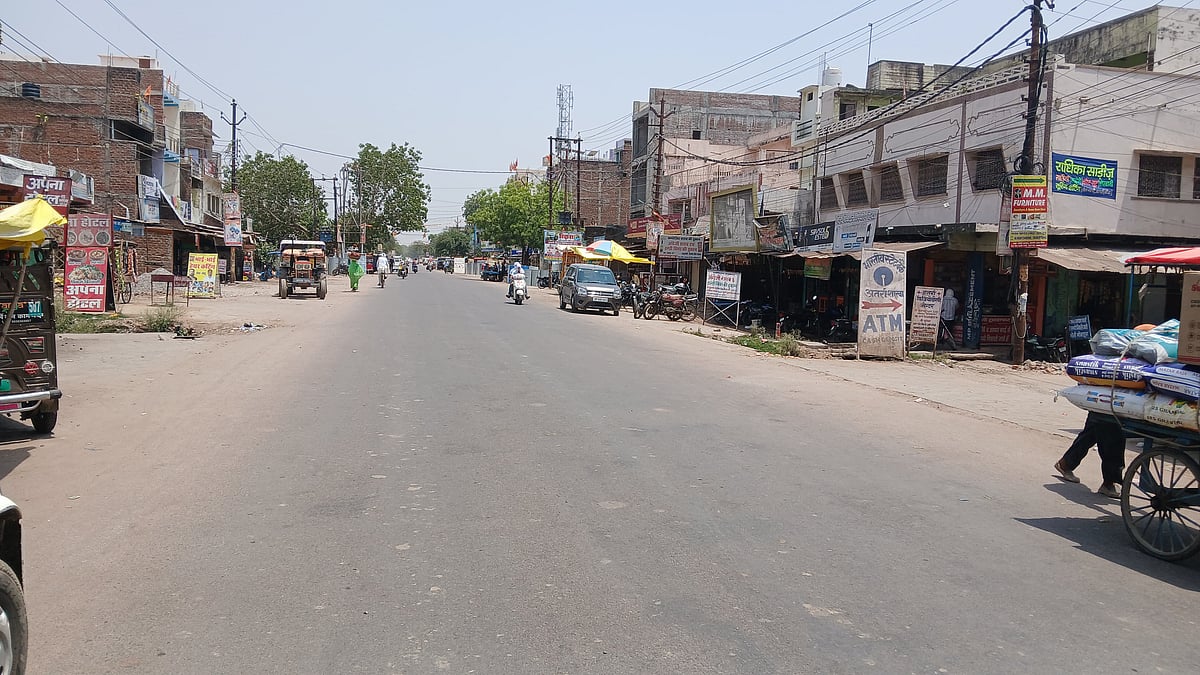
The Attarra bazar in Banda, which is usually chock-a-bloc with people and vehicle, wears a deserted look on Wednesday noon as people stay indoors because of scorching heat. |
Banda: On May 20, a full-page advertisement issued by the Uttar Pradesh Information and Public Relations Department celebrated the state’s transformation into an “Expressway State”. Among the flagship projects listed was the Bundelkhand Expressway, promoted as a symbol of development connecting the drought-prone Bundelkhand region with central Uttar Pradesh.
But one of the districts linked by the expressway, Banda, has simultaneously emerged as the hottest place in India.
The district touched 48.2 degrees Celsius this summer, turning into a symbol not of climate resilience, but of ecological collapse. Environmentalists, researchers and residents say Banda’s record-breaking temperatures are not merely the outcome of an unusually harsh summer. They argue the district is paying the price for years of unchecked mining, destruction of forests, shrinking rivers and development policies that ignored ecological costs.
What is unfolding in Banda reflects a deeper crisis in Bundelkhand, where rapid infrastructure expansion, illegal extraction of natural resources and administrative apathy have steadily dismantled the fragile environmental systems that once moderated the region’s heat.
On April 27 this year, Banda recorded 47.6°C, the highest temperature anywhere in India that day. According to the Lucknow Meteorological Department, it was also the hottest city in the world among more than 8,000 monitored weather stations. The temperature surpassed Banda’s earlier April records of 47.4°C set in 2022 and repeated in 2026.
The district again emerged as India’s hottest location on May 18 with 47.6°C after recording 46.4°C a day earlier. Since mid-April, Banda has repeatedly topped the country’s temperature charts.
Scientists say climate change has intensified heatwaves across north India, particularly in semi-arid regions such as Bundelkhand. But they warn that local ecological destruction has amplified the impact in Banda.
According to an RTI reply issued by the Uttar Pradesh Forest Department in December 2020, construction of the Bundelkhand Expressway led to the felling of nearly 1.89 lakh trees along the corridor, including thousands in Banda district.
Researchers say the district has simultaneously witnessed a steep decline in forest cover. A 2025 study conducted by scientists from Banda Agriculture University, Lucknow University, Banaras Hindu University and Mahatma Jyotiba Phule Rohilkhand University found that Banda’s forest cover declined from nearly 120 square kilometres in 2005 to around 95 square kilometres now, a loss of more than 15%.
Dense forests declined even faster. Researchers warned that if degradation continued at the present pace, parts of the district could become barren within two decades.
Another study published in the Journal of Extension Systems tracked forest cover between 1991 and 2022 using satellite and ground data. The study documented sharp declines across dense forests, open forests and total geographical forest area.
Environmental researchers say the consequences are now visible in Banda’s changing climate.
The district’s rocky terrain and naturally low moisture levels always made summers difficult. But forests, hill systems, rivers and groundwater recharge zones once provided a buffer against extreme heat. That buffer has steadily weakened.
Prof Dinesh Saha, head of the meteorological department at Banda Agriculture University, says mining has accelerated the drying of rivers and weakened groundwater recharge. Deforestation has reduced moisture retention, while dust from stone crushers settles over vegetation and soil.
“All these factors compound each other. The situation is serious,” he says.
The ecological destruction is particularly visible across the Vindhyan hills that cut through Banda district.
Local environmental activists allege decades of illegal and excessive mining have scarred large sections of the hill range. Blasting operations and stone crushers continue to operate across several stretches despite repeated complaints.
Environmental activist Raja Bhaiya of Vidya Dham Samiti in Banda says nearly a quarter of the Vindhyan hills in the region have either disappeared or been severely damaged.
“For over two decades, I kept warning authorities that this would have consequences,” he says. “Now those consequences are visible in front of everyone.”
Scientists say the destruction of the Vindhyan system has disrupted Banda’s natural water cycle. The sandstone layers in these hills absorb rainwater and gradually release it underground, helping recharge aquifers. Excessive blasting has damaged that structure.
At the same time, stone crushing operations have coated surrounding areas with fine dust, reducing soil moisture and damaging vegetation.
The district’s rivers have suffered a similar fate.
The Ken River, one of Bundelkhand’s most important rivers, flows through nearly 100 kilometres of Banda and adjoining areas before joining the Yamuna. Environmentalists allege that stretches of the river have been subjected to industrial-scale sand mining.
Heavy earthmovers and Pocland machines are routinely seen operating inside riverbeds despite rules prohibiting mechanised mining in active river channels.
Also Watch:
Social activist says nearly 55,000 tonnes of red sand are extracted daily from the Ken river system. “Mining no longer stops at the river. Even sand deposited in nearby agricultural fields after floods is being removed,” he says.
Residents say the same pattern has spread to smaller rivers such as the Ranj and Bagai. Water levels have dropped sharply across several stretches and villagers fear the region may lose critical groundwater reserves.
Water conservation expert Uma Shankar Pandey claims excessive sand extraction has stripped away the natural riverbed that once retained water and helped recharge groundwater.
“In its place, exposed rocky surfaces increase runoff and reduce water retention,” he says.
The combined impact of deforestation, mining and shrinking water bodies has altered Banda’s local climate dramatically.
Jhansi-based environmentalist Dhanushveer Sahani says Banda has gradually turned into a “heat island” due to continuous ecological degradation across Bundelkhand.
“The disappearance of green cover, declining moisture levels, shrinking water bodies and expanding stretches of exposed sand have created conditions where heat keeps intensifying,” he says. “Hot westerly winds coming from the Thar Desert further worsen the situation.”
Sahani explains that the land now absorbs and retains heat for much longer periods, preventing temperatures from cooling adequately at night. Low humidity and sparse vegetation have further reduced the region’s natural ability to regulate heat, making summers increasingly harsh and prolonged.
Life in Banda
The consequences are reshaping daily life across Banda.
By 10 in the morning, large parts of the city fall silent. Roads empty out as temperatures become unbearable. Traders begin work at dawn and shut operations before midday. Farmers have started working at night under LED floodlights because daytime labour has become impossible.
Construction workers are refusing afternoon shifts despite losing up to 40% of their wages. Migration from villages has begun earlier than usual this year as labourers leave in search of more tolerable conditions elsewhere.
Even the electricity system is under stress. At 44 substations across the district, electricity department employees are pouring water over more than 1,300 transformers to prevent them from overheating amid soaring temperatures and rising power demand.
For nearly six to seven hours every day, large parts of Banda have become practically unlivable.
Yet through the scorching afternoons, mining trucks continue to move across the district’s roads.
For residents and environmental researchers alike, Banda’s heat is no longer just a weather event. It is a warning about the ecological cost of development pursued without environmental safeguards.
In Bundelkhand, they say, the forests disappeared, the hills were blasted, the rivers were mined and the temperatures kept rising.
RECENT STORIES
-
-
-
-
-