CEC Protest: Supreme Court Orders No Illegal Detentions, Normal Metro And Rail Services, Restoration Of Internet In Delhi
The Supreme Court issued interim directions during a special Sunday hearing on Delhi protests against CEC Gyanesh Kumar, ordering normal Metro operations, uninterrupted internet services and protection against unlawful detentions. Lawyers alleged police brutality, mass detentions and movement restrictions.

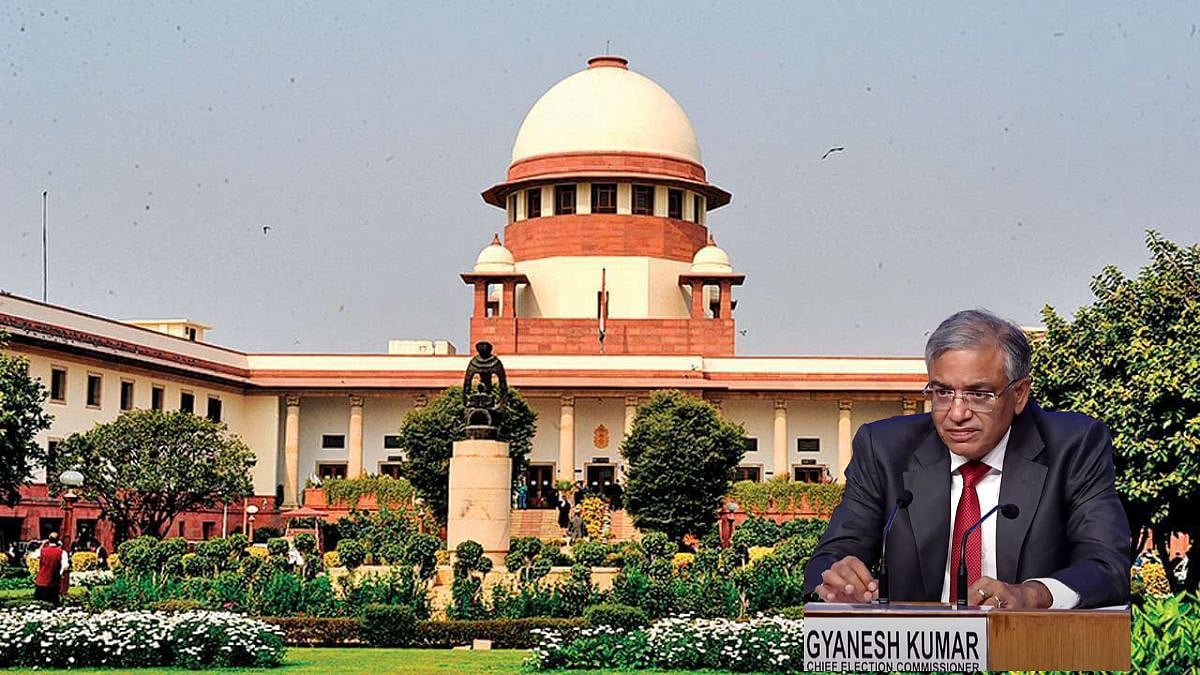
CEC Protest: Supreme Court Orders No Illegal Detentions, Normal Metro And Rail Services, Restoration Of Internet In Delhi | Canva
The Supreme Court, during a special Sunday sitting on October 11, issued interim directions to protect the rights of peaceful protesters amid demonstrations in Delhi against Chief Election Commissioner (CEC) Gyanesh Kumar and the Election Commission of India.
A bench of Justices Joymalya Bagchi and V Mohana directed that no person should be detained except through the procedure established by law, particularly in the case of peaceful and unarmed assemblies outside areas covered by prohibitory orders under Section 163 of the Bharatiya Nagarik Suraksha Sanhita (BNSS), Live Law reports.
The court also directed authorities to remove the board announcing the imposition of Section 163 near the Supreme Court, if it had not already been taken down, to ensure unhindered access to courts.
The interim directions remain subject to public order and law and order requirements.
Supreme Court Orders Normal Transport Services And Unrestricted Internet
The court directed that Metro and railway services operate normally unless restrictions become necessary due to public order disturbances, as contemplated under Article 19(2) of the Constitution.
It also ordered that people be allowed to move freely across Delhi, subject to traffic regulations. Authorities were directed to immediately review barricades in view of prevailing law and order and traffic conditions.
The bench further directed that internet services remain undisturbed, while Justice Bagchi clarified orally that the court was not curtailing the authorities’ powers under the Information Technology Act.
Solicitor General Tushar Mehta assured the court that Metro services were fully operational, all stations had reopened by 10 pm on October 10, trains were running normally and internet connectivity had been restored.
The bench also referred to its October 9 order directing authorities to reconsider the proposed closure of 57 Metro stations. It had held that Metro and railway services could be regulated in appropriate circumstances but should not be prohibited outright. The reconsidered decision was to be widely publicised to prevent inconvenience to commuters.
After examining the contempt petition, the court issued notices to the alleged contemnors, directing them to file affidavits and submit a compliance report. It also ordered that other petitions mentioned during the hearing be tagged with the contempt proceedings.
Lawyers Allege Police Excesses, Detentions And Restrictions On Movement
During the hearing, Senior Advocate Kapil Sibal, appearing for Rashtriya Janata Dal (RJD) MP Manoj Jha, alleged that police were picking up people from trains and detaining individuals outside the 4 km radius around Jantar Mantar where Section 163 had been imposed.
He also claimed that internet services had been suspended in the area and 45 Metro stations remained closed despite the court’s October 9 order.
Senior Advocate Shadan Farasat alleged that he was subjected to police brutality during the October 10 protests.
“The question is not only about lawyers. We don't have special rights as lawyers. Yesterday, the situation in the city was remarkably suppressive. People were not allowed to stand there either. I was thrown into a moving bus after I was picked up. It's about citizens' right to protest. The sense I got - yesterday, we were one step away from a POLICE STATE. Kindly restore citizens' right to protest peacefully in the capital. Yesterday, that right was destroyed,” he said.
Senior Advocate N Hariharan submitted that even practising lawyers were unable to move freely around Delhi.
Senior Advocate Gopal Sankaranarayanan referred to screenshots from videos and alleged that prohibitory orders under Section 163 had also been imposed outside the Supreme Court.
“It's reported in LiveLaw also. It's shocking. Nature of violence being perpetrated-it's not even a question of proportionality. First, necessity is to be seen. Unarmed children - to beat, kick them...scuffle with them is uncalled for. We are finding several videos - these people wear it as a badge of courage. This is something which has raised many emotions amongst us. It's come so close to the door,” he said.
Sankaranarayanan sought the removal of barricades, restoration of free movement and normal Metro services. He also demanded accountability for alleged police excesses, including the deployment of personnel without identification badges.
Senior Advocate Sanjay Hegde argued that access to justice also meant access to lawyers and that preventing advocates from performing their duties directly affected the dignity of the Supreme Court.
“Solicitor General is leader of the Bar. He must ensure that every lawyer can access their clients and provide assistance at police stations. Yesterday, lawyers were beaten in police stations. Policemen threatened lawyers with FIR,” Hegde said.
Advocate Sumita Hazarika alleged that she was among 150 lawyers participating in a peaceful march when four were detained and taken away in a prison van. She also claimed that a woman police officer pushed her and prevented her from stopping.
“No name badge. If there was violence, action could have been taken. But we were peaceful,” she said.
Hazarika questioned how protesters could identify police personnel when officers were not wearing name badges.
Senior Advocate Shoeb Alam submitted that the matter concerned citizens’ fundamental rights under Article 19 of the Constitution. Justice Bagchi observed that the Chief Justice of India had clarified that Article 19(2) provided for regulation rather than prohibition.
Senior Advocate Kirti Uppal, representing a Lawyers’ Foundation, sought to intervene and raised concerns about the impact of the situation on the legal profession. His submissions drew boos from lawyers present in court, prompting senior counsel to call for decorum. The bench also expressed its disapproval.
Advocate Jai Anant Dehadrai, appearing for some Delhi Police officers, said that his clients had also faced brutality during the protests.
Justice Bagchi responded, “Police officers don't have an individual right to maintain law and order over and above the state. Please assist learned SG. Life and liberty equally sensitive - we have said that before. Be it police officer, citizen. All intervention applications will be listed.”
Petitioners Raise Mass Detentions, Fundamental Rights Concerns
Senior Advocate and Trinamool Congress Rajya Sabha MP Menaka Guruswamy, appearing as petitioner in person, argued that restricting Metro services deprived citizens of their ability to move freely.
She cited reports claiming that 7,000 people had been detained, while the State had not disclosed official figures.
“45 detention centres reported as set up all across Delhi. Opposition leaders were picked up. MPs barricaded into their houses. This is not just. Young people have decided to lawfully protest because they feel the election system is not fair. An interim prayer is there. Constitution says in Art. 358 that Art. 19 rights can be restricted when an emergency is imposed. Is the State saying there is an undeclared emergency? Habeas corpus is the classic relief. When we filed, we were not aware of the magnitude of people taken away. As internet was disconnected,” she said.
Guruswamy also drew a comparison with the Emergency era and referred to the Supreme Court’s ADM Jabalpur judgment.
”You are assembled here today because something graver is at stake. Suspension of citizens' peacefully exercised rights. The last time this court had to consider such challenges was at the time of emergency. We come back 50 years later - your Lordships had passed ADM Jabalpur!,” she added.
She sought notices to the alleged contemnors, including the Union Home Secretary and a senior Metro official, and demanded the immediate withdrawal of prohibitory orders.
Mehta submitted that the habeas corpus petition might no longer survive because the detained individuals had been released.
Opposing the contempt allegations, he maintained that Metro operations had not been curtailed on October 10 and that the total volume of services remained unchanged.
“Trains were inducted as per standard schedule. 4750 trains ran on 10th Oct as per schedule on internet. Delhi Metro - there are 303 stations, 47 were closed/restricted,” he said.
Justice Bagchi directed the authorities to file their responses and compliance report by Tuesday, October 13.
“Are advisories by railway authorities? Please file your response to these petitions and compliance by Tuesday. In the meantime, the metro functioning should continue in accordance with the normal schedule (subject to a public order condition envisaged under Art.19(2)). No advocate should in any way be hindered in discharging their professional duties. We are consciously saying 'professional'. Internet facility to the city has to be restored,” he said.
The court also indicated that it wanted submissions on whether provisions of the Police Act were consistent with the constitutional protections under Article 19.
Sibal argued that no law could violate the protections under Article 19(2), except on public order grounds. He also raised concerns about restrictions affecting journalists.
After the order was dictated, Advocate Tanushree Bhalla sought the return of digital devices seized by authorities, including from people who had not been detained. She submitted that the devices contained sensitive information relating to vulnerable victims.
RECENT STORIES
-
-
-
-
-