Air India Phuket-Delhi Flight Mid-Air Drop: Pilot Body Flags Multiple Hydraulic Failures, Defends Crew
Captain Sam Thomas, President of the Airline Pilots Association of India, said the Air India Phuket-Delhi flight’s mid-air altitude drop should be investigated for reported hydraulic and flight-control failures rather than focusing solely on the pilot’s drug test. He defended the crew, praised cabin staff and called for greater transparency in aviation investigations.

Air India Phuket-Delhi Flight Mid-Air Drop: Pilot Body Flags Multiple Hydraulic Failures, Defends Crew | AI
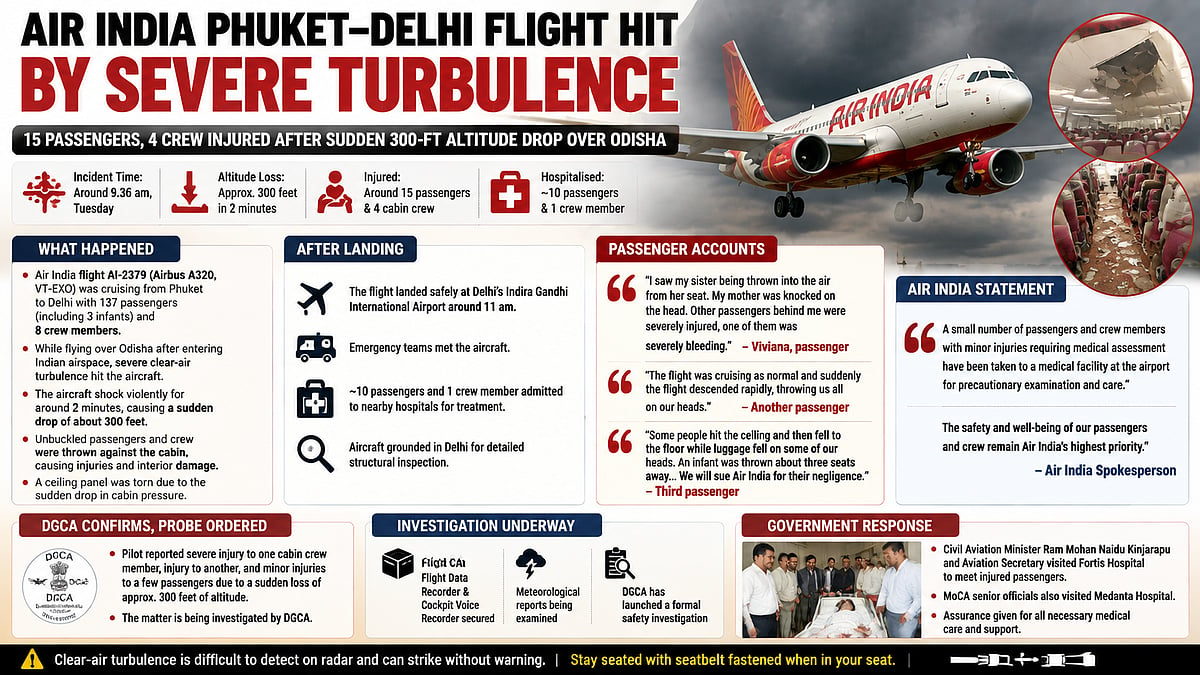
In an exclusive conversation, Captain Sam Thomas, President of the Airline Pilots Association of India, addressed the recent mid-air altitude drop incident involving the Air India Phuket–Delhi flight of August 4. Thomas said the investigation must focus on the aircraft’s reported technical warnings and snags, and not focus solely on the pilot’s psychoactive-substances test.
On the cause of the altitude drop Thomas said, from the documentation filed with the DGCA, three hydraulic pressures indicated low simultaneously which means a system malfunction occurred. This was followed by a flight control warning, an autopilot disconnect, and a stall warning.
He explained that when a stall warning goes off, the correct procedure is to push the nose down. The co-pilot did exactly that to recover the aircraft. This push-down induced negative G-forces, which is why anyone seated without a seatbelt was thrown upwards. The crew successfully recovered the aircraft, and hydraulic pressures were restored one by one.
ALSO READ
Meanwhile, Airbus teams have arrived in the country to investigate the rare technical failure on the aircraft.
On the Pilot’s Drug Test Controversy and False Positives
Capt. Sam Thomas said, the co-pilot who was actively flying and recovered the aircraft during the event passed his drug test completely. Regarding the 'non-negative' result for the Pilot in Command he said that further analysis of a B-sample was required.
Captain Thomas also spoke of self-medication which is extremely common in India and that consuming over-the-counter drugs or using antihistamines could potentially result in false positives.
Thomas defended the crew's decision to not divert the flight to Lucknow but
landing it in Delhi saying the judgment that Delhi offers superior emergency medical facilities wasn't unfounded.
ALSO READ
Praising the crew on duty he said, "The cabin crew did a fantastic job. Despite sustaining serious injuries themselves during the sudden drop, they continued serving, administering first aid, and ensuring passenger safety until the plane landed safely."
On the pace of the investigation and expected timeline of the findings Thomas lamented, "Technically, an investigation of this nature shouldn't take more than 10 days, though with backlogs at the Aircraft Accident Investigation Bureau, it might take up to a month."
Thomas also called for greater transparency in aviation investigations, saying that clear communication would help reduce speculation and public anxiety. “When authorities maintain secrecy, it creates a vacuum for wild speculation and narratives. Once you bring in transparency, it calms people down,” he said.
Speaking on air travel Thomas said, "If you travel by air, turbulence is something you have to deal with...you cannot wish it away."
Highlighting Indian passengers' complete disregard for safety measures, Thomas said the simplest safety measure is to keep your seatbelt fastened at all times while seated, regardless of whether the sign is on or off. He also emphasised that passengers need to listen to the crew, and practice basic flight etiquette for ease.
RECENT STORIES
-
-
-
-
-