After Chabahar and Mongla Setbacks, Why Indonesia's Sabang Port Is India's Crucial New Maritime Frontier
Following setbacks at Chabahar and Mongla, New Delhi is shifting its strategic focus eastward to Indonesia’s Sabang port. This crucial deep-sea project at the Malacca Strait offers India a powerful naval sentinel to counter rising Chinese influence across the Indo-Pacific

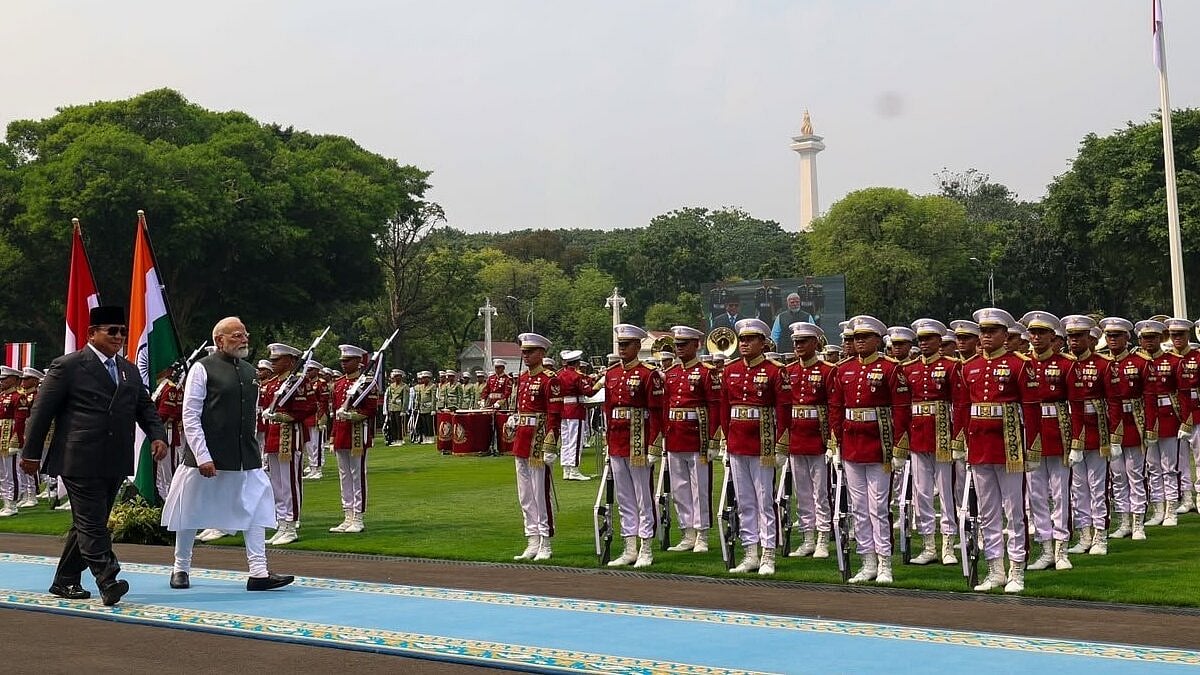
Prime Minister Narendra Modi accorded a ceremonial welcome at the Istana Merdeka in Jakarta, Indonesia on July 7, 2026 | X handle of @narendramodi
Following slowdowns and diplomatic dampeners at Iran's Chabahar port, alongside recent strategic setbacks regarding development projects at Bangladesh’s Mongla Port, India's eyes are shifting decisively toward Southeast Asia. The focus is now on a small but exceptionally powerful piece of land: Sabang, Indonesia.
The geopolitical chess player that stops moving loses the game. For New Delhi, recent shifts in the neighbourhood have forced a rapid re-evaluation of its overseas maritime strategy.
Securing a foothold here is no longer just a diplomatic victory. It has become an urgent strategic necessity. To counter China’s sweeping Belt and Road Initiative (BRI) and its growing web of dual-use ports across the Indian Ocean, India needs high-intensity execution on its long-discussed joint venture in Indonesia.
What is the Sabang Port project?
The Sabang project is a comprehensive infrastructure pact between New Delhi and Jakarta to jointly develop a deep-sea port and an economic zone on Weh Island in Indonesia. Originally set in motion during Prime Minister Narendra Modi’s state visit to Jakarta in May 2018, the two nations established a Joint Task Force to construct port-related infrastructure.
Highlighted by Prime Minister Modi, this pact expands beyond traditional infrastructure, with the leader noting today in Jakarta, "As two close maritime nations, we (India and Indonesia) have also decided to deepen our cooperation in the blue economy, port development and maritime trade."
According to details shared by Indonesia’s former Coordinating Minister for Maritime Affairs, Luhut Pandjaitan in May 2018, the project extends beyond commercial shipping docks. The bilateral arrangement covers the construction of a hospital, connectivity frameworks with India’s Andaman and Nicobar Islands and potential military access. The agreement envisions allowing Indian naval vessels and coast guards to visit the port, turning a commercial venture into a shared security anchor.
Where is Sabang and why does the geography matter?
Sabang is located on Weh Island at the absolute northern tip of Sumatra, Indonesia. It sits at the western gates of the Strait of Malacca, a narrow channel that serves as one of the world's most critical maritime chokepoints. Geographically, Sabang is positioned just 710 kilometres southeast of India’s Andaman Islands and less than 100 miles from India’s ongoing deep-sea port project at Great Nicobar.
This specific location makes Sabang an unmatched maritime sentinel. The Strait of Malacca carries roughly 15 million barrels of oil per day from West Asia and West Africa, and it handles nearly 40 per cent of India’s total trade. By developing a base here, India places itself directly at the throat of global energy shipping lanes, dramatically shifting the balance of power in the eastern sector of the Indian Ocean.
Who is driving this partnership?
The initiative is steered by the highest levels of government in both New Delhi and Jakarta. For India, the project is a crucial manifestation of Prime Minister Modi’s Act East and SAGAR (Security and Growth for All in the Region) policies. It is supported technically by RITES, a Government of India enterprise that has conducted pre-feasibility studies on the island’s infrastructure potential.
On the Indonesian side, leadership stems from a desire to maintain regional autonomy. Jakarta explicitly wants to avoid being controlled by China's BRI and rejects Beijing's unilateral claims over parts of Indonesia’s exclusive economic zone in the South China Sea.
When did this happen and why is high intensity needed now?
The groundwork was laid between 2018 and late 2019, when the first Joint Task Force produced an action plan covering trade, tourism and infrastructure. However, international infrastructure projects are notoriously slow, and India has historically shown a lacklustre track record in completing cross-border connectivity links on schedule.
High-intensity activity is required immediately because India’s western and northern maritime strategies have hit bumps. Political volatility and diplomatic friction have dampened the momentum of the Chabahar port in Iran, while shifting political dynamics in Bangladesh have stalled India's aspirations at Mongla Port. With the western and northern corridors facing friction, India must rapidly secure its eastern flank before China permanently locks down the surrounding waters.
How Sabang will transform regional geopolitics
The project will function through a hybrid model of economic integration and strategic defence alignment. Mechanically, the port boasts a natural depth of 40 metres, which is deep enough to accommodate all commercial vessels including submarines.
The plan operates on two distinct tracks. On the civilian front, it creates the Aceh-Andaman connectivity corridor, boosting sail tourism, cruise shipping and private business investments between Sumatra and Port Blair. On the strategic front, the arrangement allows real-time intelligence sharing, joint maritime patrols and naval coordination. While the official stance focuses strictly on trade and connectivity to avoid directly provoking Beijing, Sabang ultimately gives the Indian Navy a sovereign-backed platform to monitor Chinese naval movements entering the Indian Ocean.
RECENT STORIES
-
-
-
-
-