9 Per Cent Of Higher Education Students Report Suicidal Thoughts, Supreme Court-Appointed Panel’s Survey Finds
A Supreme Court-appointed National Task Force survey found 9% of higher education students reported suicidal thoughts often or very often in the previous year, while 15% experienced severe distress in six months. More than 2.43 lakh students responded, but officials said the findings are preliminary and not representative.

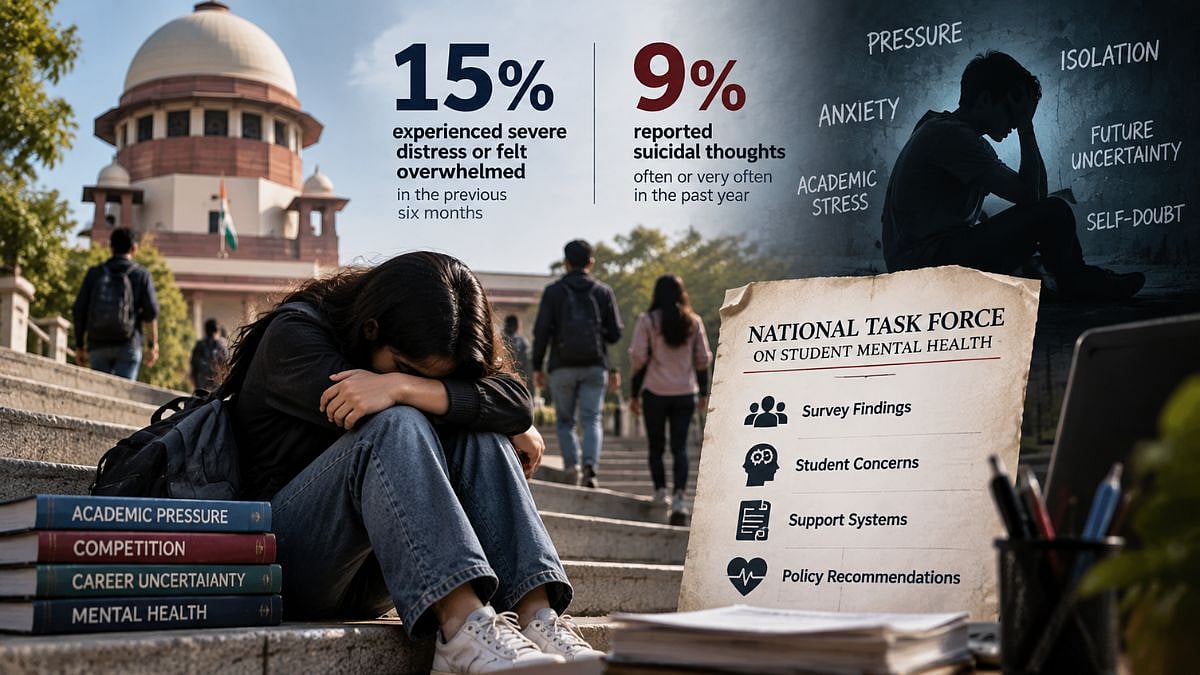
A nationwide survey has highlighted concerns over student mental health, campus pressures and access to counselling services | AI Generated Representational Image
New Delhi, September 29, 2026: About 15% of students in higher education institutions experienced a period of severe distress or felt overwhelmed in the previous six months, while 9% reported experiencing suicidal thoughts often or very often in the past year, according to a nationwide survey conducted by a Supreme Court-appointed panel examining student suicides.
The findings are expected to form part of the final report of the National Task Force (NTF), which was set up to address students’ mental health concerns and prevent suicides in higher educational institutions (HEIs). The final report is expected to be submitted by October 31, 2026. The findings underline the scale of mental health concerns on campuses and the need for stronger student support systems.
One In Three Feels Like An Outsider
The NTF survey received responses from more than 2.43 lakh students. Of them, 67% belonged to the Scheduled Castes (SC), Scheduled Tribes (ST) and Other Backward Classes (OBC) categories. About 34% of respondents reported feeling like an outsider on campus to varying degrees.
The survey also found that 56% of students trusted their administration to handle serious issues fairly, while about 32% said their institutions did not offer counselling services. Officials said concerns over academic choices and frequent worries about employment were common among students.
Findings Are Preliminary
A senior official cautioned that the results should not be treated as representative of all students because of the nature of the sample.
“Responses to many other items, including open-text fields, are still being analysed. Moreover, due to the non-representativeness of the current sample, the observations need to be taken as preliminary and tentative,” the official said, The Hindu reports.
Even with that limitation, the emerging patterns point to areas requiring attention. The official said there was a need for standardised student support systems, faculty training, measures to reduce stigma, crisis standard operating procedures (SOPs), regular monitoring backed by quality data, and a responsive and transparent administration to address students’ mental health concerns.
Discrimination And Harassment Flagged
The task force had submitted an interim report earlier this year highlighting a range of problems faced by students in higher education.
It noted that students’ experience of higher education had been marked by “deep-rooted social discrimination, rampant sexual harassment in medical and engineering colleges; gender discrimination by faculty in medical, law and State universities, in terms of academic support, hostel curfews and moral policing; caste identification by NEET-UG and JEE ranks; caste-based humiliation and discrimination in terms of admission, grading, language gaps and faculty attention”.
The findings have gained significance amid renewed debate over student suicides following the deaths of two students at IIT Delhi and IIT Bombay, which led to widespread outrage.
Students Speak About Campus Pressures
Apart from conducting the nationwide survey, the NTF carried out institutional visits and consultations with stakeholders to understand the problems students face.
“A total of 30 meetings at 19 institutional sites have been conducted so far across Delhi and the National Capital Region (NCR), Tamil Nadu, Karnataka, Assam and West Bengal, spanning different types of institutions and disciplines. Due to the very small number of sites visited, this is not a representative sample, and the views provided will be taken in that light,” the official said.
“Despite institutional limits and apprehension, students at most HEIs spoke extensively about their academic, social, mental health, faculty-related and administrative concerns.”
Academic Overload Adds To Stress
Students reported problems including strict attendance policies, demanding schedules and academic and clinical overload in medical and allied fields. Medical students also raised concerns about on-call hours stretching well beyond mandated as well as human limits.
Students in engineering colleges highlighted intense competition arising from relative grading and stringent placement criteria.
The task force also heard complaints about inconsistent and insufficient academic support because of faculty shortages in State universities. Students in dental, nursing and mental health educational institutions reported inadequate practical training that left them under-prepared for professional practice.
PhD scholars, meanwhile, raised concerns about supervisors who were either neglectful or over-controlling and exploitative.
Task Force Set Up By Supreme Court
The Supreme Court constituted the NTF in March 2025 to address the rising incidence of student suicides and examine mental health and well-being concerns among students in higher education institutions across the country.
Also Watch:
ALSO READ
The task force is headed by Justice S Ravindra Bhat. Its members include psychiatrist Alok Sarin; Mary E John, former director of the Centre for Women’s Development Studies; Arman Ali, Executive Director of the National Centre for Promotion of Employment for Disabled People; Rajendar Kachroo, founder of the Aman Satya Kachroo Trust; and Seema Mehrotra, professor of clinical psychology at the National Institute of Mental Health and Neurosciences (NIMHANS), among others.
To get details on exclusive and budget-friendly property deals in Mumbai & surrounding regions, do visit: https://budgetproperties.in/
RECENT STORIES
-
-
-
-
-