Why Raja Needs To Be Moved To Vantara - And Why An Airlift Is Essential For His Safe Transfer
Seven-week-old elephant calf Raja, battling a fractured leg and multiple health complications after being rejected by his mother, may need an airlift from Assam to Vantara in Jamnagar. Specialised veterinary care could help address his critical condition and long-term recovery.

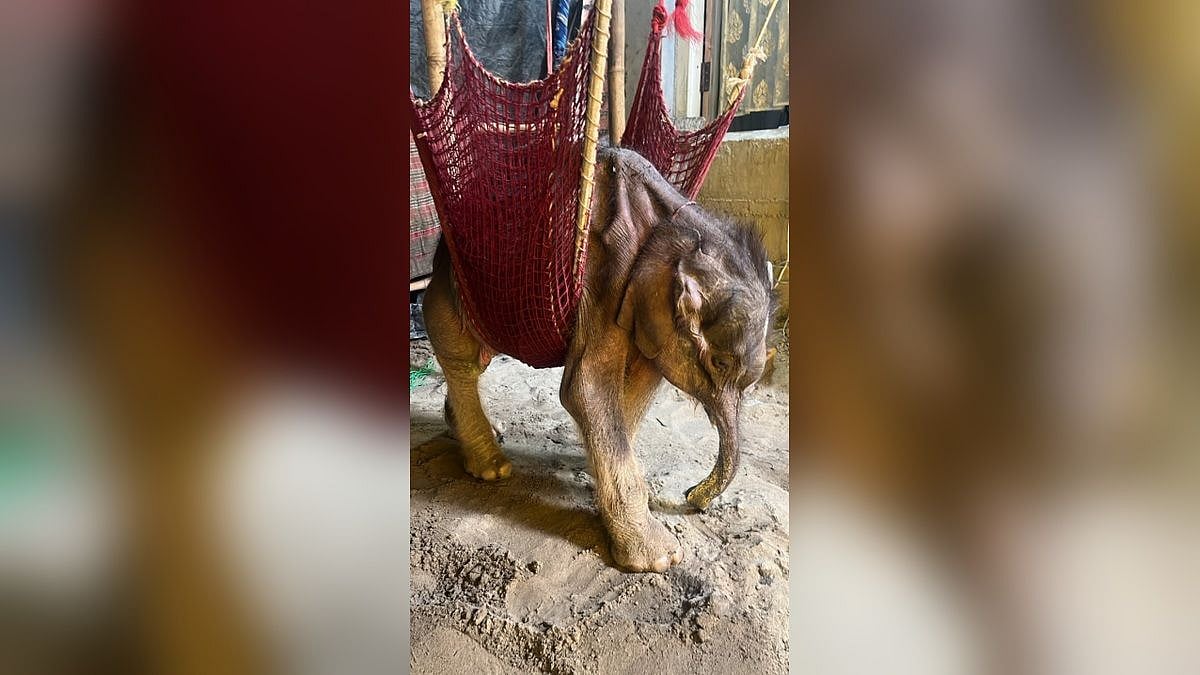
Why Raja Needs To Be Moved To Vantara - And Why An Airlift Is Essential For His Safe Transfer | File photo
For a seven-week-old elephant calf, a 2,500-kilometre journey is not simply a matter of covering distance. Raja was rejected by his young mother on his very first day and sustained a complete fracture of his right hind leg after being kicked. He also never received colostrum, his mother's first milk, which is essential for building a newborn calf's immunity. Since then, he has battled several health complications, including an infection, repeated episodes of severe low blood sugar, liver stress, pressure sores and an umbilical hernia. The combination of his young age, serious fracture and multiple medical complications makes his condition particularly fragile, calling for intensive veterinary attention and specialised care.
Since October 8, a team of 11 people comprising three veterinarians, two paravets, five mahouts and one supervisor has been caring for him in Assam. The team has been closely monitoring his condition and attending to his needs through this critical period. Given the complexity of his case, access to advanced veterinary infrastructure and round-the-clock attention is an important consideration for the next stage of his treatment.
The question, then, is why should an airlift be considered instead of moving him by road? The distance between Assam and Jamnagar is more than 2,500 kilometres, a journey that could take several days by road. For a calf with a fractured leg and multiple health complications, prolonged travel and repeated handling could place considerable strain on his body. An airlift could significantly reduce the time spent in transit, allowing Raja to reach specialised treatment sooner while avoiding the physical demands of a prolonged road journey. A custom-built crate designed around his size and needs, along with close veterinary supervision, would be essential to making the transfer as carefully managed as possible. In his case, the choice of transport should be an important part of the medical decision.
If airlifted, transporting an elephant calf this young requires careful planning at every stage. His fractured leg and medical needs would have to be considered while preparing the custom-built transport crate, arranging feeding and medication, and ensuring that an expert veterinary team accompanies him. The objective would be to minimise the physical strain of the journey while ensuring that his care continues uninterrupted.
Vantara's work also extends to providing specialised care to elephants in need, including those in Assam. In 2026, its efforts have included cases such as Maniki, Joymoti and the Tezpur tusker. Joymoti, a 53-year-old elephant who was swept away by floodwaters from Nagaland into Assam, was airlifted to Jamnagar after sustaining injuries, including to her eyes. While each case has presented different challenges, these instances underline the importance of specialised veterinary intervention and appropriate transport when an animal's condition and location make a long road journey unsuitable.
If sent to Vantara, Raja would have access to one of the world's largest elephant hospital, supported by a team of around 80 wildlife veterinarians and facilities caring for more than 260 rescued elephants. His treatment would focus on managing his fracture, addressing his existing health complications and supporting his nutrition and mobility. Since the injury may leave a permanent deformity, his long-term care would be particularly important. The facility's veterinary specialists and experienced elephant caregivers could provide the sustained attention his condition demands.
Raja's situation brings into focus a larger question about wildlife healthcare: how can specialised medical care reach animals when they need it most, even when they are located thousands of kilometres away? His case highlights that providing treatment is not just about having the right medical expertise, but also about ensuring that an animal can reach it with the least possible strain. For a seven-week-old calf dealing with multiple health challenges, an airlift is therefore not simply a faster way to travel; it is an important consideration in getting him the care he needs.
RECENT STORIES
-
-
-
-
-