India At Venice: The Indian Pavilion Makes a Striking Debut Transforming the Arsenale into a Living Landscape
The National Pavilion of India at the 61st Venice Biennale is curated by Dr. Amin Jaffer and showcases the work of artists including Alwar Balasubramaniam, Sumakshi Singh, Ranjani Shettar, Skarma Sonam Tashi and Asim Waqif. 'Geographies of Distance: Remembering Home' remains open until November. If you are going to Venice this year, this is the reason to go. Deviina Dalmia weighs in.

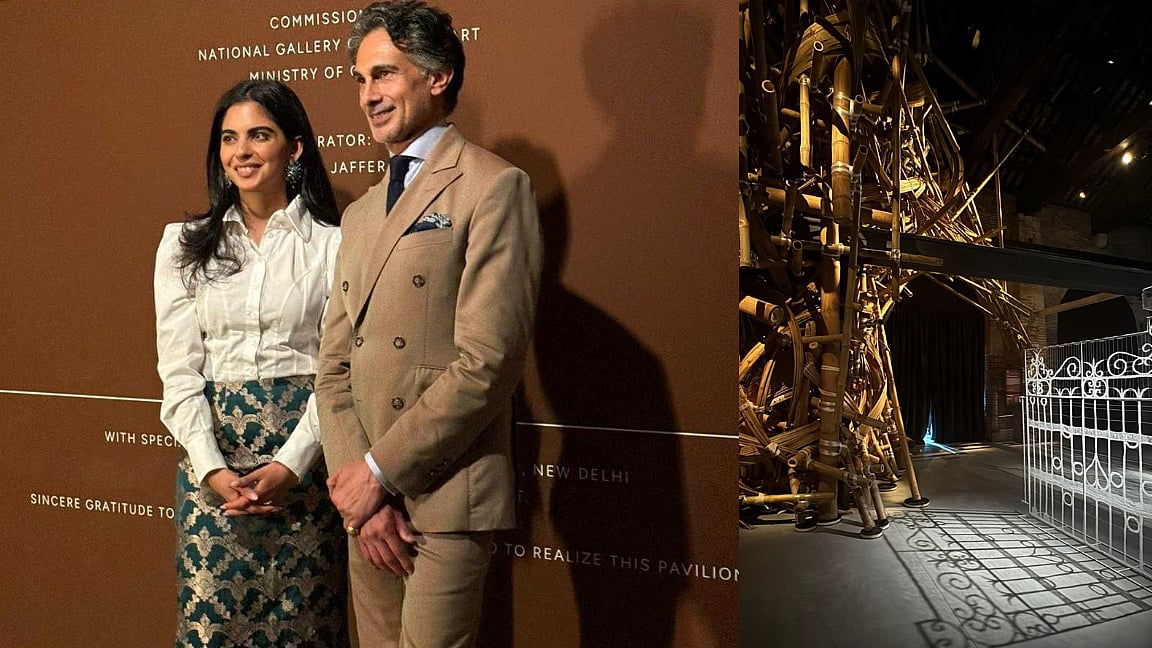
Isha Ambani with Dr. Amin Jaffer |
Outside, Venice was flooding. Inside the Arsenale, India arrived.
There was torrential rain during the inauguration — the kind Venice produces without warning, that turns the city dark and wild. It did not matter. Inside the Arsenale, the energy was electric. Every Indian and indophile in Venice had come, and they had come dressed for a celebration.
Dr. Amin Jaffer opened the pavilion alongside the President of the Biennale, and the room had the quality of a moment that people will remember as having been present for. The Ambanis arrived and were given a walkthrough through each work in turn, the golden canopy of Ranjani Shettar's suspended installation above the entire gathering like a second ceiling, breathing with the movement below.
The works are extraordinary. Ranjani Shettar has filled the Arsenale's great nave with suspended botanical forms — enormous translucent structures in white and amber gold, pods and leaves and flowers and spiraling tendrils, all floating, all lit from within by the material itself, tissue-thin and luminous.
The scale is unlike anything else in the Biennale — standing beneath it, you are inside a garden that has been lifted into the air and made permanent.
Asim Waqif's bamboo installation is its complement and counterpoint: a dense, vertiginous tangle of bamboo poles, rattan, cane, and woven baskets, structural and chaotic, a material record of making and accumulation that demands you look closely at how things are held together.
Sumakshi Singh's ghostly white thread and lace architectural forms — fragile, precise, spectral — create spaces within spaces, architectures of absence.
Skarma Sonam Tashi's compressed-earth city: stacked vernacular buildings in the muted pinks and greys of Himalayan adobe, hundreds of them, dense as a lived settlement, the accumulated weight of place made tangible on the Arsenale floor.
Every person I have spoken to since has said the same thing without being prompted: it is the finest pavilion at this Biennale. I believe them. It is the finest pavilion at this Biennale. And I say this as someone who has seen everything else. Geographies of Distance: Remembering Home is open until November. If you are going to Venice this year, this is the reason. It will make you proud — and not only if you are Indian.
RECENT STORIES
-
-
-
-
-