US OPT Visa Rule 2026: Top Universities Oppose Proposed $70,000 Fee For International Students
Major US universities, including Michigan, Cornell, USC and Washington, have raised concerns over proposed OPT fees of $70,000 for initial recommendations and $30,000 for subsequent requests. Michigan and Cornell plan to oppose the DHS proposal, citing financial burdens and potential legal challenges.

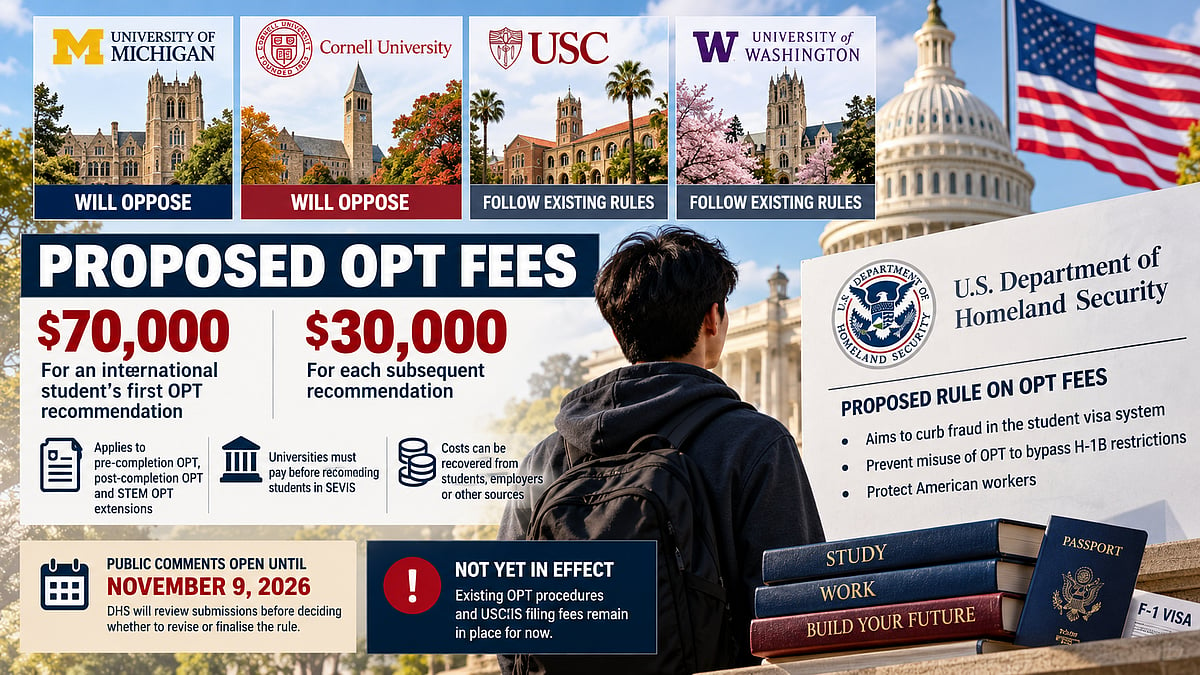
US OPT Visa Rule 2026: Top Universities Oppose Proposed $70,000 Fee For International Students | Ai
Several major US universities, including the University of Michigan, Cornell University, the University of Southern California (USC) and the University of Washington, have raised concerns over a proposed federal rule that would require universities to pay $70,000 for an international student’s initial Optional Practical Training (OPT) recommendation and $30,000 for each subsequent recommendation.
Announced by the US Department of Homeland Security (DHS) on October 7, 2026, the proposal aims to curb fraud in the student visa system, prevent the misuse of OPT to bypass H-1B visa restrictions and protect American workers. However, universities have flagged the financial implications for institutions and students, with the University of Michigan and Cornell confirming that they intend to formally oppose the move.
The proposed fees are not yet in effect. DHS is accepting public comments until November 9, after which it will review the submissions and decide whether to revise or finalise the rule. Meanwhile, universities have advised international students to continue following existing OPT requirements and application deadlines.
Michigan, Cornell to oppose proposed OPT fees
The University of Michigan and Cornell have explicitly stated that they will submit comments opposing the proposal, describing it as a significant departure from the existing OPT framework.
“The proposal to require these new fees is unprecedented, since filing fees have always existed but there has never been a fee to obtain the DSO’s OPT recommendation,” the University of Michigan said in its statement.
Cornell, in its own guidance issued and also confirmed its opposition, stating, “Cornell opposes this proposal and intends to submit a comment.”
Both universities highlighted that the proposal remains at the consultation stage and could change before implementation. Cornell noted that the rule would take effect only if published as a final regulation in the Federal Register, adding that the process typically takes several months after the comment period closes.
The prospect of legal challenges is another concern. The University of Michigan said, “There will certainly be litigation from higher education institutions or associations challenging the fee,” while Cornell warned that the proposal was likely to face legal challenges if finalised.
The institutions have also acknowledged the uncertainty the proposal has created for international students. The University of Michigan said it understood the “frustration and concern” the proposed regulation would cause, while Cornell said further clarity would emerge after the public comment process.
USC, University Of Washington urge students to follow existing rules
While the University of Michigan and Cornell have explicitly announced plans to oppose the proposal, USC and the University of Washington have focused on reassuring students that current OPT arrangements remain unchanged.
University of Southern California (USC) said, “At this time, no changes have been confirmed or taken effect.” The university reiterated that existing eligibility requirements, application procedures and filing fees remain in place, and advised students to continue following the guidance issued by its Office of International Services.
USC also pledged to advocate for its international community, stating that it would provide further updates as the regulatory process progresses.
The University of Washington, in a statement similarly urged students not to assume that the proposed fees would automatically become policy. Its International Student Services team is reviewing the proposal with university leadership, campus partners and national higher education organisations, including NAFSA: Association of International Educators, the Presidents’ Alliance on Higher Education and Immigration, and the Association of American Universities.
“We recognise that news about this federal government OPT fee proposal may create concern and uncertainty,” the University of Washington said, adding that it could not speculate “when or even if this proposal will be finalised.”
The university also encouraged students to continue pursuing educational and employment opportunities under the F-1 regulations currently in force. Taken together, the universities’ responses reflect a shared concern over the proposal’s potential impact, even as they differ in how explicitly they have declared their opposition.
What the proposed $70,000 and $30,000 fees means
Under the DHS proposal, universities would be required to pay $70,000 for an F-1 student’s first OPT recommendation and $30,000 for each subsequent recommendation. The charges would apply to pre-completion OPT, post-completion OPT and STEM OPT extensions.
According to the University of Michigan’s explanation, the first OPT request made after the rule takes effect would attract the $70,000 fee, regardless of the type of OPT sought. Subsequent requests would be subject to the $30,000 charge.
The fees would be payable by institutions before designated school officials recommend students for OPT through the Student and Exchange Visitor Information System (SEVIS). Under the proposed rule, US Citizenship and Immigration Services (USCIS) would not grant employment authorisation if the required fee had not been paid.
Although universities would be responsible for paying the charges, the proposal would allow them to recover the costs from students, employers or other funding arrangements. This provision has raised questions about whether the financial burden could eventually reach international students seeking work experience after graduation.
The proposed fees would be separate from the existing USCIS application charges. The University of Michigan lists the current application fee as $470 for online filings and $520 for paper applications.
The new charges would apply only to OPT recommendations made after the regulation takes effect. They would not apply retroactively to employment authorisations already approved and in progress at that time, according to the University of Michigan.
DHS says move aims to curb fraud and protect US workers
DHS has defended the proposal as a measure to strengthen oversight of the OPT programme and protect American workers.
In its October 7 announcement, the department said the proposed fees were intended to address fraud and abuse identified by the Student and Exchange Visitor Program (SEVP), including questionable employment arrangements and so-called “pay-to-stay” schemes.
A DHS spokesperson said: “Optional Practical Training was never meant to be a back door into the American workforce, a subsidy for cheap labor, or a prize for those who game the system.”
The spokesperson added, “American workers should not have to compete against a program that has been turned into a pipeline for cheap foreign labor.”
According to DHS, the fees would encourage universities to exercise greater scrutiny when recommending students for OPT and help prevent employers from using the programme to circumvent H-1B visa restrictions, fees and prevailing wage requirements.
ALSO READ
OPT allows eligible international students on F-1 visas to undertake temporary employment directly related to their field of study. Students can generally receive up to 12 months of OPT at each eligible education level, while those with qualifying degrees in science, technology, engineering and mathematics (STEM) fields may be eligible for an additional 24-month extension.
Public comments open until November 9
The public comment period for the proposed rule runs from October 8 to November 9, 2026. DHS will review the submissions before deciding whether to revise or issue a final regulation. A separate 60-day comment period applies to the Paperwork Reduction Act section of the proposal.
Until a final rule is published and takes effect, the proposed fees remain inactive and existing OPT application procedures and USCIS filing fees continue to apply.
RECENT STORIES
-
-
-
-
-