NEP 2020 Set To Revolutionise Indian Education, Teachers At The Epicentre of Change
NEP 2020 brings profound, wide-ranging changes in Indian education, placing teachers at the center. Schools shift to outcome-based learning, standardized curricula, no specialization, and new subjects, while colleges face tenure, international standards, and skill-focused education. Teachers must upskill, adapt pedagogy, and guide students to ensure successful reform.

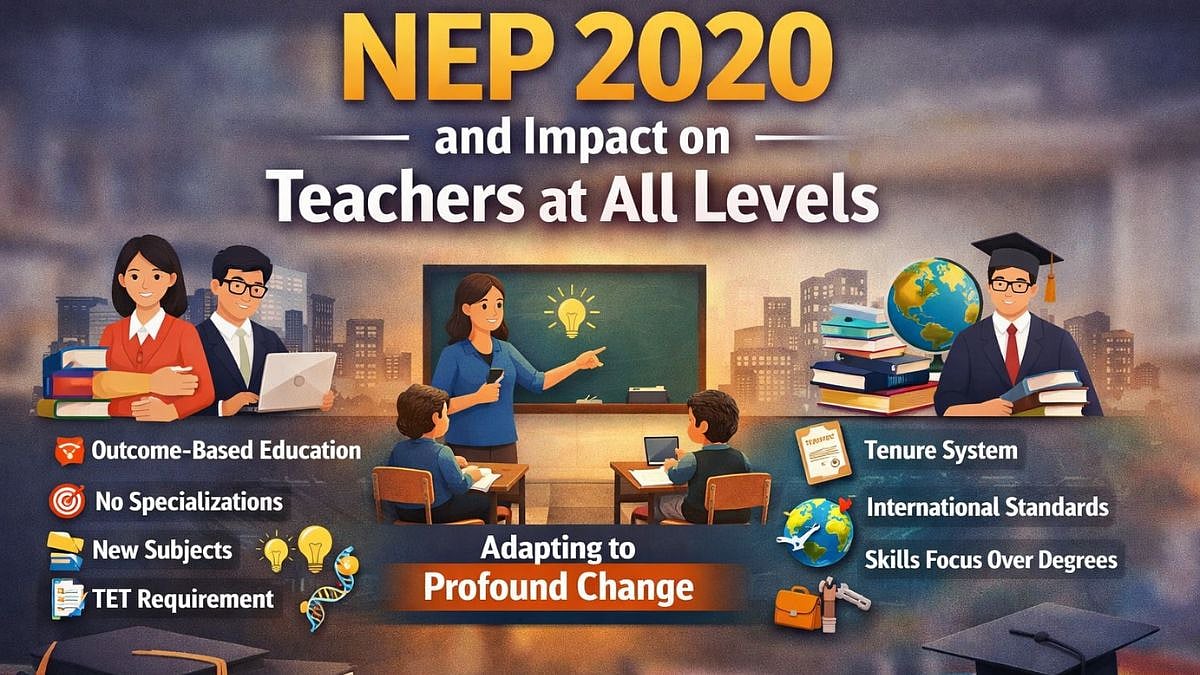
NEP 2020 Set To Revolutionise Indian Education, Teachers At The Epicentre of Change | ChatGPT
One of the major highlights of NEP 2020 is that it is not incremental; it is profound and all pervasive. It, therefore, encompasses changes that have far reaching consequences. The resultant impact is on all education stakeholders. The impact is maximum on one stakeholder, i.e. the teachers who are expected to be fulcrum of any change in educational landscape. NEP 2020 has attempted to bring in massive changes the way the teachers teach inside the classroom and operate outside. The changes are, in some ways, substantive and many of the teachers need to be equipped with tools & techniques to adapt to the changes.
At School Level:
Requirement for change at school level is more significant. Some of the major ways teachers are going to be impacted include:
Outcome Based Education: The entire school education is destined to migrate to OBE based on Bloom’s Taxonomy: a revolutionary shift in approach to curriculum design and classroom delivery. Majority of teachers are not accustomed at all with the basics of OBE and will, therefore, need significant training intervention at all levels. This is applicable for the entire value chain of teaching process from defining course outlines, session design, pedagogic approaches and assessment.
Standardization of Curriculum: Over a period, the curriculum content of all the school boards is likely to be uniform so that the students graduating from any corner of India from any school will have the same understanding and competencies in terms of the standard prescribed by NCERT. This means that finally all boards will migrate towards one single board, i.e. CBSE as of now. It is a huge shift and teachers from state boards must update themselves in terms of the content and delivery pattern of CBSE board.
No Specializations: This is another major shift; NEP prescribes that there will be no stream of specialization in 11th standard (arts, science or commerce, etc.) and all students would have an equal plate of content so that they graduate from school education as “generalists” and not “specialists”. The idea is that the concept of specialization at school level preempts understanding of the basics of all subjects and knowledge remains truncated. Therefore, 9th to 12th standard has been clubbed as one block (secondary education) under the new educational structure. This will create complete rehaul of syllabus and curriculum. The teachers need to update themselves accordingly.
Focus on Why and How: There is going to be significant shift in teaching and assessment from “what” to “how” and “why” with a view to improve the “critical thinking” among students. In technical terms, teachers need to move the learning style and hierarchy from level “1” to minimum level “3” to “4” of Bloom’s Taxonomy. The pedagogy approaches and assessment tools are going to be significantly different. Experiential learning is going to be one teaching methods teachers should be conversant with. The teachers, therefore, should learn the latest engaging and interactive group focused and student centric teaching methods.
Requirement of TET: Under the current scenario, TET is expected to be mandatory at least for those teachers teaching from 1st to 8th standard. It may be an irreversible process. There is a possibility that this examination or any other similar one being made mandatory for schoolteachers at all levels purely with a view to improving quality and bringing convergence. This is going to put additional pressure on teachers.
New Subjects: The focus would be some of the new subjects like Critical Thinking, Sanskrit (comprehensive), Indian Knowledge System (IKS), Entrepreneurship, Project Based Learning, Vocational Courses, among others. While some of these subjects will require appointments of specialist teachers, some may have to be taught by the existing staff because of reduction in the usual workload. Of course, training will be provided; but the point is that teachers must be inclined to learn and upskill themselves to remain valid. One additional skill set required would be “research skills” as some of the courses will involve undertaking projects and the schoolteachers need to guide such projects following a structured route.
At College Level:
The challenges at the college level will be similar; only nomenclatures may undergo a change like NET or even PhD being made mandatory for recruitment at entry level Assistant Professor level as we go along. The existing faculty who does not possess required degrees as above (NET / PhD) might be required to complete the same within a time bound period like TET for schoolteachers.
Some other major challenges at college level teachers could be summarized as below:
Tenure System: Regulators may introduce concept of “tenure system” for college faculty in terms of global practices. There will be thus significant pressure on new recruits in terms of performance through teaching as well as research before they become “tenured faculty” by a specific period, say, 3 years or so. “Perform” or “Perish” will become the standard norm.
International Quality: As we go along, internationalization of higher education will be a reality. It will take various shapes like twinning programs, international faculty, exchange programs, setting up of campuses by foreign universities, good number of international students studying in India, among others. India may become a significant education hub at least for Asia, Africa and Europe. The pressure will thus be on Indian faculty to perform with their counterparts in terms of teaching as well as research publication in international journals. Otherwise, admission / retention of students will be a significant issue. Teachers in this changing context must play vital role to make their institutions “centers of excellence” to remain relevant.
Degree vs Skills vs Retire Early Vocations: The implementation of NEP recommendations will make the debate more intense with students opting for more relevant, value-added, competency driven, high paying, less rigorous jobs. The focus of HEIs has therefore to shift to skills / competencies vis-à-vis mere degrees. In this transition, the important drivers will be teachers and teachers alone. Not only their aptitude, their attitude and mindset will play a pivotal role. Their traditional class teaching roles may be replaced by short term online interactions, more informal chats than formal lectures, more digital driven teaching than teaching in & from a physical set up. The question is, are we ready for the change as teachers? The teachers should always remain one / two steps ahead of students and anticipate the market dynamics to lead the students accordingly: can we really do this?
Moving Ahead:
The discussions only show the challenges (and hidden opportunities) for teachers at levels as we go along in days to come after the implementation of NEP 2020. Some of the changes are imminent; some others will take some time. The teachers, however, need to understand that they are the prime pillar to drive any change; or otherwise, the changes may overflow them. Indian teachers need to understand the upcoming reality.
RECENT STORIES
-
-
-
-
-